FEMM fatale
pp. 30-31 · Read in the full issue
Development
The Pacific's unhappy affair with reform
By Sophie Foster Hildebrand
FOR several years now, the Pacific has been harping on about reform, reform, reform.
But while some island delegates are still pro-reform, there are rumblings in the Pacific that all is not well with the reform
process.
Indeed, some delegates at the Forum Economic
Minister’s Meeting
(FEMM) have expressed reservations about the type of reforms that are being pushed and the pace at which it is being done.
For one, Fiji’s represen tative at the meeting, Ganeshwar Chand, who is the country’s housing min ister and an economist, said the new Labour govern ment would not be pres sured into implementing the Forum Economic Action Plan.
He said there were areas of the reforms that the country would not push regardless of whether FEMM called for it or not.
Fiji’s Labour government
was elected on a platform of halting the cor poratisation of public enterprises and pre venting public service redundancies.
Their target is to find ways around the reforms so that they can keep people employed.
When asked about the implementation of the FEMM reform package, Marshalls eco-
nomic minister Tony deßrum said “not at this speed and not with this blind ‘let’s go forward’.”
“We have found that the (reform) programme seems to have been put together too quickly without really thinking about the conse
quences. Everybody picks up on the key word “reform” without really trying to figure out what happens when you lay people off, what happens when the biggest employer in town says no more work, sometimes it is the only employ er.”
“WHat happens when you put people out to pasture when there are no pastures to graze, when there are no economic foundations upon which the private sec tor is developed,” he said.
He specifically said that the objec tives of FEMM overlapped with those of other ministries such as communication, transportation, and trade ministries.
“They are trying to propose that we endorse education and health and I say ‘well I’m a minister of finance. I really think the leaders ought to be discussing
that, and this should be restricted to FEMM and FEMM issues’.
“Then they say, ‘well we don’t want an endorsement, we want a statement of sup port’. So I say ‘wait a minute. I’m not sure about this’,” deßrum said.
Based on discussions with other colleagues from the smaller countries, he said he thought they held the same views of FEMM.
“It’s amazing how the observations are all practi cally the same but so little has been said previously,” he said.
Deßrum said the Forum had to be reviewed to stick with the original plan under which it was set up. “On our part, the smaller coun tries, we think the Palau
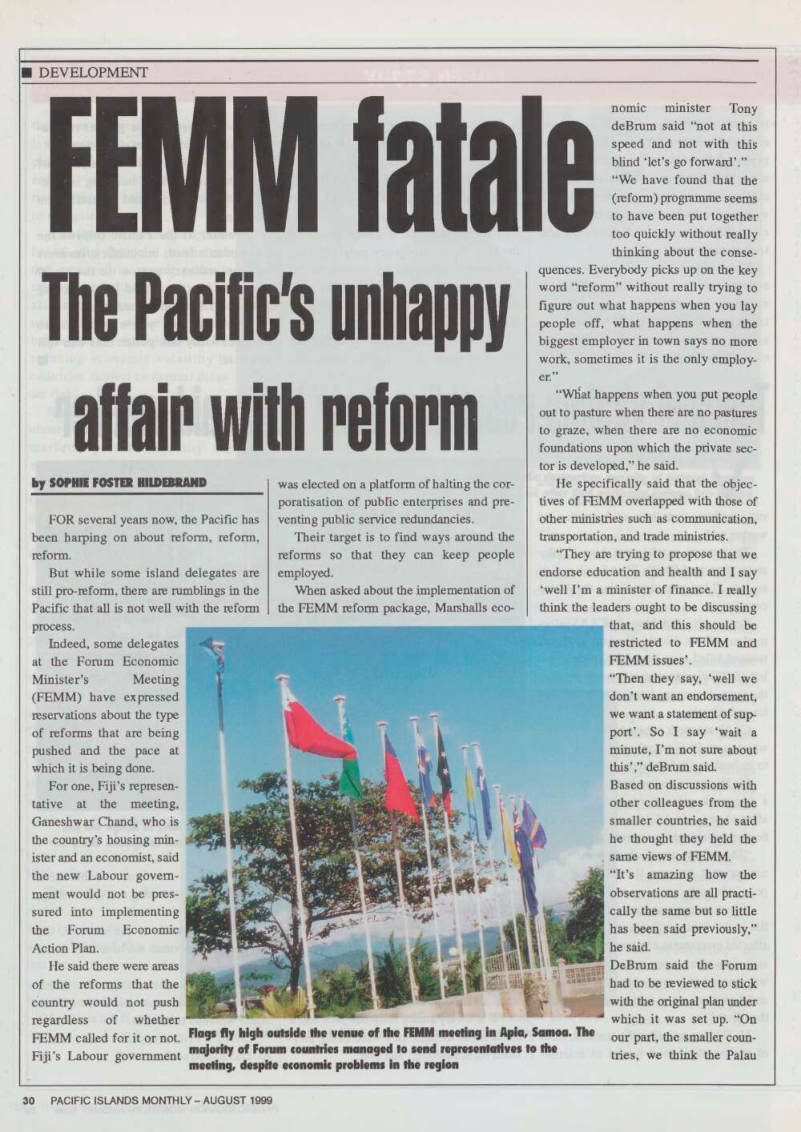
Flags fly high outside the venue of the FEMM meeting in Apiu, Samoa. The majority of Forum countries managed to send representatives to the meeting, despite economic problems in the region
Forum should be different. The idea is that all the homework has been done so here it is, sign off. But it’s not, I don’t think, the original concept,” he said.
The Solomons finance minister, Alpha Kimata, also thought that FEMM should be overhauled.
“I think there is a need for a review of the objectives since we are forming into further small groups like the MSG and the other groups. We should look at reviewing the FEMM as our umbrella body for small groups with in FEMM,” he said.
Kimata agreed that the MSG was a lot more advanced than FEMM in a lot of its economic reform dealings. As far as FEMM targets for tar iff reduction, he said the Solomons had already introduced reform in the area under its MSG oblig ations.
He said that the Solomons reform pro gramme had been a bit advanced but there were other internal factors which could
now slow the process. The Guadalcanal civil unrest, he said, had cost the govern ment about S$ 10,000. But he said there had been no assessment of the damage that had been done to the economy or the repercus sions, and that cost would be significantly
higher.
Deßrum warned that ministers would have to carefully weigh up the pros and cons of laying off large numbers of civil servants.
He said when the layoff of people occurred in the Marshalls, all their loans and other accounts with the banks there became delinquent. This, he said, had the effect of making the banks hold back on new loans or issuing loans with higher interest.
The experience of having large numbers
of suddenly unemployed people meant that
others held back on their savings and investments.
“It affects a lot more than meets the eye.
And then they (lenders/banks) go off and write reports that there is no confidence in investment in the Marshalls. If you lay off a thousand people and you’re the biggest employer in town, where’s that going to leave you?”
Deßrum thinks that there should be a review of the FEMM Action Plan. Chand said even if there was no review, Fiji would just not implement the aspects it did not like.
For FEMM, this could be a warning that all is not well as far as mass attraction to reform goes.
Indeed, the same reform that seemed so irresistible a couple of years ago, now leaves a bitter taste in many mouths, and may even come to an abrupt end. ■
Members of the Australian delegation settle in to listen to opening speeches at the 1999 FEMM meeting hosted by the Samoan government
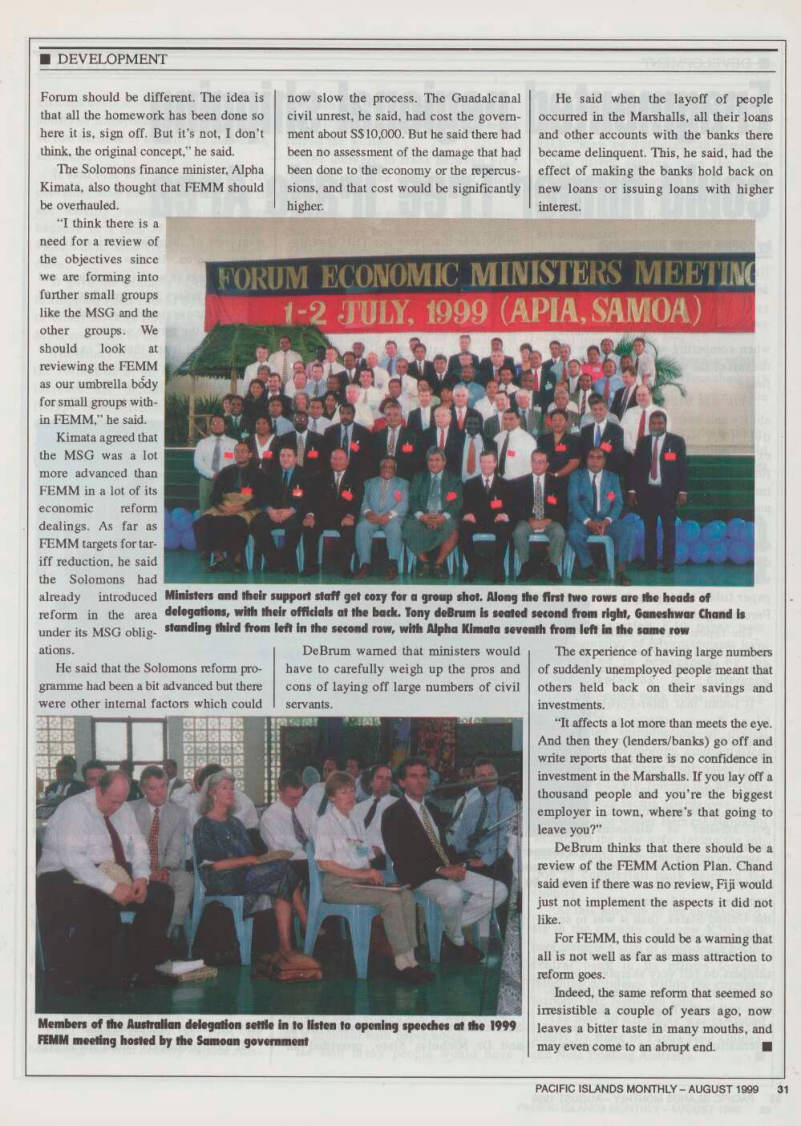
Ministers and their support staff gel cosy for a group shot. Along the first two rows are the heads of delegations, with their officials at the back. Tony deBrum is sealed second from right, Ganeshwar Chand is standing third from left in the second row, with Alpha Kimata seventh from left in the same row