Bikini's shirks and shipwrecks
pp. 24-25 · Read in the full issue
hit the Discovery Channel
By Giff Johnson
SINCE hundreds of cameramen, technicians and producers cov ered every angle of the first American nuclear tests at Bikini Atoll after World War 11, there’s never been a produc tion like what’s going oh at this former ground zero in the Marshall Islands. “It’s the biggest thing to hit Bikini since the nuclear tests,” said Bikini liaison agent Jack Niedenthal.
Twenty-three nuclear tests at Bikini have, ironically, turned this cluster of coral islands into an environment untouched by humans for more than 40 years - one that
has television producers salivating.
Since the tests ended in 1958, virtually no on has lived at Bikini, allowing marine life - and notably a huge population of sharks - to multiply. Add to that the fleet of World War II vintage warships sunk by nuclear tests, including the world’s only diveable aircraft carrier, submarines and the flag ship of the Japanese navy once com manded by Admiral Yamamoto who led the attack on Pearl Harbor in 1941, and you have all the ingredients for a ratings-grab bing film production.
The Discovery Channel is going to put Bikini’s sharks and shipwrecks at center stage in its highly rated annual “shark week”
in early August. The Discovery Channel is spending more than US$2.5 million and two months to put together a show that opens Shark Week on August 8 in the US.
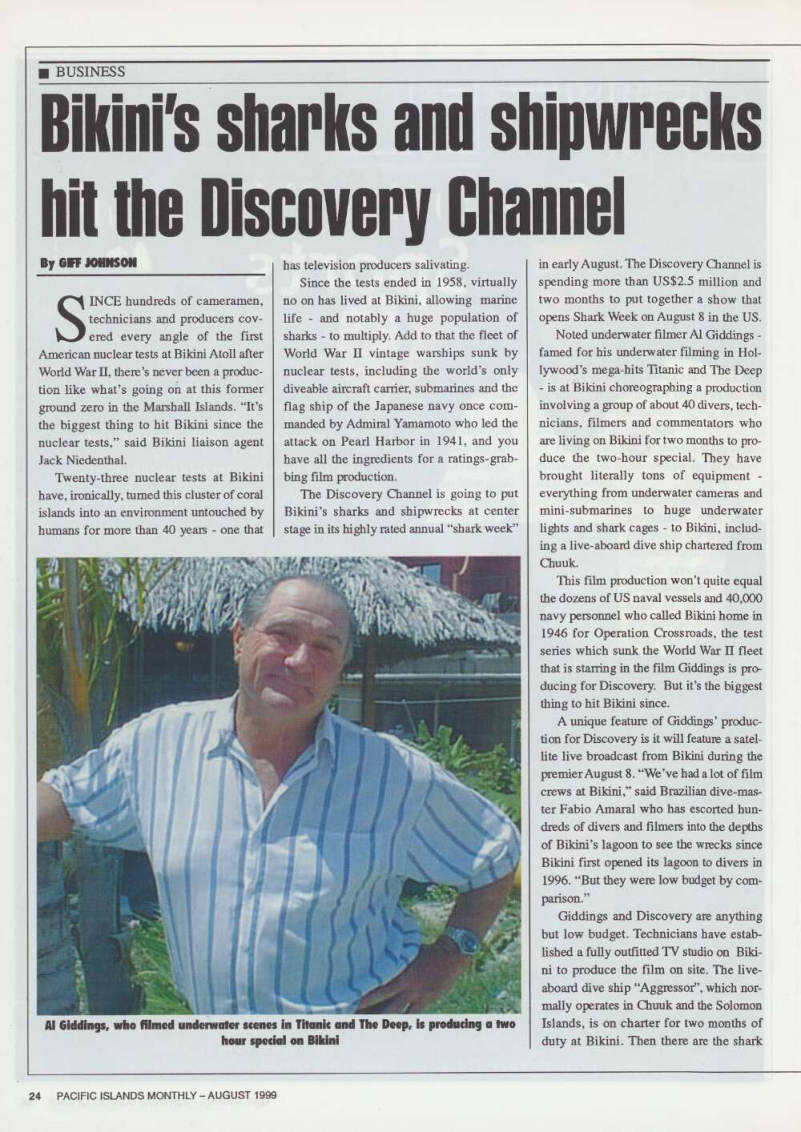
Noted underwater filmer A 1 Giddings famed for his underwater filming in Hol lywood’s mega-hits Titanic and The Deep - is at Bikini choreographing a production involving a group of about 40 divers, tech nicians, filmers and commentators who are living on Bikini for two months to pro duce the two-hour special. They have brought literally tons of equipment everything from underwater cameras and mini-submarines to huge underwater lights and shark cages - to Bikini, includ ing a live-aboard dive ship chartered from Chuuk.
This film production won’t quite equal the dozens of US naval vessels and 40,000 navy personnel who called Bikini home in 1946 for Operation Crossroads, the test series which sunk the World War II fleet that is starring in the film Giddings is pro ducing for Discovery. But it’s the biggest thing to hit Bikini since.
A unique feature of Giddings’ produc tion for Discovery is it will feature a satel lite live broadcast from Bikini during the premier August 8. “We’ve had a lot of film crews at Bikini,” said Brazilian dive-mas ter Fabio Amaral who has escorted hun dreds of divers and filmers into the depths of Bikini’s lagoon to see the wrecks since Bikini first opened its lagoon to divers in 1996. “But they were low budget by com
parison.”
Giddings and Discovery are anything but low budget. Technicians have estab lished a fully outfitted TV studio on Biki ni to produce the film on site. The live aboard dive ship “Aggressor”, which nor mally operates in Chuuk and the Solomon Islands, is on charter for two months of duty at Bikini. Then there are the shark
Al Giddings, who filmed underwater scenes in Titanic and The Deep, is producing a two hour special on Bikini
cages and shark suits. The shark suit resembles medieval armor and, Amara hopes, will insure that he stays in the lime light for a few years following the Dis covery production. But one of Giddings’ underwater photographers found out dur ing late June that a shark cage didn’t offer him much protection while working in the shark pass. The filmer was located about 15 feet underwater in the cage as techni cians above “chummed” the water with bait to drive the sharks into a feeding fren zy. The problem was the current kept pushing the bait toward the cage. A shark chasing the bait - large hunks of bloody meat - slipped into the cage through one of the “windows” at the top, and suddenly the filmer found himself literally face to face with a sizeable grey reef shark. He tried pushing it back out the hole of the cage with his feet, but that didn’t work so he moved to the bottom of the cage.
But the shark decided that might be a way out and soon the filmer was forced to the top of the cage. According to Karen Sauer, who was above the cage on the ship, the shark was getting quite riled up and the filmer figured he’d better get out of there and opened the top of the cage.
But it was still about eight feet up to the bottom of the boat and there were so many sharks roaming the space that there was no way for him to evacuate the cage.
Finally, technicians on board the ship managed to haul the cage back on board with both filmer and diver inside.
The filmer was unharmed and the shark dumped back over the side. This event was filmed and, no doubt, will be part of the Discovery production, raising ratings when it goes on air in August.
With more than 40 people at Bikini for two months, Amaral said his dive compa ny cancelled all but two of the dive groups that were previously scheduled to visit Bikini while the Discovery production is in progress.
But, he said, the cancellations won’t hurt the dive business at Bikini.
“The exposure that we’ll get from this is way bigger than anything else we’ve had,” he said. “Nothing keeps the story (of Bikini) alive more than going live on Dis covery.” ■