explode nuclear test myths
pp. 42-44 · Read in the full issue
Marshall Islands attempts to explode nuclear test myths
By Gift Johnson
Ask most Marshall Islanders about the 67 nuclear tests that the US government conducted in the 1940 s and 19505, and they will talk only about the 1954 “Bravo” hydrogen bomb that contaminated hun dreds of islanders and dozens of islands with radioactive fallout.
So effective has been the US govern ment’s focus on that single - albeit life changing - nuclear test that most Marshall Islanders have had, until recently, little awareness that many of the 67 tests conta mined them or their relatives with doses of fallout many times in excess of what are considered “permissible” levels of expo sure in the United States.
Indeed, the US government’s insistence
that only 174 people in the entire Marshall Islands are “exposed” those islanders still alive today who were on Rongelap and Utrik in 1954 when Bravo dumped ash-like fallout onto their islands - is a myth that the Marshall Islands government is attempting to explode as it seeks to get the US Congress to consider
increasing compensation payments
and expanding medical treatment programs for Marshall Islanders.
An irony of history is that it is formerly top secret US radiation studies and internal Atomic Energy
Commission/Department of Energy
reports that are fueling the growing concerns of Marshall Islanders, andunderpinning the Marshalls’ contention that US compensation and medical programs are totally inade quate.
“Critical information about the degree and range of radiation exposure from the tests, the number of communities exposed to radiation, and the extent of radiological illnesses that manifested in the Marshall Islands has been withheld, covered-up, or
grossly underrepresented by the US Department of Energy,” Finance Minister Tony deßrum told a US Congressional hear ing in Washington in mid-May.
“Because information was withheld from the Marshall Islands and the US Congress ... our governments agreed to a grossly inade quate mechanism for responding to the problems from the testing program.”
Documents recently declassified by the US government and turned over to the Marshall Islands show that: • not only the 1954 Bravo test, but many of the hydrogen bomb tests conducted dur ing this 1954 Operation Castle series sub jected inhabited downwind islands to radioactive fallout.. • exposure levels of people living on
nearly every atoll in the Marshall Islands in 1954 exceeded US and international maxi mum permissible levels establishing shortly after the Castle test series. • while US-Marshall Islands negotiations of the Compact of Free Association, which
included the nuclear test compensation package, were ongoing in the late 19705, US officials prepared a proposal to extend medical services to three additional atoll
populations exposed to fallout - Likiep,
Wotje and Mejit - and two additional groups that had been or might be exposed to residual radiation from reinhabiting the former ground zeros at Bikini and Enewetak. Not only was the medical pro gram never expanded but US. officials have adamantly maintained that only the populations of Rongelap and Utrik were exposed and needed follow-up medical treatment. Marshall Islanders did not learn of this US proposal to expand medical care until 1999 - almost 20 years after it was written.
• the total yield of tests conduct ed in the Marshall Islands was 93 times the force of the 104 tests carried out at the Nevada Test Site.
And still much test era informa tion remains classified, locked in filing cabinets somewhere in Washington, D.C. or numerous government laboratories across the country.
While declassified data shows widespread fallout exposure from the Castle series in 1954, fallout measurements from the last two test series conducted in the Marshalls remain secret more than 40 years later, despite repeated requests from the Marshalls for their release.
Operation Redwing in 1956 and Operation Hardtack in 1958
accounted for 50 nuclear tests - more than two-thirds of the total tested in the Marshall Islands - and had a combined yield greater than the Castle tests, which caused so much damage. The US focus solely on exposure caused by the Bravo
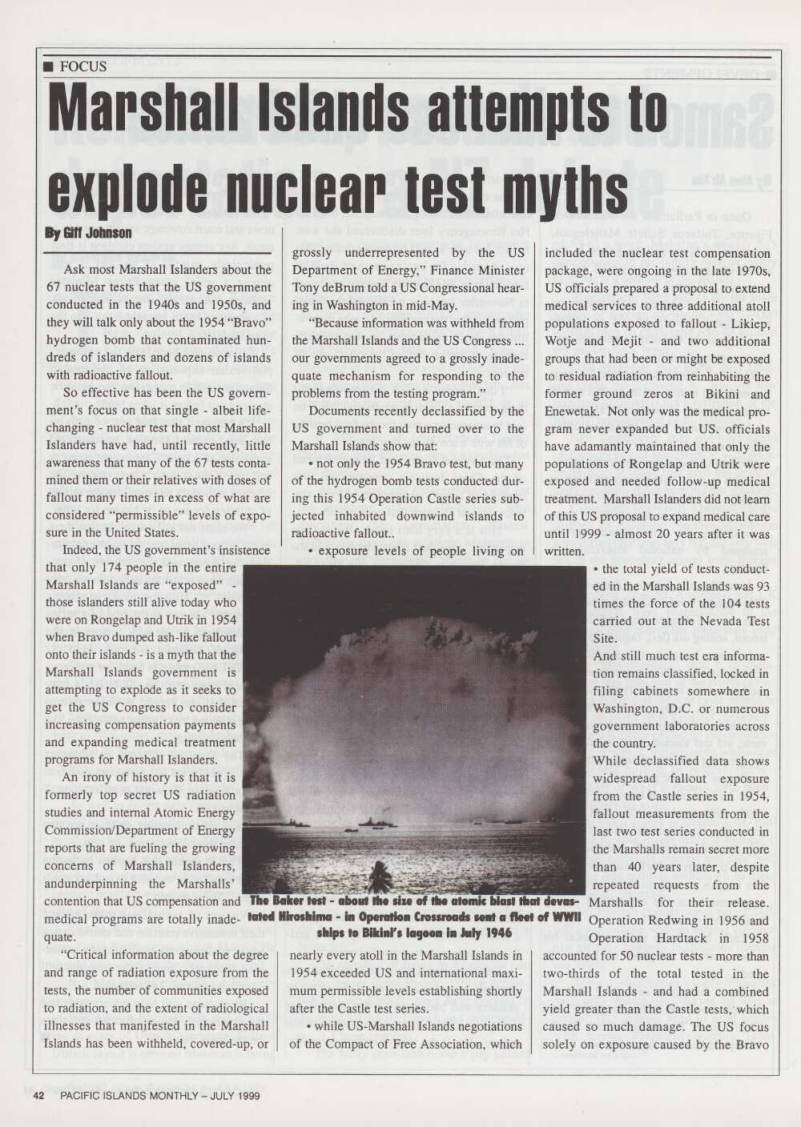
The Baker test - about the site of the atomic Mast that devas tated Hiroshima - in Operation Crossroads sent a fleet of WWII ships to Bikini's lagoon in July 1946
test is wrong, deßrum told the Congress, because it has prevented many islanders who were exposed from receiving US funded medical care reserved only for 174 people from Rongelap and Utrik who were acutely exposed to Bravo fallout. “Bravo represents about one-seventh of the mega tonage tested, but 100 percent of the crite ria for inclusion in the Department of Energy’s medical program,” he said.
As a consequence, numerous “exposed” islanders do not meet the US criteria for medical care and have fallen through the cracks of both compensation and medical programs, he said, placing an untenable burden on the Marshall Islands to provide the health care for problems resulting from radiation exposure.
It has also prevented the Nuclear Claims Tribunal from paying out full com
pensation because of the increasing number of islanders who have devel oped radiation-related cancers.
Deßrum listed many who were exposed to nuclear test radiation but not covered by US medical treatment
programs, including:
• Marshallese test site workers who participated in cleanup and reha bilitation work at Bikini and Enewetak in the 1970 s without pro tective clothing or occupational safe ty guidelines. • islanders from Bikini, Enewetak and Rongelap who were prematurely resettled on their homelands but later moved off after it was recognized they were being exposed to unsafe lev els of radiation.
• islanders from Ailuk, Likiep, Mejit, Wotje, Wotho, Ujae and UJelang who received exposures in the range of islanders from Utrik, who qualify for med ical treatment. • so-called “unexposed”
Rongelap Islanders used as a control group to compare the rate of illnesses with the 86 exposed to Bravo fallout in 1954. This control group moved back to Rongelap in 1957 and was exposed to high levels of radiation from the contaminated environ ment, a fact confirmed by US government studies even as these same studies claimed this control group to be “unexposed” and an ideal comparison group.
Deßrum labelled this “statistical manip ulation,” commenting that “we all know Rongelap was highly contaminated in 1957.
If Rongelap is still too radioactive for the community to resettle today, in 1999, with out remediation, one can only imagine how contaminated it was when the people were resettled prematurely in 1957.”
The US government recently provided a $45 million cleanup and resettlement trust fund to allow Rongelap to be safely resettled in the future. Deßrum pointed out that since the so-called “unexposed” group that reset tled on Rongelap in 1957 began to show the same kinds of illnesses as those exposed in 1954, the Department of Energy “maintains that this demonstrates that the people exposed in 1954 are not experiencing unusu al levels of radiation injury.”
One recently declassified US govem-
ment document from the late 1970 s reports on the “unexpectedly high increase of can cer of the thyroid” among the Utrik popula tion which “is unexplained on the basis of their acute initial exposure to radiation (from Bravo). The question has been raised concerning the possibility of the long term effects of low levels of radiation present on both Rongelap and Utrik following the return of the inhabitants.” But, sadly for Marshall Islanders, no one from the US gov ernment side was raising the question about the danger of low dose radiation, for if they were, then what of the many inhabited islands that received radiation doses close to
Utrik’s? Not only was the US uncon cerned with the effects of low-dose radia tion, it carried out an extensive public rela tions campaign to downplay the signifi cance of exposures to Marshall Islanders.
“The inhabitants of all islands other than Rongelap, Utrik, Alingnae and Rongerik (the latter two are uninhabited but were used by Rongelap Islanders) have been reassured repeatedly that they have not been exposed to ‘significant’ radia tion,” this US report observes. Yet while dismissing the “significance” of these low-dose exposures, this same US report was anticipating an increased number of thyroid tumors and cancers from so-called “unexposed” islands and reported that US officials were even beginning to make arrangements with additional American hospitals to handle the expected increased
i number of surgeries and treatment. . Yet the US government maintains the fiction of the “four atolls” - that expo sure was limited to the populated I atolls of Bikini, Enewetak, Rongelap i and Utrik - to this day. Deßrum testi- I fied to the US Congress about a Department of Energy public rela tions campaign in the early 1980 s as I negotiations were ongoing to develop the Compact and the compensation pact. A dual English/Marshallese lan- I guage booklet prepared by the DOE 1 “misrepresentsthe amount of harm caused by the testing program,” he commented, adding that the booklet compared islands on a scale ranging from “the largest amount of radioac
tive atoms” to the “least amount of radioactive atoms.” Downwind atolls that neighbor Utrik, such as Mejit, Ailuk, Likiep and others fell into the “least” cate gory and as a result “they were disregard ed in any medical care or environmental monitoring programs in the Compact,” deßrum said. But, he added, “the least amount of radioactive atoms in the Marshall Islands exceeds acceptable radi ation exposure levels in the US hundreds of times.”
“Ailik’s exposure of 6420 millirems of radiation from just the Castle series in 1954 was an exposure level about 250 times a recently established. ■
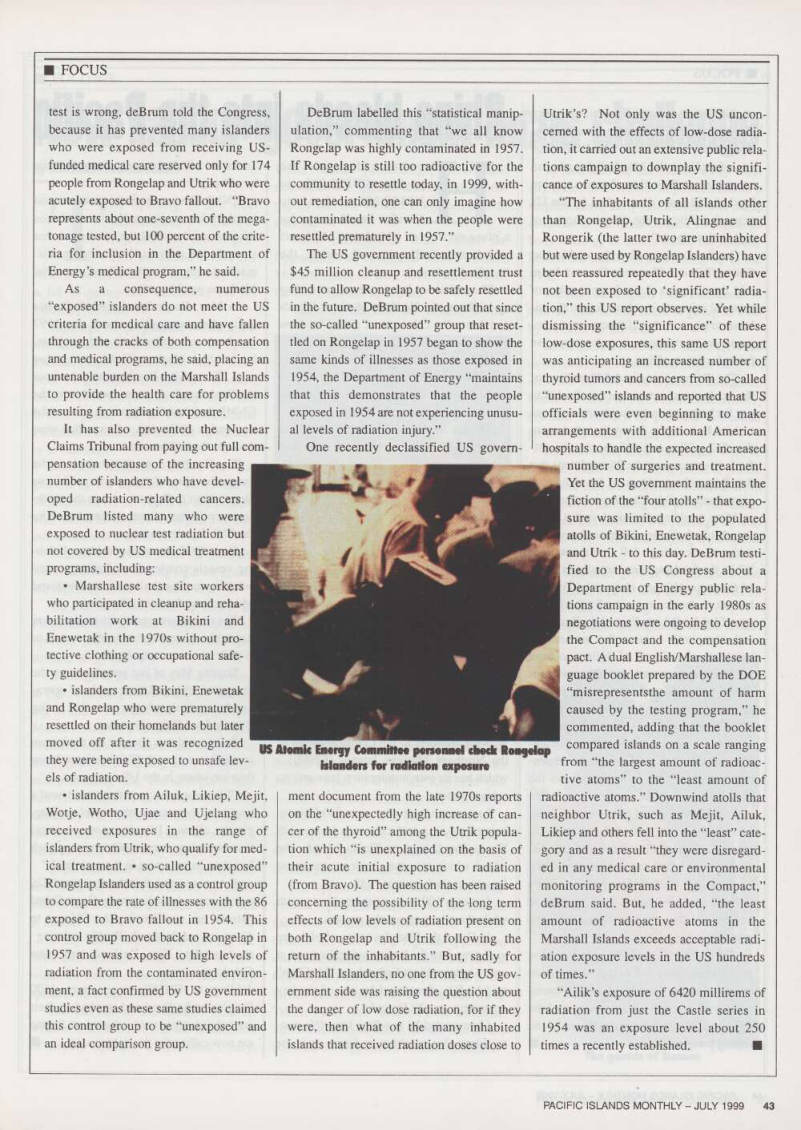
US Atomic Energy Committee personnel check Rongelap islanders for radiation exposure
US Environmental Protection Agency standard for exposures to manmade radia tion. “I fail to understand how DOS’s sur vey of atolls in the Marshall Islands can categorize atolls with radiation exposure level of 250 times the standard for the US general public as the ‘least amount of radioactive atoms.”
On the compensation front. Nuclear Claims Tribunal Chairman Oscar deßrum told the congress that a large number of personal injury claims have forced the tri bunal to pay less that 100 percent of com pensation to claimants in order to reserve funds for future claims.
The Tribunal received $45 million of the nuclear test settlement for the US to pay for both personal injuries and damages to land. But, so far it has awarded more than $67 million to 1,613 people who suf fer from one or more the 35 conditions that the Tribunal considers to be radiation caused and eligible for compensation.
More troubling, he noted, is that about one-third of all the claimants have died without receiving full compensation.
While the fund has been virtually exhaust ed for personal injury claims, the Tribunal has yet to decide on claims for land dam ages filed by Bikini, Enewetak, Rongelap and other atolls - claims that are seeking hundreds of millions of dollars to fund nuclear cleanups and rehabilitation pro grams. Later this year, the Marshall Islands is expected to submit a formal petition to the US Congress seeking to get the Congress to invoke the “changed circum stances” clause of the Compact’s compen sation pact. This provision allows the Marshalls to ask the Congress for more compensation if it can prove that the com pensation already provided is manifestly inadequate based on information that has surfaced since the Compact was negotiated in the early 1980 s. In mid-May, Tony deßrum appealed to the US Congress to address the lingering problems from the nuclear testing period.
The failure Compact’s compensation
pact to recognise the extent of radiation exposure to the Marshall Islands govern ment were not, and have not been told the full truth about the consequences of the testing p rogramme. ■