as kina continues to fall
pp. 18-19 · Read in the full issue
Nation heads fan trouble as kina continues to fall
By Brian Tobia
Papua New Guinea’s local currency, the kina, has plunged to its lowest level since it was floated and thrown into a basket of currencies in 1994 by the then government of for mer Prime Minister Sir Julius Chan.
Just five months ago, the kina was worth US 48 cents but it now worth just US 33 cents. Much of PNG’s imports come from Australia and in January it was worth 80 Australian cents yet currently it is worth just 50 cents and “we are in the real worst times than in 1994 when the kina was float ed”, says Institute of National Affairs director, Mike Manning.
The decline in the value of the kina against other major currencies is due to “less foreign currency inflows” he said.
There is inadequate inflow of foreign capital to support the weakening kina.
Economic experts say there were three factors which were drive down the value of the kina.
Firstly, there is not enough inflow of foreign capital from both agricul tural and mineral exports - gold and! oil prices are down from what was pro jected in the 1999 budget and export receipts are not coming in on time.
But the export earning situation is ' not bad, consider
ing the fact that the coffee season is coming up and commodity exports are steady.
Secondly, the decline inflow of private capital into the country and invisible export (of capital) is a very serious concern.
The unsteady political climate coupled with the declining value of the kina is deter ring the investor confidence.
The Investment Promotion Authority recently sounded a warning that the number of business registrations had dropped which may imply that investor confidence has declined and foreign investment drying up while other investors (including Papua New Guineans) are taking their money out from
Png.
The third most serious factor is the absence of foreign borrowings to fund the k 2.054 billion 1999 Budget.
The revenue for this year includes an amount of K 383.2 million as a consession ary income that would come from the World Bank and International Monetary Fund.
The government must agree to the terms these institutions have been asking for to have access to funds - but it has not been able to satisfy the institutions so far and negotiations are continuing.
The US$25O million loan expected from the Kredit Bank of Canada to fund the bond issue is still to come.
But exports say this bond issue may not be successful because “it costs more to gain less”.
This means finance needed by the gov ernment to fund the budget it is not forth coming and places PNG in a very desper ate situation.
According to Mr Manning, the fall in the kina has also resulted in the increase of consumer good by about 17 percent.
And this is expected to continue as long as the kina continues to drop against
major currencies.
The diminishing kina is imposing more hardship on the average families,
small businesses, [ home buyers and j the transport sec tor.
Home buyers will have to deal with ' high interest rates, S families will have 1 to tackle high cost ;of consumable I items and high transport costs, I and small time [entrepreneurs j have to handle I increasing cost of doing business.
Average urban families in the low income earning bracket are suffer
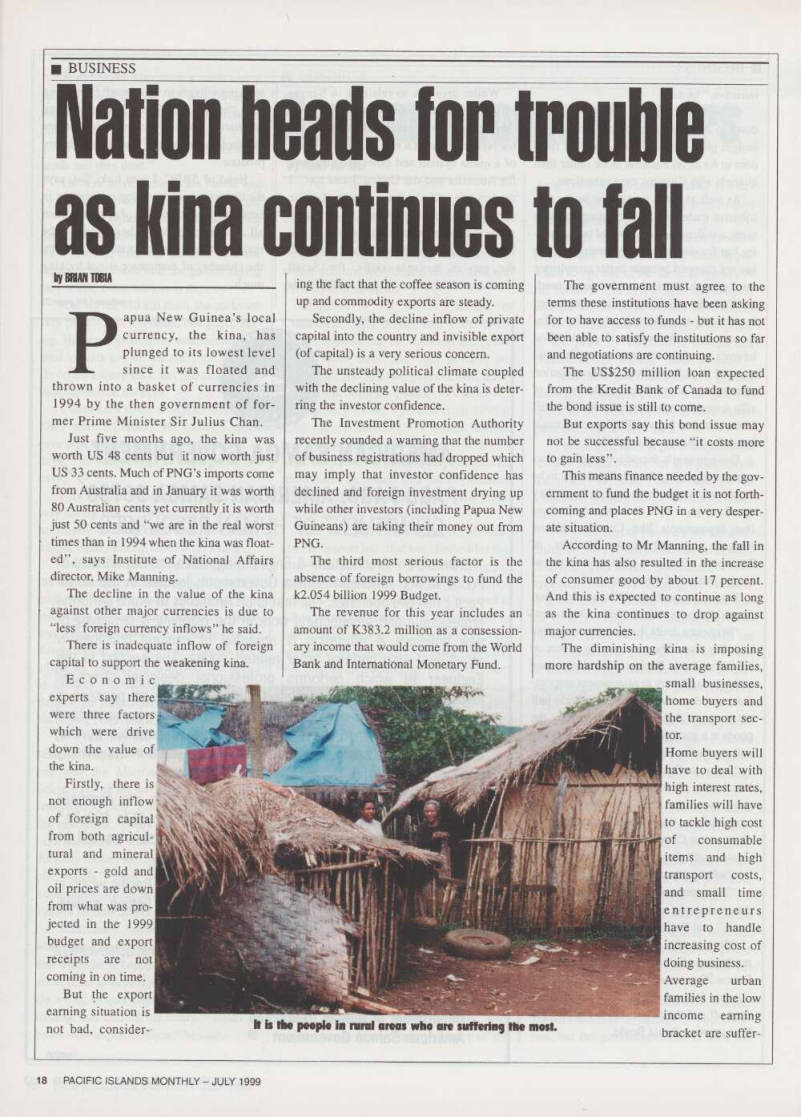
it is the people in rural areas who are suffering the most.
ing because their meagre wages cannot see them through to the next fortnight.
In rural areas, people have stopped buy ing expensive store goods and are growing their own - surplus is sold for cash income.
But what is causing despair among the people is government’s response to the crash of the kina. It pretends that a low value currency is good for PNG.
PNG’s 1999 budget is hopelessly inac curate in every sense - the economic con ditions on which it was planned or based have not been achieved. Promised funding for basic services (health, education and infrastructure) has been constantly delayed; public services restructure pro gramme not finalised and budget deficit is no longer close to being funded.
Central Bank Governor Morea Vele said in May that PNG’s fiscal operating deficit now stands at K3B million and there is less hope for funding it.
He shifted the blame to some of the major players in the market place for “playing up and trying to drive down the kina by not bringing in export receipts quickly”.
He said this was causing problems with capital inflows and making it difficult for the government.
“The government has to cut back on its expenditure in the absence if such external inflows,” he added.
These warnings were ignored and this did not happen in the last quarters of 1998.
“And in the first quarter this year we have run a deficit on government fiscal operations of around K3B million.
“So we are still living beyond our means and the pressure that is coming from the currency is largely from that source,” he added.
According to Mr Vele, normally the last and the first quarter of the following year are usually difficult periods when agricul tural export receipts are very low, but this improves in the second and the third quar ters agricultural export increases.
“The government finds that those inflows that should be coming in this quar ter are not as much as anticipated in the budget.
“There seems to be some exception that the kina would fall further and exporters want to hold money offshore and bring it
in when the rate of the kina is at its lowest and make more profits.
“This makes economic management a lot harder than it should be because PNG’s reserve position should be a lot better in the second and third quarters.
“So there are some players in the mar ket playing upto .. there are some players who want to drive the kina down further,” added Mr Vele.
He said from the foreign exchange point of view, the government will have to make sure that players stay within regula tions because there are some legal open ings for them in terms of holding funds off shore for their operational requirements.
But beyond these legal requirements they should bring them onshore.
The bank has to monitor those and make sure that after the lapse of the legal period, players should bring funds onshore.
“We just have to keep chasing and mon itoring them because it is very difficult but some of them are cooperative,” he added.
The agricultural exporters have a legal retention period of six months while oil and mineral exporters have up to three months. Perhaps with all these problems sorted out, PNG in the long term will like, as in the first 22 years of independence, to enjoy comparatively low inflation, afford able imports, strong foreign reserves and good investment inflows.
In developments at the time this issue went to press, the PNG Chamber of Commerce reported that two meat process ing firms had suspended operations because of the falling value of the kina.
Chamber spokesman Michael Mayberry said the canneries could no longer afford to import raw meat from Australia, despite government approval for an 11 percent retail price increase for canned meat. “They say that the Price Controller said he’s given them 11 percent and they should tighten their belt and try and operate within that price increase, but
the meat packing companies are saying
that with the price of raw material they would be making a gross loss and no amount of belt tightening would be able to cope with that thing,” said Mayberry.
“It was just a question of cost of imports against what they can sell at.” ■