Sole survivor talks about massacre
pp. 15-16 · Read in the full issue
in Kiribati during the Cold War
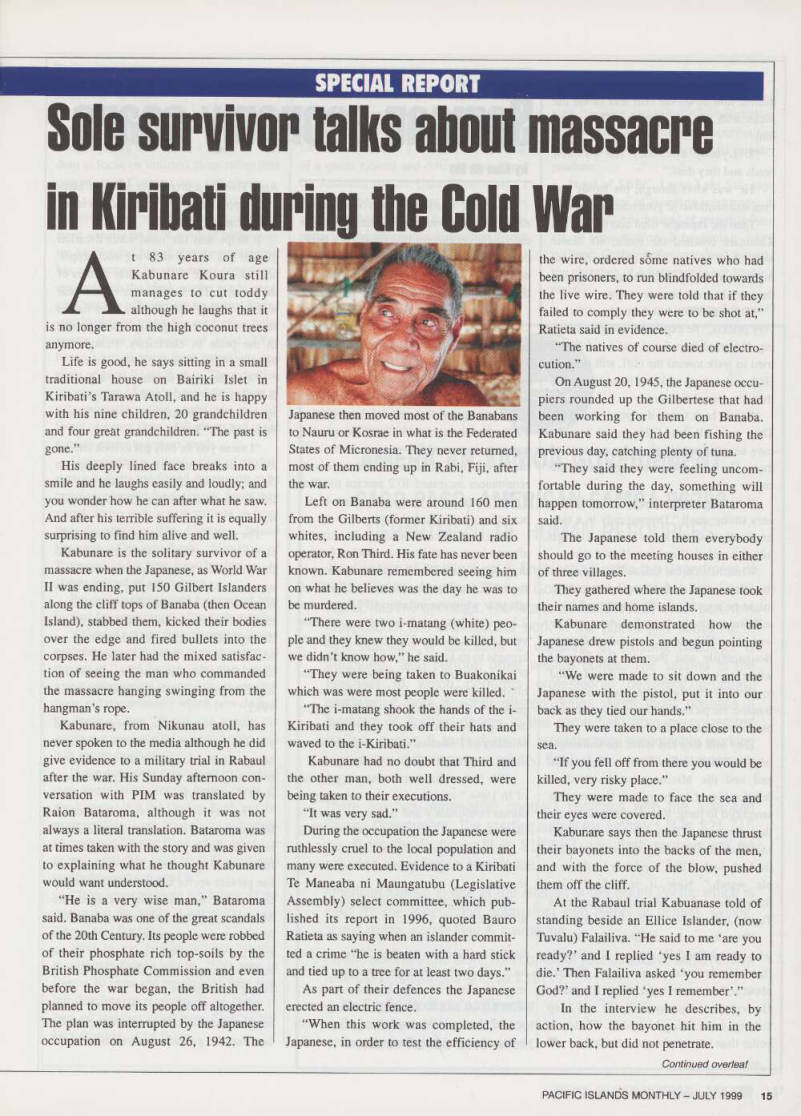
At 83 years of age Kabunare Koura still manages to cut toddy although he laughs that it is no longer from the high coconut trees anymore.
Life is good, he says sitting in a small traditional house on Bairiki Islet in Kiribati’s Tarawa Atoll, and he is happy with his nine children, 20 grandchildren and four great grandchildren. “The past is
gone.”
His deeply lined face breaks into a smile and he laughs easily and loudly; and you wonder how he can after what he saw.
And after his terrible suffering it is equally surprising to find him alive and well.
Kabunare is the solitary survivor of a massacre when the Japanese, as World War II was ending, put 150 Gilbert Islanders along the cliff tops of Banaba (then Ocean Island), stabbed them, kicked their bodies over the edge and fired bullets into the corpses. He later had the mixed satisfac tion of seeing the man who commanded the massacre hanging swinging from the
hangman’s rope.
Kabunare, from Nikunau atoll, has never spoken to the media although he did give evidence to a military trial in Rabaul after the war. His Sunday afternoon con versation with PIM was translated by Raion Bataroma, although it was not always a literal translation. Bataroma was at times taken with the story and was given to explaining what he thought Kabunare would want understood.
“He is a very wise man,” Bataroma said. Banaba was one of the great scandals of the 20th Century. Its people were robbed of their phosphate rich top-soils by the British Phosphate Commission and even before the war began, the British had planned to move its people off altogether.
The plan was interrupted by the Japanese occupation on August 26, 1942. The
Japanese then moved most of the Banabans to Nauru or Kosrae in what is the Federated States of Micronesia. They never returned, most of them ending up in Rabi, Fiji, after the war.
Left on Banaba were around 160 men from the Gilberts (former Kiribati) and six whites, including a New Zealand radio operator, Ron Third. His fate has never been known. Kabunare remembered seeing him on what he believes was the day he was to be murdered.
“There were two i-matang (white) peo ple and they knew they would be killed, but we didn’t know how,” he said.
“They were being taken to Buakonikai which was were most people were killed.
“The i-matang shook the hands of the i- Kiribati and they took off their hats and waved to the i-Kiribati.”
Kabunare had no doubt that Third and the other man, both well dressed, were being taken to their executions.
“It was very sad.”
During the occupation the Japanese were ruthlessly cruel to the local population and many were executed. Evidence to a Kiribati Te Maneaba ni Maungatubu (Legislative Assembly) select committee, which pub lished its report in 1996, quoted Bauro Ratieta as saying when an islander commit ted a crime “he is beaten with a hard stick and tied up to a tree for at least two days.”
As part of their defences the Japanese erected an electric fence.
“When this work was completed, the Japanese, in order to test the efficiency of
the wire, ordered sSme natives who had been prisoners, to run blindfolded towards the live wire. They were told that if they failed to comply they were to be shot at,”
Ratieta said in evidence.
“The natives of course died of electro cution.”
On August 20, 1945, the Japanese occu piers rounded up the Gilbertese that had been working for them on Banaba.
Kabunare said they had been fishing the previous day, catching plenty of tuna.
“They said they were feeling uncom fortable during the day, something will
happen tomorrow,” interpreter Bataroma
said.
The Japanese told them everybody should go to the meeting houses in either of three villages.
They gathered where the Japanese took their names and home islands.
Kabunare demonstrated how the Japanese drew pistols and begun pointing the bayonets at them.
“We were made to sit down and the Japanese with the pistol, put it into our back as they tied our hands.”
They were taken to a place close to the sea.
“If you fell off from there you would be killed, very risky place.”
They were made to face the sea and their eyes were covered.
Kabunare says then the Japanese thrust their bayonets into the backs of the men, and with the force of the blow, pushed them off the cliff.
At the Rabaul trial Kabuanase told of standing beside an Ellice Islander, (now Tuvalu) Falailiva. “He said to me ‘are you ready?’ and I replied ‘yes I am ready to die.’ Then Falailiva asked ‘you remember God?’ and I replied ‘yes I remember’.”
In the interview he describes, by action, how the bayonet hit him in the lower back, but did not penetrate.
Continued overleaf
It did leave him with a gash and it pushed him down the cliff and he hit the rocks with his left shoulder. That saved him.
“Everybody else, they fell on their heads and they died.”
He was alive though, his hands and eyes still bound so he pretended to be dead.
Then the Japanese fired into the bodies.
Kabunare counted the shots; 40. Some were close to him. He understood some Japanese and could hear the guards saying they would come back next day.
“The waves will kill them, the rocks are very prickly,” he explained one guard say ing. He heard them leave and carefully he tried to walk toward the cliff, still tied up.
He found a sharp rock and freed his hands, then uncovered his eyes.
“I went back to see if anyone was alive.
They were all dead.” He found a small cave near by and hid there for a couple of days. The bodies kept sweeping into the cave.
“I try to push them off and there was a very strong smell.” Dressed only in a sulu he finally left the cave and tried to go inland, nearly killing himself on a mine.
When he saw the Union Jack flying on the administration building he thought it might be a trick to make him reveal him self. But it was the Australian Army and he was safe. Kabuanase was taken first to Bougainville and then to Guadalcanal where he was shown prisoners and asked to identify the Japanese commander of Banaba. He picked out Suzuki Naoomi and his deputy Nara Yoshio.
They said they had killed the Gilbertese because Tokyo had told them to fight to the end and the Micronesians knew their defence layout on the island. Naoomi was sentenced to hang. Kabuanase said he saw the execution. “They left him to hang,” said Kabuanase who demonstrated what the body looked like, “and they let the peo ple watch.” Now it is behind him.
Sometimes when he sees Japanese in Tarawa he remembers what happened.
“Sometimes I remember my friends who were killed.” He stresses now though that while he is happy to talk to i-Kiribati about it, he is more interested in life today.
He wants, to stay physically fit and keep fishing, and cutting his toddy. “Toddy is better than imported sugar,” he said. ■