Were American
Special Report
Tarawa's main islet in appalling state
Stories and Pictures
By Michael Field
Were American
Marines to storm across the beaches of Tarawa these days they’d risk serious injury - from the thousands of rusting cans, the car wrecks and any of a number of major diseases that can come from having great piles of human excrement every where.
Betio, the heavily populated main islet on Tarawa, capital of Kiribati, is a cesspit of disease - a public health disaster waiting to happen.
“I’m pleased you use the word filthy,” says former president leremia Tabai.
“People here do not realise just how dirty this place is and they need the i matang (whites) to remind them.”
Kiribati has a population of around 80,000 with the bulk of them living in crowded south Tarawa - and 28,000 of them on Betio’s 116 hectares, smaller than most big city parks. They have no sewage, limited running water and most of them live straight on the hard packed dirt.
Families live right on each other; ailing children roam crying among the shanties and mothers sit around smoking a foul smelling local concoction. Some of the world’s saddest looking dogs mooch through the garbage while fowls scratch,
and deposit their litter, where ever they please.
What is also bizarre, and poten tially a source of a major catastro phe, is the way in which Betio people seeming willing to go to the toilet where ever they please.
The beach is the preferred option but just about anywhere does.
Almost nobody has a job and as each day wears on the men pass their time in a haze induced by the thousands of cans of VB beer con sumed, mainly in spartan drinking pits.
Diarrhoea is already common in children. Cholera seems but a
step away. And Acquired Immune Deficiency Syndrome - AIDS - is already a major menace on Tarawa.
When it rains the power station - an envi ronmental disaster all on its own - sends its great ponds of spilled fuel oil through the island. It soaks into the soil and the ground
water, compounding the problem.
The islet reeks of the smell of decaying sewage and, after rains, fuel oil.
Betio was completely flattened in 1943 when the US Marines staged a bloody land ing their which left around 6000 Japanese and American bodies on the tiny island.
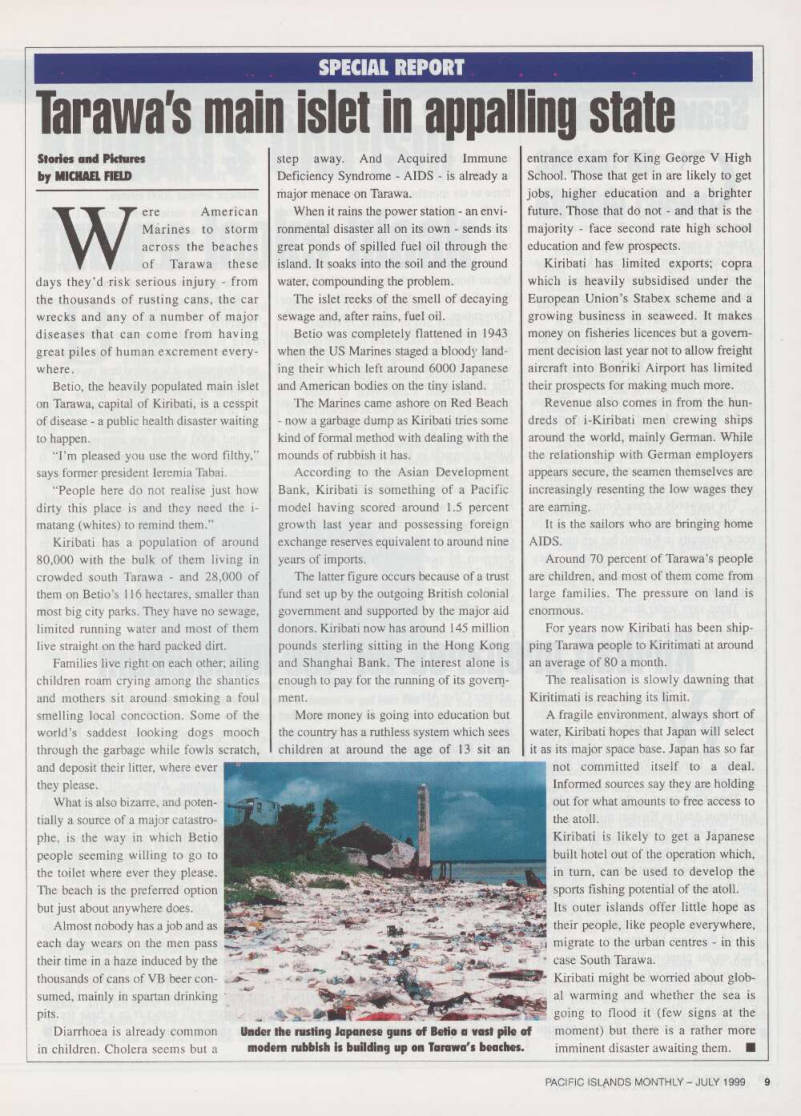
The Marines came ashore on Red Beach - now a garbage dump as Kiribati tries some kind of formal method with dealing with the mounds of rubbish it has.
According to the Asian Development Bank, Kiribati is something of a Pacific model having scored around 1.5 percent growth last year and possessing foreign exchange reserves equivalent to around nine years of imports.
The latter figure occurs because of a trust fund set up by the outgoing British colonial government and supported by the major aid donors. Kiribati now has around 145 million pounds sterling sitting in the Hong Kong and Shanghai Bank. The interest alone is enough to pay for the running of its govern ment.
More money is going into education but the country has a ruthless system which sees children at around the age of 13 sit an
entrance exam for King George V High School. Those that get in are likely to get jobs, higher education and a brighter future. Those that do not - and that is the majority - face second rate high school education and few prospects.
Kiribati has limited exports; copra which is heavily subsidised under the European Union’s Stabex scheme and a growing business in seaweed. It makes money on fisheries licences but a govern ment decision last year not to allow freight aircraft into Bonriki Airport has limited their prospects for making much more.
Revenue also comes in from the hun dreds of i-Kiribati men crewing ships around the world, mainly German. While the relationship with German employers appears secure, the seamen themselves are
increasingly resenting the low wages they
are earning.
It is the sailors who are bringing home
Aids.
Around 70 percent of Tarawa’s people are children, and most of them come from large families. The pressure on land is enormous.
For years now Kiribati has been ship ping Tarawa people to Kiritimati at around an average of 80 a month.
The realisation is slowly dawning that Kiritimati is reaching its limit.
A fragile environment, always short of water, Kiribati hopes that Japan will select it as its major space base. Japan has so far
not committed itself to a deal.
Informed sources say they are holding out for what amounts to free access to the atoll.
Kiribati is likely to get a Japanese built hotel out of the operation which, in turn, can be used to develop the sports fishing potential of the atoll.
Its outer islands offer little hope as their people, like people everywhere, migrate to the urban centres - in this case South Tarawa.
Kiribati might be worried about glob al warming and whether the sea is going to flood it (few signs at the moment) but there is a rather more imminent disaster awaiting them. ■
Under the rusting Japanese guns of Betio a vast pile of modem rubbish is building up on Tarawa's beaches.