Regional Economic. A partnership
p. 56 · Read in the full issue
Re-Run
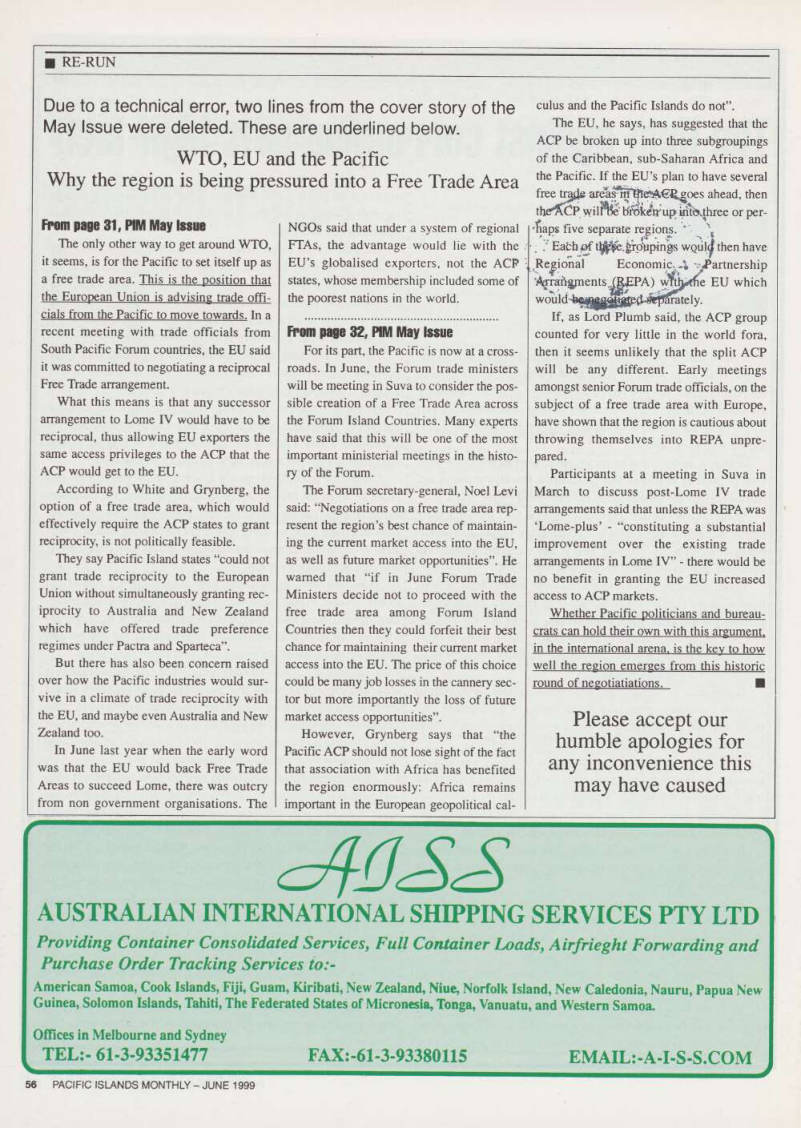
Due to a technical error, two lines from the cover story of the May Issue were deleted. These are underlined below.
WTO, EU and the Pacific Why the region is being pressured into a Free Trade Area
From page 31, PIM May Issue The only other way to get around WTO, it seems, is for the Pacific to set itself up as a free trade area. This is the position that the European Union is advising trade offi cials from the Pacific to move towards. In a recent meeting with trade officials from South Pacific Forum countries, the EU said it was committed to negotiating a reciprocal Free Trade arrangement.
What this means is that any successor arrangement to Lome IV would have to be reciprocal, thus allowing EU exporters the same access privileges to the ACP that the ACP would get to the EU.
According to White and Grynberg, the option of a free trade area, which would effectively require the ACP states to grant reciprocity, is not politically feasible.
They say Pacific Island states “could not grant trade reciprocity to the European Union without simultaneously granting rec iprocity to Australia and New Zealand which have offered trade preference regimes under Pactra and Sparteca”.
But there has also been concern raised over how the Pacific industries would sur vive in a climate of trade reciprocity with the EU, and maybe even Australia and New Zealand too.
In June last year when the early word was that the EU would back Free Trade Areas to succeed Lome, there was outcry from non government organisations. The
NGOs said that under a system of regional FTAs, the advantage would lie with the EU’s globalised exporters, not the ACP states, whose membership included some of the poorest nations in the world.
From page 32, PIM May Issue For its part, the Pacific is now at a cross roads. In June, the Forum trade ministers will be meeting in Suva to consider the pos sible creation of a Free Trade Area across the Forum Island Countries. Many experts have said that this will be one of the most important ministerial meetings in the histo ry of the Forum.
The Forum secretary-general, Noel Levi said: “Negotiations on a free trade area rep resent the region’s best chance of maintain ing the current market access into the EU, as well as future market opportunities”. He warned that “if in June Forum Trade Ministers decide not to proceed with the free trade area among Forum Island Countries then they could forfeit their best chance for maintaining their current market access into the EU. The price of this choice could be many job losses in the cannery sec tor but more importantly the loss of future market access opportunities”.
However, Grynberg says that “the Pacific ACP should not lose sight of the fact that association with Africa has benefited the region enormously: Africa remains important in the European geopolitical cal
cuius and the Pacific Islands do not”.
The EU, he says, has suggested that the ACP be broken up into three subgroupings of the Caribbean, sub-Saharan Africa and the Pacific. If the EU’s plan to have several free areapnlftc*A6li«c)es ahead, then
wilFbe - broketrup intKthree or per
haps five separate regions. ‘ \ .' Each of groupings wqulq then have
Regional Economic. A partnership
vs\ytne EU which If, as Lord Plumb said, the ACP group counted for very little in the world fora, then it seems unlikely that the split ACP will be any different. Early meetings amongst senior Forum trade officials, on the subject of a free trade area with Europe, have shown that the region is cautious about throwing themselves into REPA unpre pared.
Participants at a meeting in Suva in March to discuss post-Lome IV trade arrangements said that unless the REPA was ‘Lome-plus’ - “constituting a substantial improvement over the existing trade arrangements in Lome IV” - there would be no benefit in granting the EU increased access to ACP markets.
Whether Pacific politicians and bureau crats can hold their own with this argument, in the international arena, is the kev to how well the region emerges from this historic round of negotiatiations. ■
Please accept our
humble apologies for
any inconvenience this
may have caused