fun@ funafuti
pp. 52-53 · Read in the full issue
Yachting
Story and pictures by SALLY ANDREWS
AFTER sailing through the tropical convergence zone, the skies cleared and a sta ble smudge of palm trees rose into view on the horizon. We had found our clearance port, Funafuti - the capital atoll of Tuvalu.
Before the advent of global positioning satellites (GPS), finding a low-lying atoll was a satisfying if risky business.
Navigating solely by sun, stars and sex tant, sailors were at the mercy of weather conditions which could obscure the sky for days.
Caution, luck and skill played equal parts in a safe landfall. GPS makes a nav igator’s life easier, though you still need eyeballs and commonsense. At Tuvalu, our charts and global positioning dis agreed by nearly a mile.
During our visit, a warship entered Funafuti lagoon. Next afternoon, radio silence was broken: “Fellowship, this is the Australian Warship Ipswich, Captain Kraus speaking. Please join us for cock tails at 1800 hours.” Like a lunatic, I tore
apart my clothes locker looking for some thing suitably unwrinkled to wear.
Running late, we were grateful when the local police officer gave us a lift to the party. On the way, he remarked on the anticipated weekend workload, mostly for minor infractions like drunk & disorderly behaviour. I hoped we wouldn’t become a statistic.
On a goodwill tour of the South Pacific, the Ipswich had invited the who’s who of Tuvalu - government and bank officials and other VlP’s - plus two itiner ant sailors. Hospitality was flowing, as were the drunks, and we mixed with the crowd. The evening was warm and the roll of the deck gentle.
We marvelled at the ship’s air condi tioning system, and the generous amount of refrigerated storage space - much of it dedicated to chilling beer. As the duty officer descended into the tinier holds, he looked like Victor Hugo’s misshapen bell ringer Quasimodo. In the engine room, an impressive array of computers monitored all ship’s systems.
After the reception wound down, a group of us headed to the Island Twist at
I the Vaiku Langi Hotel where I the local rock band, Funafuti I Island Power, was surging.
I The admission price included I a fragrant floral headdress I and, crowned with colourful I flowers, I was quickly I whisked off to dance with a I Tuvaluan chap and then an I Aussie sailor. I had been in I Tuvalu only a week and I wasn’t sure I could maintain the lifestyle. Foster, my part ner, disappeared into the
I woodwork, chuckling. He
I preferred to admire the ladies I from a distance. As I whirled I around, I caught his eyes, ' which instantly creased in laughter.
Tuvalu seemed to be “Party Capital of the Pacific” and there were endless reasons to party - to herald the weekend, to raise funds, to celebrate birthdays and weddings. But,
after seeing the south end of the atoll, per haps “Land of the Blue Tin Road” was a more appropriate pseudonym. Lacking yellow bricks and a functioning can crush er, a veritable highway of Fosters beer tins had appeared.
The disposal of glass, plastic and metal refuse has become a major environmental problem at Tuvalu. Most Tuvaluans have had to switch from subsistence farming to consuming imported products.
There is simply not enough land to grow food on. The airport, built by the US troops during World War 11, takes up most of the arable land. In addition, the last thirty years has seen a tenfold increase in the number of people living in the capital.
By chance, we ran into Marina at her Happy Face Store. Twenty years earlier, she and her late-husband, plantation man ager Bill Frew, had welcomed yachties who stopped at Fanning in the Line Islands.
She had not changed. Amiable as always, Marina invited us to a birthday party at the Nukulaelae Maneapa. The guests were elegantly dressed, and
speeches, dancing, eating flowed into one
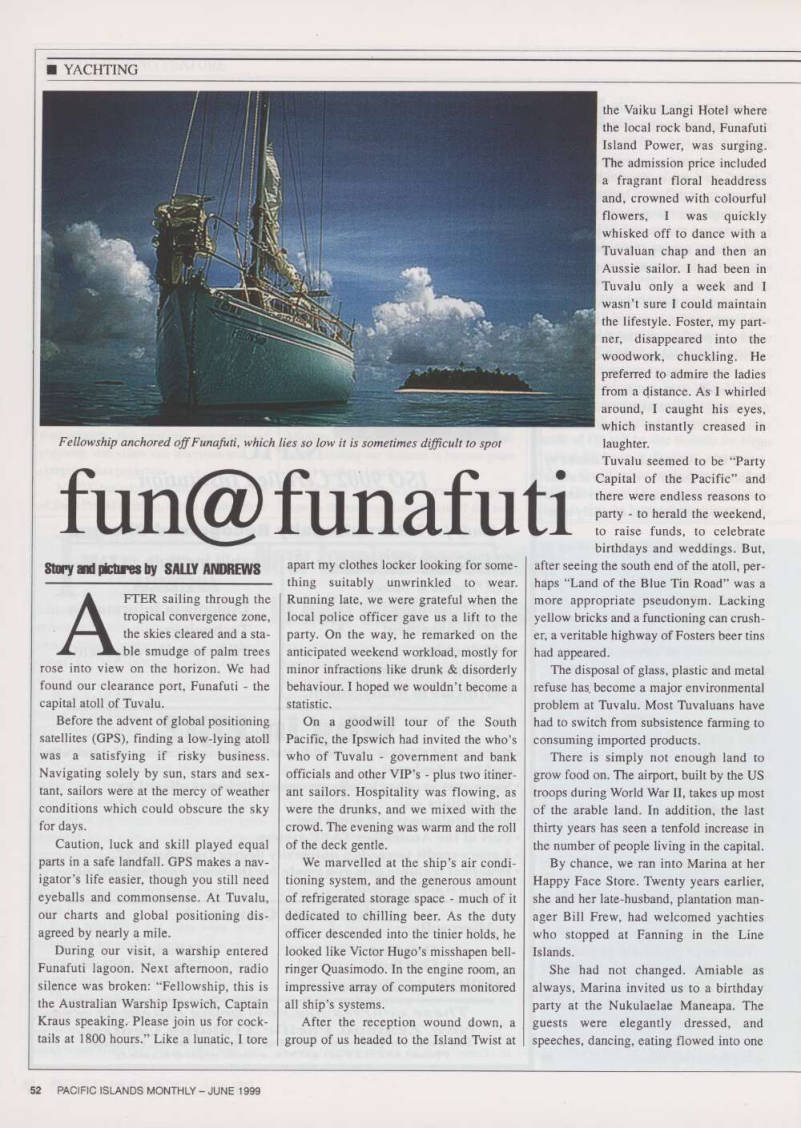
Fellowship anchored off Funafuti, which lies so low it is sometimes difficult to spot
another. Mountains of food on the long banquet tables mirrored the mix of influence - with imported orange Fanta and red apples alongside green
drinking coconuts.
For a change of scenery and a quiet weekend, we sailed to Funafala in the southwestern lagoon. The anchorage is surrounded by ultra marines and sapphire blues. “A nice place for a picnic,” said the Pastor.
Under his watchful eyes, the local Girls and Boys Brigade were camped out, studying the Bible and learning traditional skills.
The Pastor shared Tuvalu’s histo ry with us - seemingly a series of aggressions by blackbirders, whalers, beachcombers, Tongan and Kiribati warriors, Samoan pastors, British colonialism, American troops. Finally, after years of foreign domination, he felt Tuvaluans were
shaking free from the influence of the past and discovering and redefining their cul ture. Meanwhile, the girls wove mats and plates out of palm fronds, the boys husked coconuts. The plan was to live off the land like the ancestors for a couple of days, catching fish and harvesting pulaka (taro).
coconuts, pandanus and bananas. At breakfast, though, the poor kids had looked so unhappy. No bread, no crackers.
So the Pastor caved in, he told us, and had zoomed by boat back to the mainland to buy two boxes of Lees biscuits! At the end of their adventure, the kids sang and
danced and laughed as they crossed the lagoon headed back to Funafuti. It seemed a shame that kids no longer learned the traditional skills of their ancestors at home, that they had to rely on extra-cur ricular activities like a weekend church camp. But since independence in 1978,
Tuvalu has had to adapt to mod em life including dependence on remittances; sales of stamps at the Philatelic Bureau; Fish Licencing fees for access to Tuvalu’s FEZ; sales of licencing for the Internet “dot.tv” suffix; and aid money.
Unfortunately, the influx of aid money creates paradoxes like fishing fleets, freezers and gear but no one goes fishing because there is no infrastructure to keep it running - no mechanics, no fuel, no markets because there’s no room on the plane.
Despite Tuvalu’s constant adap
tation to contemporary environ mental and economic concerns, the lagoon and the people who live on its edge are warm and welcoming - making Funafuti a fun place to visit. Just be sure to bring your party clothes. ■
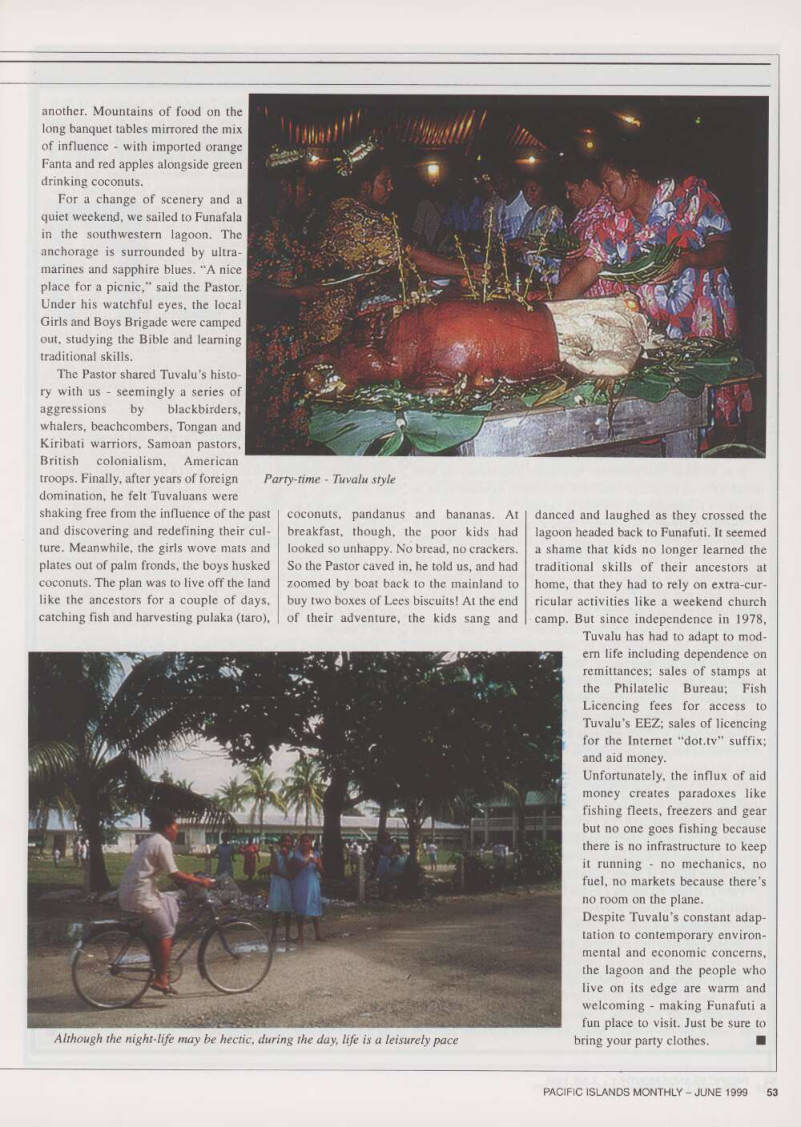
Although the night-life may be hectic, during the day, life is a leisurely pace
Party-time - Tuvalu style