trigger discriminatory sentiments
pp. 46-47 · Read in the full issue
New Zealand's portability bill could trigger discriminatory sentiments
By John Uri
NEW Zealand’s decision to enhance superannuation portability by extending it to other pacific islander nationalities have been warmly received particularly by pacific governments as the bill was announced earlier in the year The proposed arrangement allows pacific workers to retire to the pacific with full pension.
Previously, partial portability (25 per cent gross) were only available to NZ cit izens including nationals of Niue, Tokelau and the Cook Islands by virtue of these countries colonial relationship with New Zealand.
Not only will superannuation portabil ity be increased to 100 per cent, but eli gibility will be extended to cover over 12 other pacific nationalities including Tonga, Samoa, PNG, Fiji, provided they meet residency requirements.
In announcing the deal. New Zealand’s Social Services Minister, the Hon Roger Sowry, said the arrangement is New Zealand’s way of recognising its “special relationship” with pacific work ers and those who contributed to NZ’s economy over the years.
The government defined the package as a “just reward” although it is seeming ly a political reward for pacific govern ments since pensioners have little to gain by retiring to the Pacific.
In the absence of a cost-benefit analy sis, the New Zealand government, like its pacific counterpart, stands to rake in enormous savings in terms of what it will save from the deal.
The government announced that the scheme will add over $0.5 million per annum to NZ’s current $6 billion although this may depend on the number of retirees signing up under the deal.
Nonetheless, the benefit for NZ is signif icant.
For pacific governments, this will depend on how many of it’s former nationals will return home. Amendments to the Portability Bill is still being stud ied by a parliamentary Select Committee whose report is expected to finish later this month.
While the scheme’s viability is yet to be ratified, an analysis of the deal reveal that individuals taking up the offer will be disadvantaged rather immensely.
The government has been mostly care ful in the way it has worded its press release when it described NZ’s “special relationship” with pacific nations, echo ing its historical ties with the pacific and the workers who contributed to NZ’s economy.
This is arguably an important politi cal initiative by the National government but a very weak and suspicious deal indeed. The decision or indecision whether to introduce portability has been the subject of heated political debate over
the past 9 years so just why the bill is being viewed favourably now remains unclear. The National leadership said that NZ’s improved economic conditions was a key reason for introducing the deal for pacific workers. But the real truth may lie ahead.
On the face of the deal, the govern ment could be viewed as pro-pacific in its stance. But the deal is flawed for sev eral reasons.
Why has the government targetted pacific nationalities in this package instead of making the offer based on res idency or citizenship criteria? It is impor tant to note that there are other ethnic workers in NZ who equally fit the same elibility or requirement The Nationals have been meticulous in the way it has promoted aspects of the portability arrangement by using terms such as special relationship, historical ties, past inequities and just reward implying of course that pacific workers (or do they mean pacific governments) meant more to them now than before.
The tone and languages used in its press release can of course distort the government’s real intention since porta bility, as in this case, will have no real benefits to retirees who return to the pacific.
Also, the deal has the appearance of an arrangement between the government and the devil himself, since its been aimed at luring unwary retirees into something which could lock them away for the rest of their lives.
Most Pacific people, more often than not, tend not to analyse the ramifications of policy decisions in terms of how it will affect them even before signing the dot ted line.
Questions have also been raised over whether a policy of this type should ever be framed for pacific nationalities.
The portability bill is not only dis criminatory in nature since it seeks to distinguish pacific islanders from other ethnic nationalities but this could lead to something more sinister, and could set the stage for future policy changes with the likely effect of eroding the rights of pacific residents in NZ.
Nonetheless, whether Pacific workers have contributed to NZ’s economic development or not hardly justify the need to create one set of rule for them, and another for others.
While some might view the govern ment’s initiative as pro-pacific, the truth is quite the opposite.
The government dislikes the idea of reciprocal agreements with Pacific nations even though this would have been the most sensible arrangement to follow.
The government also knows that since the deal is only an offer (an agreement with thin air), it can wash its hands from any responsibilities knowing fully well that once a pensioner leaves NZ, further care and support shifts to the pacific gov ernment. That is where the problem is.
Most Pacific governments don’t oper ate on the same basis as NZ in terms of
implementing policy and budgetary lay
.out for pensioners or for old people. So the pensioner’s family ends up shoulder ing the burden of this policy.
It should be kept in mind that the majority of families in Pacific countries have no stable income and are dependent on overseas remittances. If you have spent most of your life working in New Zealand, and all you receive is a 100 per cent portability pension, (this isn’t much
in moneary terms), wouldn’t you be bet ter off retiring to Australia or the UK or to countries other than the Pacific?
By retiring to the Pacific, your pen sion is reduced (because you are retiring to the Pacific), you lose all government concessional benefits and entitlements (because you are leaving NZ, and these are not transferrable to pacific countries), and you stand the chance of being humil iated because pacific governments often use public investments for the wrong rea sons. We know that most pensioners will be cared for by family members but thats beside the point.
Under this arrangement, there is in fact no obligation on the part of both pacific and NZ governments to assist retirees once they arrive home because it has been made clear to you that the arrangement is only an offer. If you have any administrative queries, or questions on your pension, you will have to foot the bill for calls to NZ(phone calls are cost ly). Your pacific government have no mandate to do it for you.
There is no denying that a historical relationship did exist between NZ and the pacific but the govemmentis offer is sig nificantly inadequate and does not even rise to the level of that relationship.
Firstly, the government could have enticed pacific governments to agree on some pre-determined principles such as making it obligatory for pacific bureau crats to invest more in resources and ser vices for old people.
Secondly, pacific governments should establish a statutory authority whose role is to advocate on behalf of retirees or pensioners, and finally for governments to ensure that pensioneris savings are
protected from banking sharks.
Pensioners should not be compelled to pay any cent for phone calls made to the administrators of pensions in NZ when
querying about pension rates or policy
changes. Without any agreement, pen sioners will become mere numbers in the whole exercise. The winners and losers are: NZ government 3 points. Pacific governments 2, while former NZ work ers, now pensioners likely to be doomed to oblivion, get zero. ■
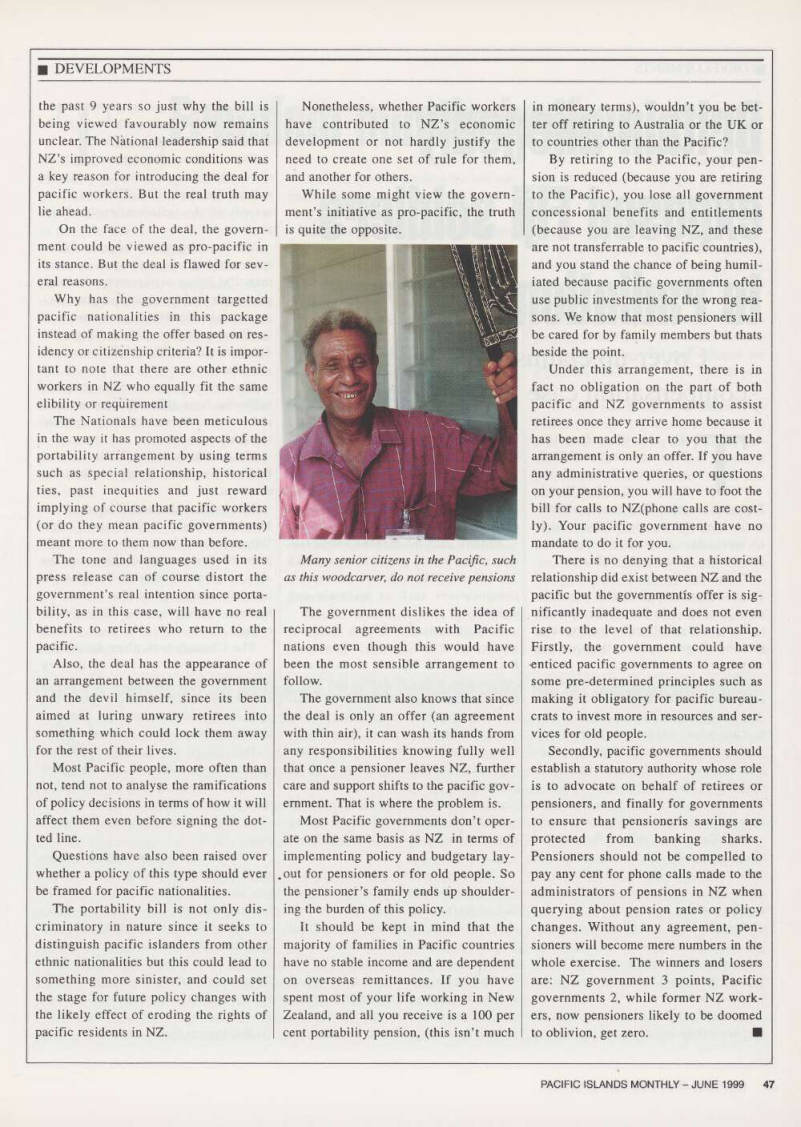
Many senior citizens in the Pacific, such as this woodcarver, do not receive pensions