Much ado about nothing?
pp. 44-45 · Read in the full issue
By Michael Held
SCIENCE, thanks to DNA testing, is pretty clear now on who Polynesians are, where they came from and the nature of their link with South American Indians.
But some wacky people still insist on trying to demonstrate the complete ly pointless, and none more so than the effort behind the Chilean raft Mata Rangi II - or "Eyes of Paradise".
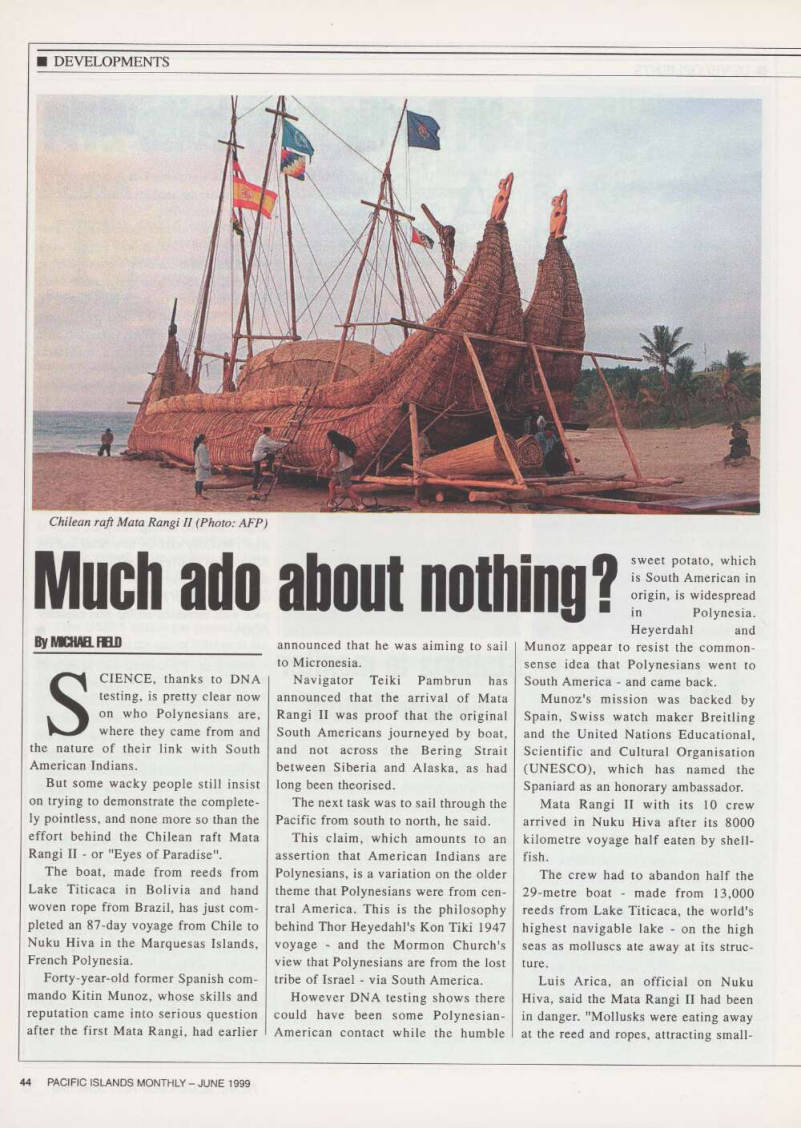
The boat, made from reeds from Lake Titicaca in Bolivia and hand woven rope from Brazil, has just com pleted an 87-day voyage from Chile to Nuku Hiva in the Marquesas Islands, French Polynesia.
Forty-year-old former Spanish com mando Kitin Munoz, whose skills and reputation came into serious question after the first Mata Rangi, had earlier
announced that he was aiming to sail to Micronesia.
Navigator Teiki Pambrun has announced that the arrival of Mata Rangi II was proof that the original South Americans journeyed by boat, and not across the Bering Strait between Siberia and Alaska, as had long been theorised.
The next task was to sail through the Pacific from south to north, he said.
This claim, which amounts to an assertion that American Indians are Polynesians, is a variation on the older theme that Polynesians were from cen tral America. This is the philosophy behind Thor Heyedahl's Kon Tiki 1947 voyage -- and the Mormon Church's view that Polynesians are from the lost tribe of Israel - via South America.
However DNA testing shows there could have been some Polynesian- American contact while the humble
sweet potato, which is South American in origin, is widespread in Polynesia.
Heyerdahl and
Munoz appear to resist the common sense idea that Polynesians went to South America - and came back.
Munoz's mission was backed by Spain, Swiss watch maker Breitling and the United Nations Educational, Scientific and Cultural Organisation (UNESCO), which has named the Spaniard as an honorary ambassador.
Mata Rangi II with its 10 crew arrived in Nuku Hiva after its 8000 kilometre voyage half eaten by shell fish.
The crew had to abandon half the 29-metre boat - made from 13,000 reeds from Lake Titicaca, the world's highest navigable lake - on the high seas as molluscs ate away at its struc ture.
Luis Arica, an official on Nuku Hiva, said the Mata Rangi II had been in danger. "Mollusks were eating away at the reed and ropes, attracting small
Chilean raft Mata Rangi II (Photo: AFP)
er fishes and consequently sharks, adding to the danger".
Munoz decided to cut loose half the boat on the high seas because they were in danger of losing everything.
Because the boat was a solid piece constructed from bundles of reeds bound together, it floated even after part was cut away.
"There will be a review of what is left of the boat to decide whether the Mata Rangi II can continue with the aim of reaching Asia," Mendoza said.
In 1997 Munoz went to Rapa Nui or Easter Island and built a similar craft, Mata Rangi, from reeds there.
Ironically it got so heavy while being built that modern technology was needed to launch it.
It sailed for Pitcairn on May 4 but four days later the 11 man crew found they had two stowaways, including a man wanted for rape and robbery.
On May 12 radio contact with the raft was lost. Twenty days after depar ture, and just 340 kilometres out from Rapa Nui, the boat broke up.
The Chilean Armada training ship Esmeralda found her, lying submerged with water coming in the hole where the mast had been.
Esmeralda's crew noted the 13 on board the raft had been "prisoners of fear".
Now Munoz has proven again it is possible to drift from one point to another in the South Pacific - some thing that everybody knew anyway.
Its puzzling that nobody takes much interest in the other great migration across the same waters. That was the enslaving, by South Americans, of hundreds of Polynesians. They robbed atolls in what is now Tokelau, the Cook Islands, Tuvalu and Kiribati, and took them last century to South America where they disappeared, for ever.
UNESCO and the Spanish
Government might find establishing
the fate of those people much more useful than Mata Rangi style stunts which show nothing. ■