PNG shows signs of recovery
p. 42 · Read in the full issue
By Sam Vulum
THE US$3.5 billion Papua
New Guinea-Queensland gas pipeline and the US$3B3 million Ramu cobalt and nickel projects are expected to contribute significantly to the projected recovery of the struggling PNG economy.
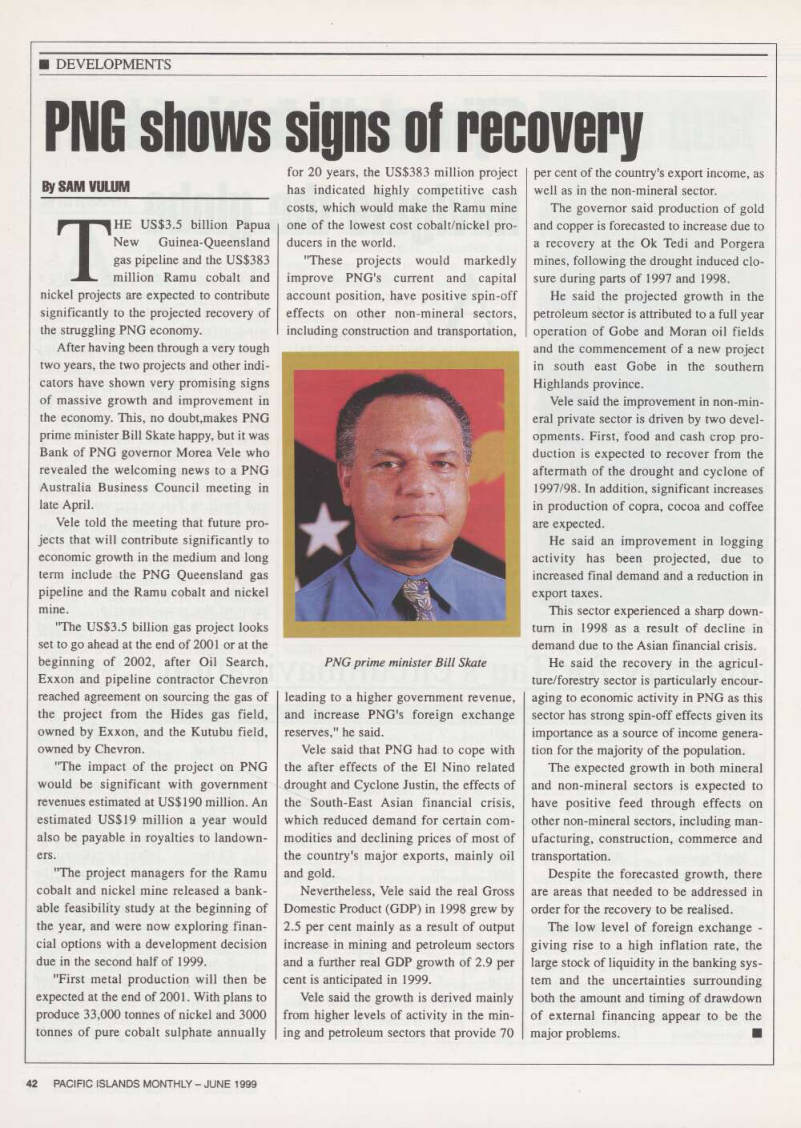
After having been through a very tough two years, the two projects and other indi cators have shown very promising signs of massive growth and improvement in the economy. This, no doubt,makes PNG prime minister Bill Skate happy, but it was Bank of PNG governor Morea Vele who revealed the welcoming news to a PNG Australia Business Council meeting in
late April.
Vele told the meeting that future pro jects that will contribute significantly to economic growth in the medium and long term include the PNG Queensland gas pipeline and the Ramu cobalt and nickel mine.
"The US$3.5 billion gas project looks set to go ahead at the end of 2001 or at the beginning of 2002, after Oil Search, Exxon and pipeline contractor Chevron reached agreement on sourcing the gas of the project from the Hides gas field, owned by Exxon, and the Kutubu field, owned by Chevron.
"The impact of the project on PNG would be significant with government revenues estimated at US$l9O million. An estimated US$l9 million a year would also be payable in royalties to landown ers.
"The project managers for the Ramu cobalt and nickel mine released a bank able feasibility study at the beginning of the year, and were now exploring finan cial options with a development decision due in the second half of 1999.
"First metal production will then be expected at the end of 2001. With plans to produce 33,000 tonnes of nickel and 3000 tonnes of pure cobalt sulphate annually
for 20 years, the US$3B3 million project has indicated highly competitive cash costs, which would make the Ramu mine one of the lowest cost cobalt/nickel pro ducers in the world.
"These projects would markedly improve PNG's current and capital account position, have positive spin-off effects on other non-mineral sectors, including construction and transportation,
leading to a higher government revenue, and increase PNG's foreign exchange reserves," he said.
Vele said that PNG had to cope with the after effects of the El Nino related drought and Cyclone Justin, the effects of the South-East Asian financial crisis, which reduced demand for certain com modities and declining prices of most of the country's major exports, mainly oil and gold.
Nevertheless, Vele said the real Gross Domestic Product (GDP) in 1998 grew by 2.5 per cent mainly as a result of output increase in mining and petroleum sectors and a further real GDP growth of 2.9 per cent is anticipated in 1999.
Vele said the growth is derived mainly from higher levels of activity in the min ing and petroleum sectors that provide 70
per cent of the country's export income, as well as in the non-mineral sector.
The governor said production of gold and copper is forecasted to increase due to a recovery at the Ok Tedi and Porgera mines, following the drought induced clo sure during parts of 1997 and 1998.
He said the projected growth in the petroleum sector is attributed to a full year operation of Gobe and Moran oil fields and the commencement of a new project in south east Gobe in the southern
Highlands province.
Vele said the improvement in non-min eral private sector is driven by two devel opments. First, food and cash crop pro duction is expected to recover from the aftermath of the drought and cyclone of 1997/98. In addition, significant increases in production of copra, cocoa and coffee are expected.
He said an improvement in logging activity has been projected, due to increased final demand and a reduction in export taxes.
This sector experienced a sharp down turn in 1998 as a result of decline in demand due to the Asian financial crisis.
He said the recovery in the agricul ture/forestry sector is particularly encour aging to economic activity in PNG as this sector has strong spin-off effects given its importance as a source of income genera tion for the majority of the population.
The expected growth in both mineral and non-mineral sectors is expected to have positive feed through effects on other non-mineral sectors, including man ufacturing, construction, commerce and transportation.
Despite the forecasted growth, there are areas that needed to be addressed in order for the recovery to be realised.
The low level of foreign exchange giving rise to a high inflation rate, the large stock of liquidity in the banking sys tem and the uncertainties surrounding both the amount and timing of drawdown of external financing appear to be the major problems. ■
PNG prime minister Bill Skate