America's Cup spin
pp. 38-39 · Read in the full issue
off for the Pacific
By Michael Held
PREPARE yourself for a billionaire, or two, at an island near you later this year.
When sport’s oldest trophy, the America’s Cup, goes on the line, in Auckland later this year some very, very rich people want to come.
They are coming on their “super
yachts” and already around 100 of them have booked space at the spe cial parking facility for the elite in the America’s Cup village in down town Auckland.
Word on the docks has it that the cruising grounds of Vanuatu, Fiji and Vavau in Tonga are set to cash in on them too.
If Fiji’s marina and ship repair facilities can get their act together there will also be big business as New Zealand’s boat yards are all booked out by the famous and the rich.
What is clear about the super yacht business and the America’s Cup is how different most of it is from what is usually seen on South Pacific waters. These boats are sel dom seen in this part of the world; they hang out in the Caribbean and the Mediterranean.
They do not have run-abouts for getting people on and off; they have flight-decks and a helicopter or two for that. And they do not make long voyages because, paradoxically, their owners are not very much into sailing (in contrast, for example.
Rupert Murdoch whose yacht Morning Glory is well known in the Pacific - and which is a real sailing yacht).
Most of the boats coming for the Cup will be lifted onto the deck of a huge purpose built ship that will bring a fleet at a time of super yachts.
The regatta comes in two parts.
On October 18 the starter’s gun fires on what will be the start of up to 400 one-on-one match races involving 15 syndicates from 10 countries. They are racing for the Louis Vuitton Cup. Whoever holds that gets the right to take on Team New Zealand and the Royal New
Zealand Yacht Squadron who are the holders of the
America’s Cup.
The clash known as “The Match” - is the best of nine races
beginning on
February 19.
The three race courses out in Auckland’s
Hauraki Gulf are likely to become the global television event of the millennium season. All the races will be timed to the United States East Coast prime time evening tele vision audience.
Thanks to new rules and a promised end to smoked-filled jury rooms adjudicating arcane rights-of
way the event is shaping up as a television and Internet visual feast.
High technology will not only be
on the boats - they will be pitched up to viewers in ways never seen before.
A software package has been developed which, viewed on the Internet and tied in with a CD-ROM,
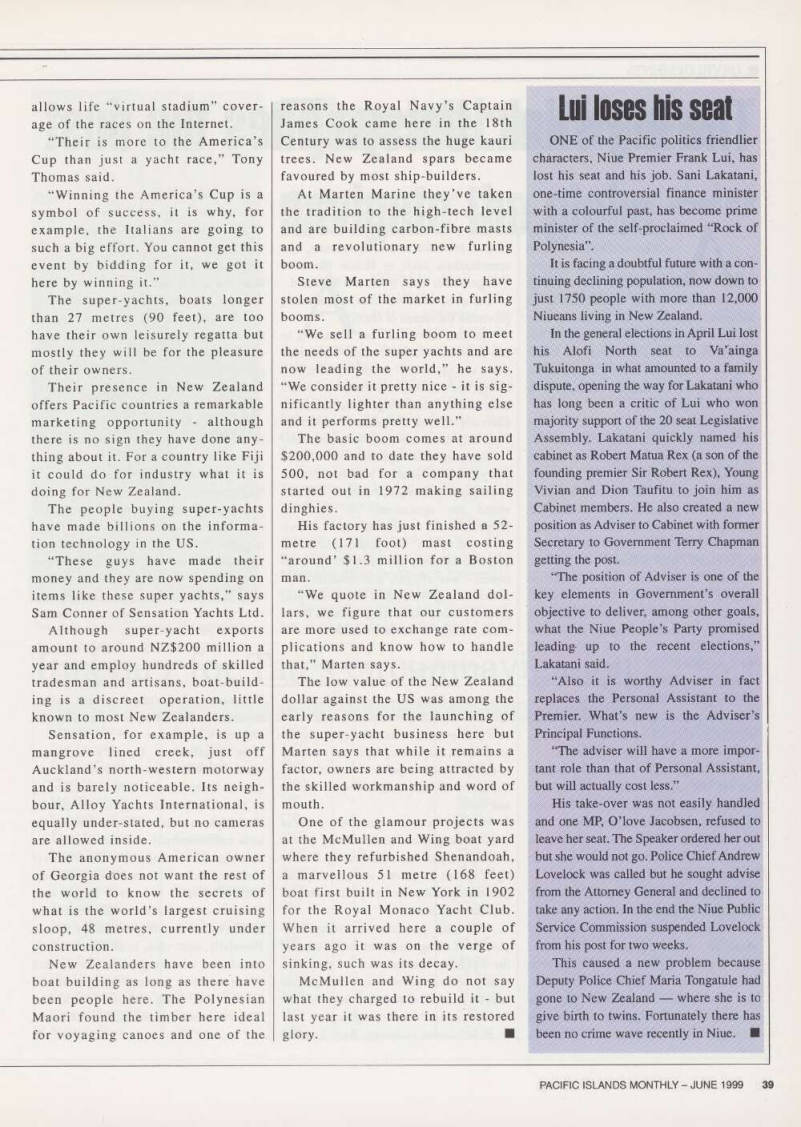
Dennis Connor’s Team New Zealand is the current America’s Cup holder and is ready to take on all challengers
allows life “virtual stadium” cover age of the races on the Internet.
“Their is more to the America’s Cup than just a yacht race,” Tony Thomas said.
“Winning the America’s Cup is a symbol of success, it is why, for example, the Italians are going to such a big effort. You cannot get this event by bidding for it, we got it here by winning it.”
The super-yachts, boats longer
than 27 metres (90 feet), are too have their own leisurely regatta but mostly they will be for the pleasure of their owners.
Their presence in New Zealand offers Pacific countries a remarkable marketing opportunity - although there is no sign they have done any thing about it. For a country like Fiji it could do for industry what it is doing for New Zealand.
The people buying super-yachts
have made billions on the informa tion technology in the US.
“These guys have made their money and they are now spending on items like these super yachts,” says Sam Conner of Sensation Yachts Ltd.
Although super-yacht exports amount to around NZ$2OO million a year and employ hundreds of skilled tradesman and artisans, boat-build ing is a discreet operation, little known to most New Zealanders.
Sensation, for example, is up a mangrove lined creek, just off Auckland’s north-western motorway and is barely noticeable. Its neigh bour, Alloy Yachts International, is equally under-stated, but no cameras are allowed inside.
The anonymous American owner of Georgia does not want the rest of the world to know the secrets of what is the world’s largest cruising sloop, 48 metres, currently under construction.
New Zealanders have been into boat building as long as there have been people here. The Polynesian Maori found the timber here ideal for voyaging canoes and one of the
reasons the Royal Navy’s Captain James Cook came here in the 18th Century was to assess the huge kauri trees. New Zealand spars became favoured by most ship-builders.
At Marten Marine they’ve taken the tradition to the high-tech level and are building carbon-fibre masts and a revolutionary new furling boom.
Steve Marten says they have stolen most of the market in furling booms.
“We sell a furling boom to meet the needs of the super yachts and are now leading the world,” he says.
“We consider it pretty nice - it is sig nificantly lighter than anything else and it performs pretty well.”
The basic boom comes at around $200,000 and to date they have sold 500, not bad for a company that started out in 1972 making sailing
dinghies.
His factory has just finished a 52metre (171 foot) mast costing “around’ $1.3 million for a Boston man.
“We quote in New Zealand dol lars, we figure that our customers are more used to exchange rate com plications and know how to handle that,” Marten says.
The low value of the New Zealand dollar against the US was among the early reasons for the launching of the super-yacht business here but Marten says that while it remains a factor, owners are being attracted by the skilled workmanship and word of mouth.
One of the glamour projects was at the McMullen and Wing boat yard where they refurbished Shenandoah, a marvellous 51 metre (168 feet) boat first built in New York in 1902 for the Royal Monaco Yacht Club.
When it arrived here a couple of years ago it was on the verge of sinking, such was its decay.
McMullen and Wing do not say what they charged to rebuild it - but last year it was there in its restored
glory. ■