Plumbing the Pacific
pp. 14-16 · Read in the full issue
for a cure far cancer
By Darrell Nicholson
IN a two-story waterfront lab in the Micronesian island nation of Palau, marine biologist Dr. Patrick Colin is undertaking what he describes as the “most important job I’ll ever do.”
Under a contract with the United States National Cancer Institute, Colin and his coworkers at the Coral Reef Research Foundation explore reefs in the Indian and
Pacific Oceans looking for slimy, spineless
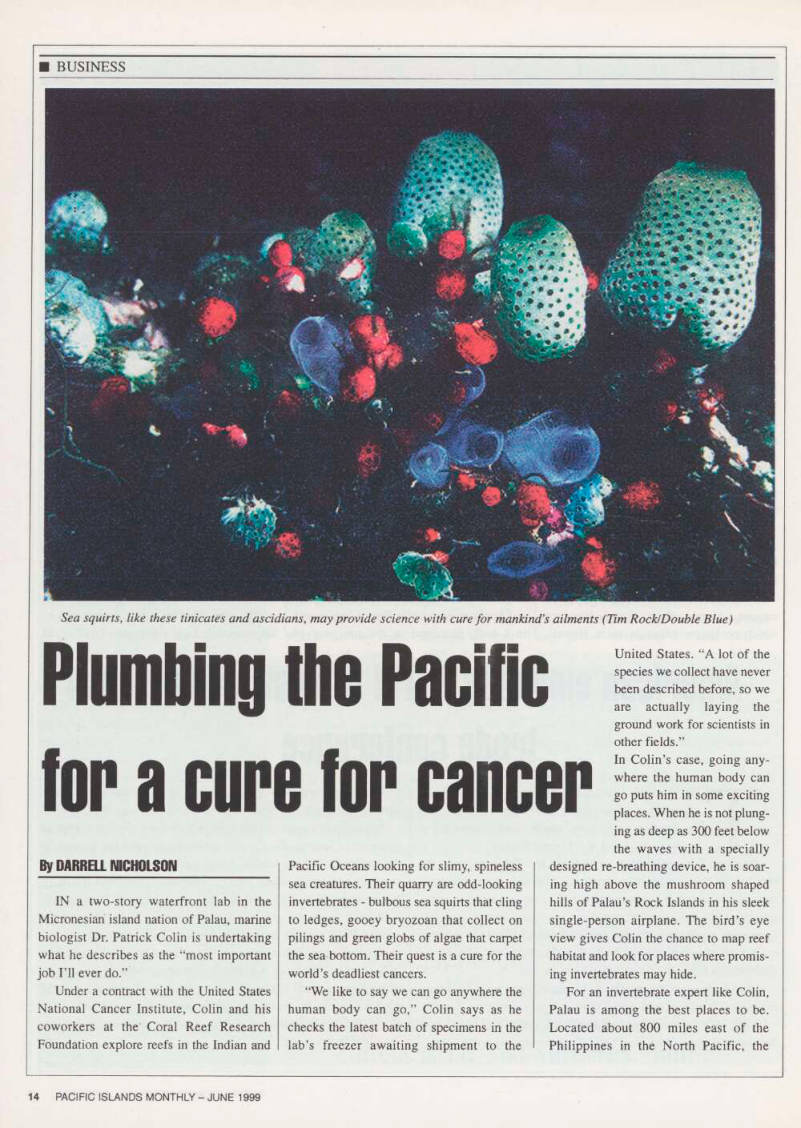
sea creatures. Their quarry are odd-looking invertebrates - bulbous sea squirts that cling to ledges, gooey bryozoan that collect on pilings and green globs of algae that carpet the sea bottom. Their quest is a cure for the world’s deadliest cancers.
“We like to say we can go anywhere the human body can go,” Colin says as he checks the latest batch of specimens in the lab’s freezer awaiting shipment to the
United States. “A lot of the species we collect have never been described before, so we are actually laying the ground work for scientists in other fields.”
In Colin’s case, going any where the human body can go puts him in some exciting places. When he is not plung ing as deep as 300 feet below the waves with a specially
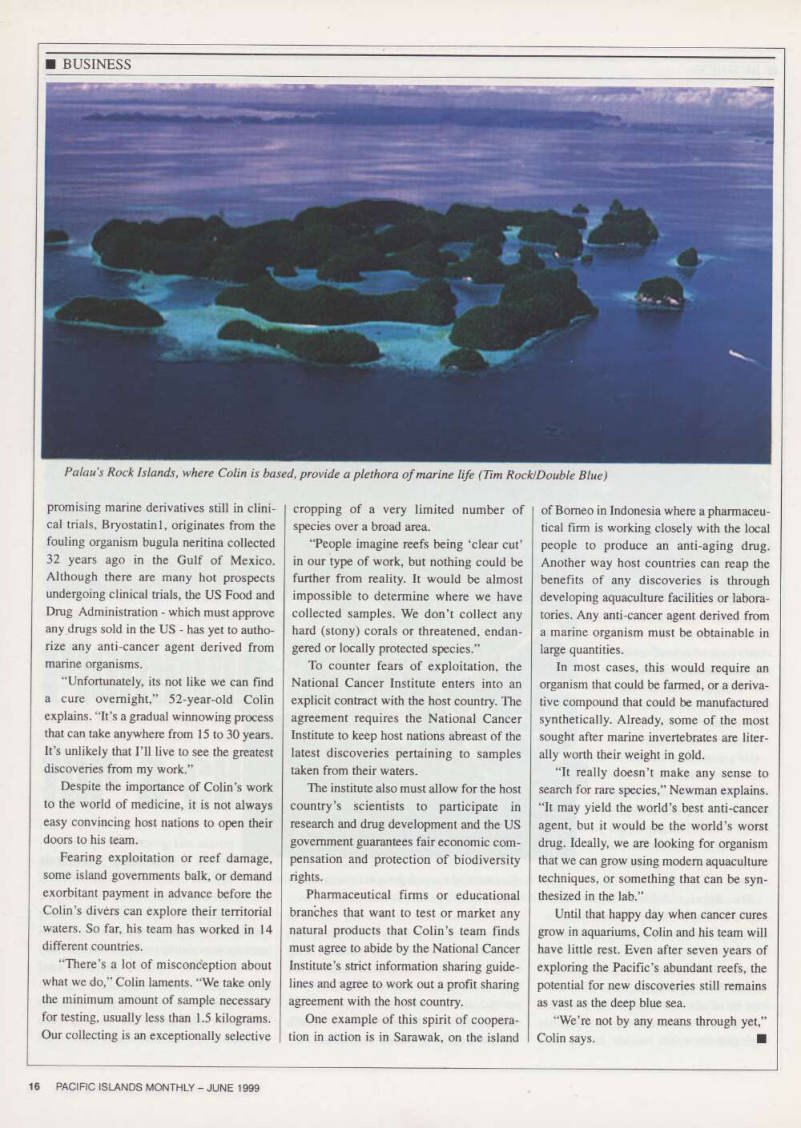
designed re-breathing device, he is soar ing high above the mushroom shaped hills of Palau’s Rock Islands in his sleek single-person airplane. The bird’s eye view gives Colin the chance to map reef habitat and look for places where promis ing invertebrates may hide.
For an invertebrate expert like Colin, Palau is among the best places to be.
Located about 800 miles east of the Philippines in the North Pacific, the
Sea squirts, like these tinicates and ascidians, may provide science with cure for mankind’s ailments (Tim Rock/Double Blue)
Republic of Palau is the westernmost island group in Micronesia. The main archipelago, centered at about 7 degrees 30 minutes north and 134 degrees 30 minutes east, is a string of more than 350 islands stretching 125 miles north and south. Lying about 300 miles to the Southwest are seven other small islands that are part of Palau, the Sonsorol Islands, Merir, Pulo Anna, Tobi and Helen’s Reef.
Just seven of Palau’s larger islands are inhabited. Population in this former US Trust Territory is about 18,000 people, most of whom live on the main island of Koror where the capital lies. Rated among the world’s greatest diving destination, Palau is
also famous for its fabled Rock Islands, more than 200 limestone islets that sprout like nearly identi cal mushrooms from a sapphire
lagoon.
For three years, the Coral Reef Research Foundation was based several hundred miles east of Palau in Chuuk, an island state in the Federated States of Micronesia.
Although the group’s work there yielded many new discoveries, the move to Palau in 1995 has opened a whole new world of discoveries.
Palau lies not far from the world’s center for marine biodiversity, a tri angle of ocean including parts of the Philippines, Indonesia and Papua New Guinea that is home to more different marine species than any spot on earth.
“We wanted to be somewhere where we could collect very thor oughly in one area and then go out and collect in other areas,” Colin says. “The biodiversity in this part of the Pacific is unlike anywhere.
We discover new organisms on almost a daily basis.”
The impetus behind Colin’s search is simple; the world needs
new drugs. With each passing year bacteri um evolve ways to fight science’s best weapons. Doctors are anxious for new com pounds that can attack cancer, AIDS and a long list of other diseases that have no cure.
The search for nature’s remedies has exploded since that historic day in 1928
when mold blown through an open window stopped staphylococcus bacteria from growing in a petri dish - an accident that led to Alexander Fleming’s discovery of peni cillin. In the latest wave of land-bound exploration, desperate researchers are combing landfills, septic tanks, and swamps for sources of new cures.
In the Pacific, long before Fleming’s dis covery, native plants were - and still are - an important source of traditional medicine.
Some familiar plants like kava are being used in prescription medications and herbal remedies in the US and Europe.
In the field of cancer research, the yew tree - found in the North America’s Pacific
Northwest - is the source of the biggest suecess story so far. Taxol, a synthetic drug based on chemical structures found in the bark of the yew tree, is now routinely prescribed to treat breast cancer. But as the potential for new discoveries in the world’s terrestrial realm gradually diminishes, sci-
enlists are turning their sights on the earth’s greatest wellspring of species - its oceans.
And what better place to look than the Pacific Ocean, the world’s oldest and largest ocean, a submarine world with a wealth of species that stretches beyond imagination?
Some scientists now believe that as much as 90 percent of the species found in the world’s reefs have yet to be described.
That would raise the relatively small sum of 93,000 known reef species to as many as 9 million. The question for cure-seekers like Colin then becomes: “Where do you start?”
For Dr. David Newman, Colin’s project supervisor at the National Cancer Institute,
the answer is simple. If it is fat, col orful and vulnerable, Newman wants its secret to survival. In the case of many invertebrates, that secret to survival means toxins.
“Competition on the coral reef is chemical warfare at its highest level,” Newman explains. “Basically all these organisms are fighting for a toehold on the reef. So if we see something like a solitary, brightly colored sponge or sea squirt, this organism probably has some form of chemical defense to knock off their
competitors.”
The trick is finding a toxin that is potent enough to wipe out cancer cells, but not so lethal that it destroys the healthy cells around it. The sam ples Colin sends to the National Cancer Institute’s Natural Products Branch in Frederick, Maryland are rigorously tested against 60 of the world’s deadliest forms of cancer and leukemia.
Other labs around the world - both private and government sponsored launch marine-based compounds
against everything from harmless
sun blisters to deadly diseases like AIDS. “Though we find anti-cancer
activity in new plants, the chemical struc tures are very similar to those we’ve already found,” Newman explains. “We don’t need another Taxol. We want something that works like Taxol.” But the path from sea bottom to pharmacy shelves can take decades. For example, one of the most
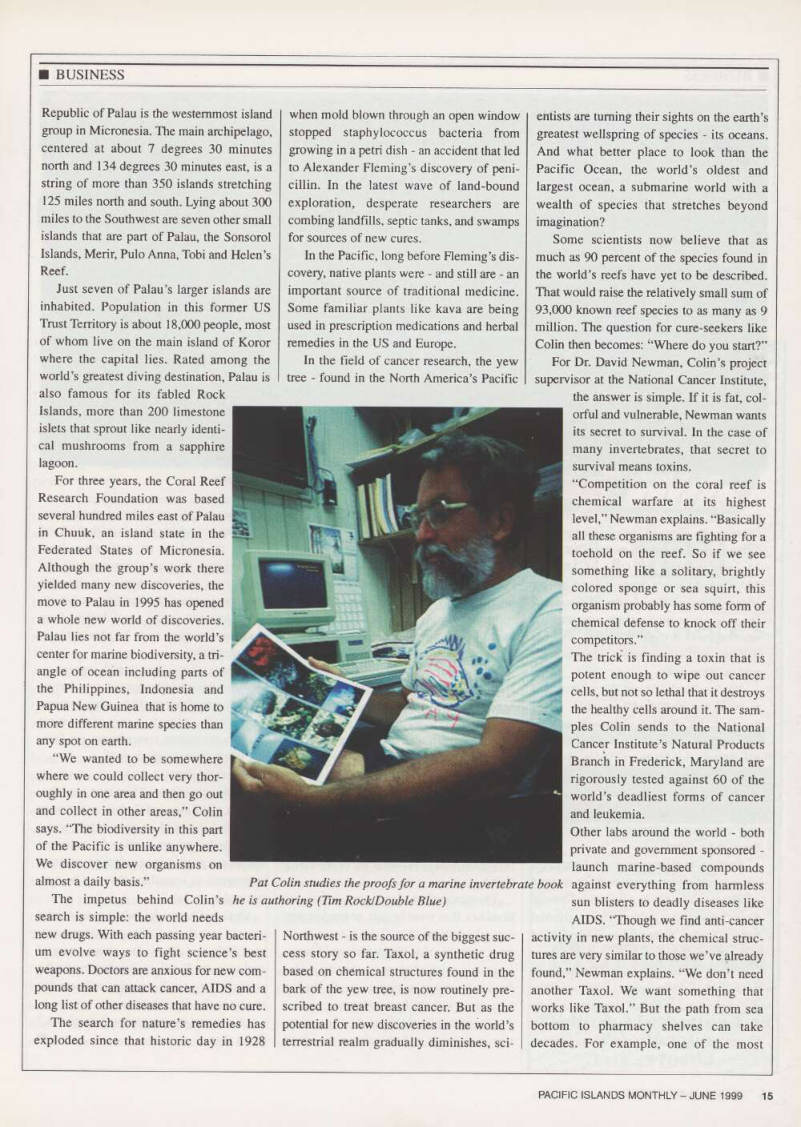
Pat Colin studies the proofs for a marine invertebrate book he is authoring (Tim Rock/Double Blue)
promising marine derivatives still in clini cal trials, Bryostatinl, originates from the fouling organism bugula neritina collected 32 years ago in the Gulf of Mexico.
Although there are many hot prospects undergoing clinical trials, the US Food and Drug Administration - which must approve any drugs sold in the US - has yet to autho rize any anti-cancer agent derived from marine organisms.
“Unfortunately, its not like we can find a cure overnight,” 52-year-old Colin explains. “It’s a gradual winnowing process that can take anywhere from 15 to 30 years.
It’s unlikely that I’ll live to see the greatest discoveries from my work.”
Despite the importance of Colin’s work to the world of medicine, it is not always easy convincing host nations to open their doors to his team.
Fearing exploitation or reef damage,
some island governments balk, or demand exorbitant payment in advance before the Colin’s divers can explore their territorial waters. So far, his team has worked in 14 different countries.
“There’s a lot of misconception about what we do,” Colin laments. “We take only the minimum amount of sample necessary for testing, usually less than 1.5 kilograms.
Our collecting is an exceptionally selective
cropping of a very limited number of species over a broad area.
“People imagine reefs being ‘clear cut’
in our type of work, but nothing could be further from reality. It would be almost impossible to determine where we have collected samples. We don’t collect any hard (stony) corals or threatened, endan gered or locally protected species.”
To counter fears of exploitation, the National Cancer Institute enters into an explicit contract with the host country. The agreement requires the National Cancer Institute to keep host nations abreast of the latest discoveries pertaining to samples taken from their waters.
The institute also must allow for the host country’s scientists to participate in research and drug development and the US government guarantees fair economic com
pensation and protection of biodiversity
rights.
Pharmaceutical firms or educational branches that want to test or market any natural products that Colin’s team finds must agree to abide by the National Cancer Institute’s strict information sharing guide lines and agree to work out a profit sharing agreement with the host country.
One example of this spirit of coopera tion in action is in Sarawak, on the island
of Borneo in Indonesia where a pharmaceu tical firm is working closely with the local
people to produce an anti-aging drug.
Another way host countries can reap the benefits of any discoveries is through developing aquaculture facilities or labora tories. Any anti-cancer agent derived from a marine organism must be obtainable in large quantities.
In most cases, this would require an organism that could be farmed, or a deriva tive compound that could be manufactured synthetically. Already, some of the most sought after marine invertebrates are liter ally worth their weight in gold.
“It really doesn’t make any sense to search for rare species,” Newman explains.
“It may yield the world’s best anti-cancer agent, but it would be the world’s worst drug. Ideally, we are looking for organism that we can grow using modem aquaculture techniques, or something that can be syn thesized in the lab.”
Until that happy day when cancer cures grow in aquariums, Colin and his team will have little rest. Even after seven years of exploring the Pacific’s abundant reefs, the potential for new discoveries still remains as vast as the deep blue sea.
“We’re not by any means through yet,”
Colin says. ■
Palau’s Rock Islands, where Colin is based, provide a plethora of marine life (Tim Rock/Double Blue)