Kiribati has big challenge ahead
p. 12 · Read in the full issue
THE Kiribati gov
ernment must!
translate policy j commitments into effective policy implementa-| tion, according to the Asian
Development Bank.
It says that the medium-term strategy, adopted in 1997, identi fied three macro-economic issues: I lack of almost any growth in perl capita GDP since independence in * 1979, the need to find employment for the 60 per cent increase in the
workforce that will occur over the next 15 years, and the government’s ability to sus tain the growth in public services.
ADB says strategies to address those issues were reducing the size of the central
government, reforming public enterprises,
and facilitating private sector development.
It says that a number of Pacific countries had adopted such a strategic framework but in the past Kiribati authorities had been slow to follow their example.
Kiribati has a small population of around 80,000, but they remain amongst the poor est in Pacific countries, with a per capita GDP of $670 at the end of 1997.
That same year per capita gross national product (GNP) was higher at $B9O because of revenues from fishing licence fees, remit tances from overseas workers, and invest ment income from the assets of the Revenue Stabilisation Reserve Fund.
The Fund was originally built up from phosphate mining royalties, and now con sists of equities and bonds invested in sev eral different international capital markets.
It is valued at about eight times the level of GDP. Kiribati has been in the news lately
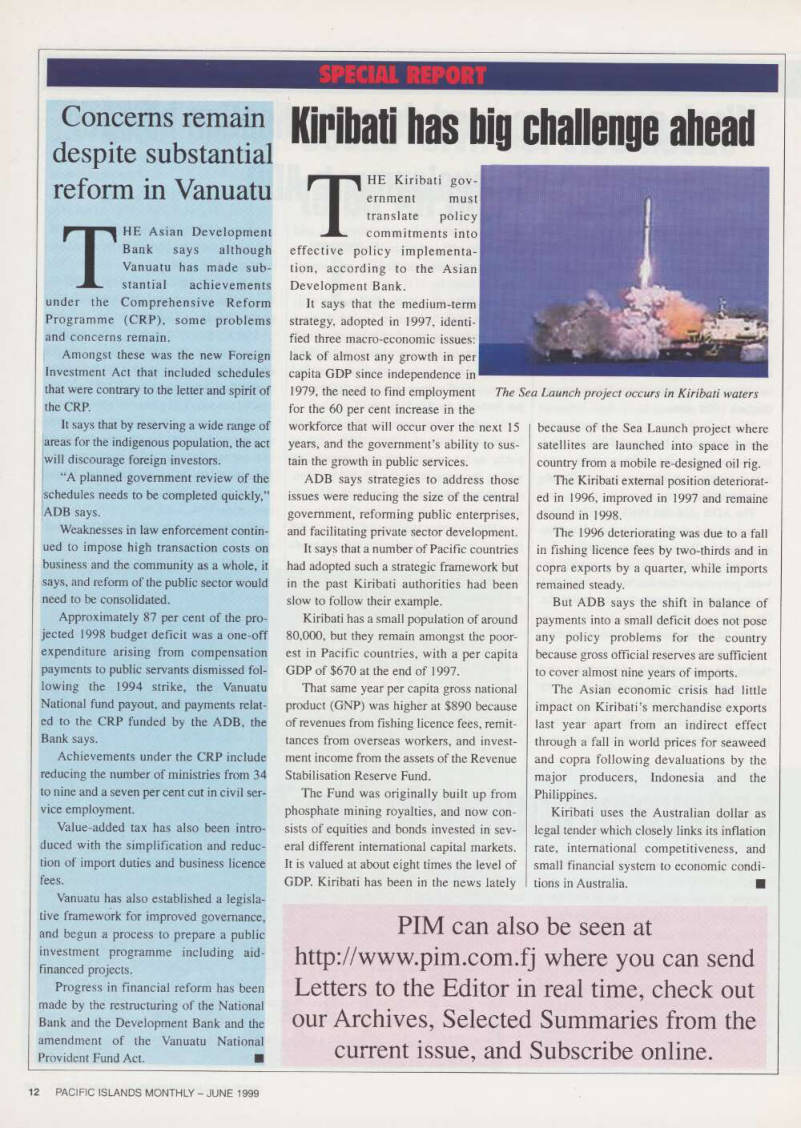
because of the Sea Launch project where satellites are launched into space in the country from a mobile re-designed oil rig.
The Kiribati external position deteriorat ed in 1996, improved in 1997 and remaine dsound in 1998.
The 1996 deteriorating was due to a fall in fishing licence fees by two-thirds and in copra exports by a quarter, while imports remained steady.
But ADB says the shift in balance of payments into a small deficit does not pose any policy problems for the country because gross official reserves are sufficient to cover almost nine years of imports.
The Asian economic crisis had little impact on Kiribati’s merchandise exports last year apart from an indirect effect through a fall in world prices for seaweed and copra following devaluations by the major producers, Indonesia and the Philippines.
Kiribati uses the Australian dollar as legal tender which closely links its inflation rate, international competitiveness, and small financial system to economic condi tions in Australia. ■
The Sea Launch project occurs in Kiribati waters