Cruising with children
pp. 52-53 · Read in the full issue
Story and pictures by SALLY ANDREWS
THERE are many books about sailing, but few written by women who have raised a family at sea. I recently had the pleasure of meeting Elizabeth Thurston (aboard Drina in New Caledonia) and Lesley Black (in Tasmania) - two Australian ‘moms’ who cruised with their children and survived to tell the tale! Spliced between adventures and misadven tures, their first-hand experiences pro vide insight into the health-care, safe ty, education and amusement of chil dren at sea.
Elizabeth Thurston’s book Dolphins at Sunset (Pan McMillan Publishers) takes us
along on the family’s four-year circumnav
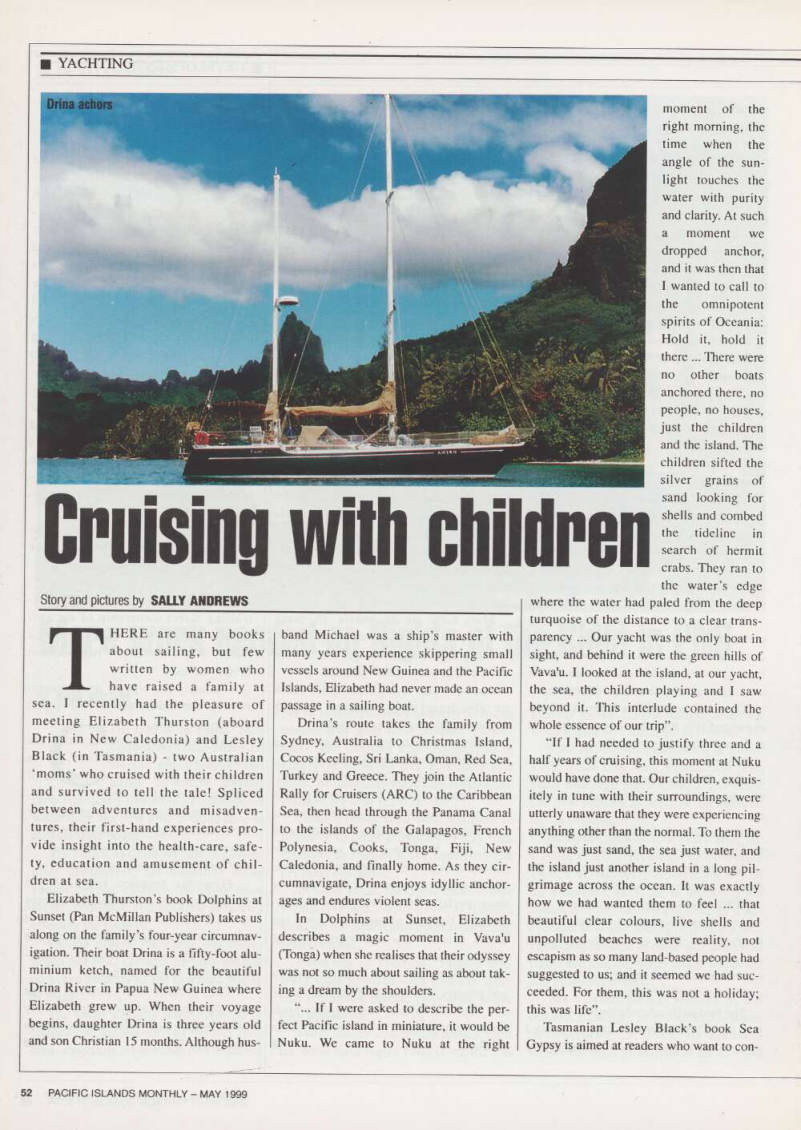
igation. Their boat Drina is a fifty-foot alu minium ketch, named for the beautiful Drina River in Papua New Guinea where Elizabeth grew up. When their voyage begins, daughter Drina is three years old and son Christian 15 months. Although hus
band Michael was a ship’s master with many years experience skippering small vessels around New Guinea and the Pacific Islands, Elizabeth had never made an ocean passage in a sailing boat.
Drina’s route takes the family from Sydney, Australia to Christmas Island, Cocos Keeling, Sri Lanka, Oman, Red Sea, Turkey and Greece. They join the Atlantic Rally for Cruisers (ARC) to the Caribbean Sea, then head through the Panama Canal to the islands of the Galapagos, French
Polynesia, Cooks, Tonga, Fiji, New
Caledonia, and finally home. As they cir cumnavigate, Drina enjoys idyllic anchor ages and endures violent seas.
In Dolphins at Sunset, Elizabeth describes a magic moment in Vava'u (Tonga) when she realises that their odyssey was not so much about sailing as about tak ing a dream by the shoulders.
“... If I were asked to describe the per fect Pacific island in miniature, it would be Nuku. We came to Nuku at the right
moment of the
right morning, the
time when the angle of the sun light touches the water with purity and clarity. At such a moment we dropped anchor, and it was then that I wanted to call to
the omnipotent
spirits of Oceania: Hold it, hold it there ... There were no other boats anchored there, no people, no houses, just the children and the island. The children sifted the silver grains of sand looking for shells and combed the tideline in search of hermit crabs. They ran to the water’s edge
where the water had paled from the deep turquoise of the distance to a clear trans parency ... Our yacht was the only boat in sight, and behind it were the green hills of Vava'u. I looked at the island, at our yacht, the sea, the children playing and I saw beyond it. This interlude contained the whole essence of our trip”.
“If I had needed to justify three and a half years of cruising, this moment at Nuku would have done that. Our children, exquis itely in tune with their surroundings, were utterly unaware that they were experiencing anything other than the normal. To them the sand was just sand, the sea just water, and the island just another island in a long pil grimage across the ocean. It was exactly how we had wanted them to feel ... that beautiful clear colours, live shells and unpolluted beaches were reality, not escapism as so many land-based people had suggested to us; and it seemed we had suc ceeded. For them, this was not a holiday; this was life”.
Tasmanian Lesley Black’s book Sea Gypsy is aimed at readers who want to con
Drina achors
vert their dreams of a cruising life into real ity. In 1981, Lesley put to sea with her hus band Geoffrey and two small children, Claire and Matthew. For nine years, Lesley’s family lived aboard thirteen-meter Thorendor, a 25 tonne cruising yacht, as they explored Australia’s eastern coastline and the southwest Pacific.
Joining Lesley and her family as they sail to New Zealand, we can almost taste the sea. “The night was black, the boat tossed about like a toy as invisible mountainous waves swept up to and under us. In the beam of the torch’s white light ... ghostly faces were framed under shining, salt-laden hair. Cold fingers grabbed at the Happing mains’l, gained control over its struggling form and forced it into obedience at the fourth reefing point...”
Lesley enjoyed life aboard Thorendor, relishing the freedom of the seas and the attendant joy of self-sufficiency.
She (not her husband) is one with gypsy blood and realises their first priority is to gather some capital: money to pay for boat repairs, replacement sails and rigging, pro visions, slippage fees and materials for annual anti-louling, fuel and engine mainte nance.
So she and husband Geoffrey spend two years working for the Australian Lighthouse Service, stationed at Swan Island
Lighthouse, South
Bruny, Eddystone
Point, and finally Maatsuyker Island.
Later, as their cruising adventures extend into the Pacific Islands (from New Zealand to Tonga, Fiji and New Caledonia), Lesley’s family finds itself accepted as a member of the great interna tional cruising frater nity and welcomed by indigenous island peoples. Close calls with cyclones and a near shipwreck pro vide reality checks.
Part II of Sea Gypsy includes prac tical suggestions on how to ‘Break Free to Cruise’. It proposes reasons to go, the fea tures of a cruising yacht, safety equip ment, cruising costs, provisioning, general galley ideas, and
advice on both raising children aboard and trading/bartering in the islands. Lesley’s love of the sea is ever-present in her book. “The sea the sea - it means so much to me. I love the immensity and solitude of the sea, God’s creation. It lures, it glistens, it sparkles, it calms me. It laps about one’s feet, gently and caressingly. It frightens me when it displays its anger with dark grey looks; whitecaps, tops turning over, threatening. At the same time I’m thrilled to the core, completely and compellingly overawed, sick with a deep welling love that bursts the heart and soul of me. I love the chal lenge of the sea that says: come with me, come with me! Where to? I don’t really care”.
Anyone, with or without children, who dreams of cruising, will enjoy
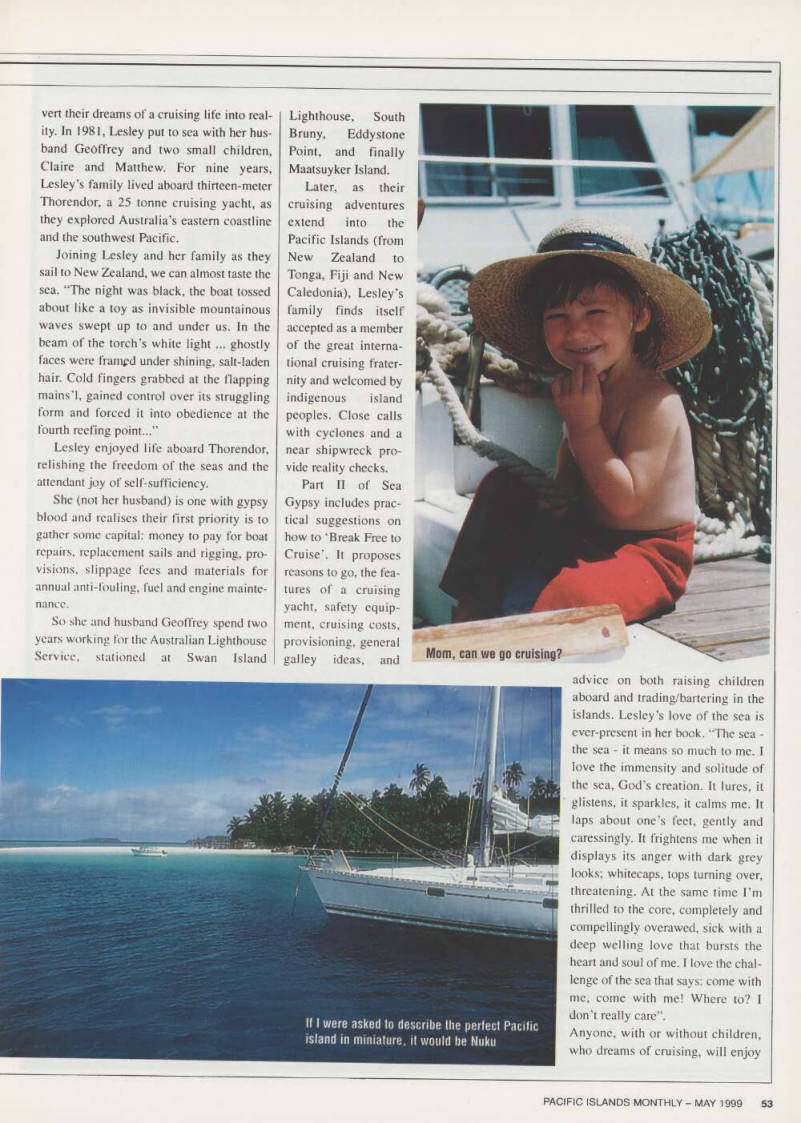
Mom, can we go cruising?
If I were asked to describe the perfect Pacific island in miniature, it would be Nuku