More work needed on Rights of the Child in PNG
pp. 50-51 · Read in the full issue
By Sam Vulum
CHILDREN in Papua New Guinea do come under all sorts of undue pressure and harsh treatment against their rights and freedoms like others the world over, but very little is being done to address their plight.
The Office of Child Welfare, a govern ment department, has identified many abuses against children, resulting from social, economic and political pressures affecting the country.
Among others, the office has estab lished that PNG children are often regard ed as the property of the extended family or clan.
The father’s family often exerts more control than the mother does the over chil dren, especially if the father dies or leaves
her or remarries. Many children do not or cannot live with their parents. Parents leave their children with grandparents or family in order to live elsewhere and work, or the father leaves the mother and children for long periods.
Some parents send their children to towns or to other provinces to stay with relatives or friends in the hope they can get good education.
In some cases, teenagers leave homes themselves and travel to urban centres looking for education, employment and entertainment.
Polygamy is common. Fathers may leave some children with wives in sepa rate and distant places, away from where they usually live.
These issues and others should form the basis for a report PNG is required to
provide to the United Nation under the UN’s Rights of Children Convention.
PNG ratified the Convention in March 1993. Since then there should have been many meetings, much research and study, and new policies to improve the situation for its children.
However, almost five years after the signing of the Convention in November 1998, PNG has yet to report to the UN on the progress it has made in improving the situation of its children and whether it has
changed laws and developed policies, pro
grams and projects to make sure that child rights are known, understood, respected and protected in PNG.
The Convention was adopted by the General Assembly of the United Nations on November 20, 1989. Its preamble recalls the basic principals of the UN and
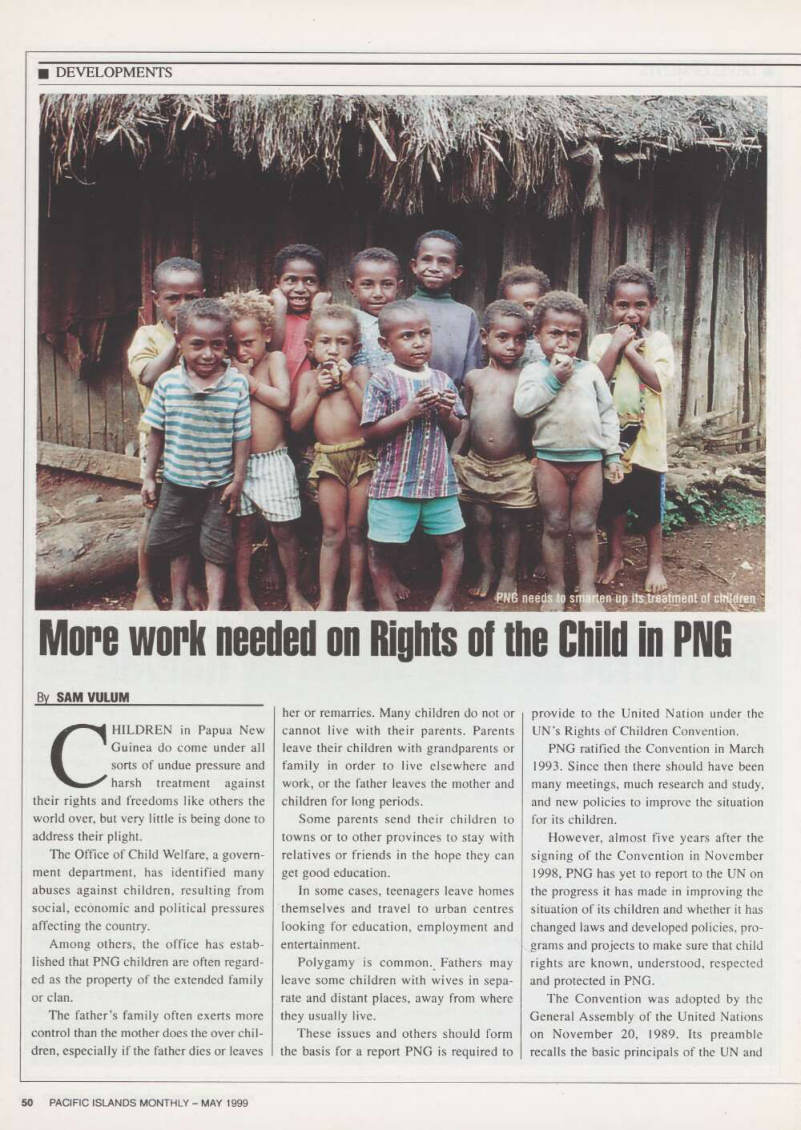
PNG needs to smarten up its treatment of children
specific provisions of certain relevant human rights treaties and proclamations.
It reaffirms that children, because of their vulnerability, need special care and protection, and it places special emphasis on the primary caring and protective responsibility of the family.
It also reaffirms the need for legal and other protection of the child before and after birth, the importance of respect for the cultural values of the child’s communi ty, and the vital role of international coop eration in securing children’s rights.
A working committee, comprising the Child Welfare Office, the Office of
Implementation and National Planning,
other government departments and non government agencies has just been formed, and is working together to prepare the first Country Report.
The committee is being supported by the UNICEF.
The Convention Rights of Child (CRC) committee has invited government depart ments, churches and non government organisations to present facts and figures to help it understand and write honestly and accurately about the rights of the chil dren in PNG.
The committee has also called on the general public all over PNG in villages, districts and provinces to provide facts, figures, stories and their honest view on the situation regarding the rights of children.
The CRC coordinator Betty Billy has expressed that PNG has fallen far behind in its reporting obligations.
“The first report is now three years overdue. Out of all countries, we are one of the three that have failed to produce a report,” she said.
Billy said periodic reports are due very five years after the initial report, or if the initial report is overdue, five years after the date the initial report was made.
“PNG needs to produce a report now. If we can submit that report by January 1999, to try to catch up on all other reviews, reforms, institution building that genuine commitment to and implementation of the convention entail,” Billy said.
She said political endorsement and sup port at the highest level is urgently needed to give full impact to these strategies and
mandate to the working committee to pro ceed with the production of the draft initial report on the behalf of the government of
Png.
In PNG, it used to be said that there are no unwanted children, and that the extend ed family would always love and provide, yet many children are mistreated in their adoptive homes, are out on their own in the streets, are working as cheap or unpaid domestic labourers.
There are also reports of newborn babies being dumped or sold and many teenage mothers birth who end up in hospi tal nurseries and adoption homes.
Many children do not get a chance to go to school. Some have to leave because they cannot pay fees, have to work at home or are being punished by parents or teachers.
Girls are often kept out of school.
Children are expected to work from an early age. Girls are usually expected to work more and harder than boys in the house, gardens, fishing, gathering, market ing, baby-sitting.
Some people seriously and cruelly over work young children in house and in gar dens. Others employ young people so that they can pay them less.
Many births are also unsafe. Too many mothers and newborn babies are dying.
Many children do not get immunised and die from preventable diseases.
Mothers with sick children and youth are often denied proper treatment at health facilities, and they die unnecessarily.
Many husbands prevent their wives from attending meetings, joining groups to learn more about child health and child care, or changing their behaviour to protect their health and the health of their families.
Children with disabilities often die at an early age. But those that survive, are ridiculed, neglected or kept in the house, out of school and out of sight. There are some special services for children with dis abilities but not enough. All over the world, sexual abuse and other forms of child abuse are common.
PNG is no different. Urban crowding and poverty also lead to child prostitution and national, cultural and religious pride make many people conceal or deny these
problems. ■