Construction beyond the reef
p. 24 · Read in the full issue
By Ed Rampell
SURVIVAL during the Aloha State’s tough times may require construction firms here to do what in academic parlance is called “decon struct,” and restructure for changing markets and new realities.
“Construction in Hawaii is at its low est contemporary level, in comparison with the 1980 s,” asserted Don Goo, chair of the Hawaii-based architectural firm Wimberly Allison Tong & Goo.
Ron Chilson of Mortenson Construction told PBN: “You’ve got to diversify to suc ceed. Different companies our size cannot sustain themselves and continue to be prof it-based on just the Hawaii market alone.
You have to diversify,” said the construc tion executive. One way building firms with offices here can survive Hawaii’s economic turndown is by working beyond the reef in other markets. Micronesia, which receives US government funding through various political affiliations with Washington, developing Pacific Islands, and the Pacific
Rim in general are all target markets for companies that do construction here.
Hawaiian Dredging Construction Company
is a Hawaii-based division of Dillingham Construction Pacific LTD of California, which said it is one of the top ten contrac tors in the Pacific Basin. Since around the 19705, it has operated in the US territory of Guam in the Western Pacific. According to Hawaiian Dredging’s Vice Pres, of Human Resources and Communications, Evelyn Kuniyoshi, the company built the Micronesian Mall at Guam, and the “zipper lane” and H-3 Freeway here.
Fletcher Pacific Construction - which has its home office at Auckland, New Zealand - has an office in Guam and Saipan in the Commonwealth of the Northern Mariana Islands, as well as Honolulu.
Fletcher has worked on the Guam Reef Hotel, Duty Free Shoppers, Continental Airlines/Air Micronesia, and condos “where America’s day begins.”
According to vice chair Michael Leineweber, Hawaii-based “Media Five is a design corporation practicing architecture,
interior design, planning, and project man agement,” which worked on the Hyatt Regency at Turnon Bay, Guam’s counter part to Waikiki.
EE Black Ltd., which has an office here it shares with its parent company, Tutor- Saliba, of California, built that Hyatt. (A receptionist at Black said the firm has also operated in the Philippines, and possibly elsewhere in Micronesia.) Since 1972, Media Five, which does not now have any offices outside of the Fiftieth State, has worked widely throughout the Pacific Basin, and beyond, on projects such as; The Regent at Fiji, the Palau Pacific resort, and the Strategic Air Command’s satellite tracking facility at a military base at Diego Garcia, in the Indian Ocean. “The latter required the importing of skilled tradesmen, from Hawaii or else where, as they are not always available overseas,” said Leineweber. He said labour for overseas construction projects was drawn from a variety of nations, such as China, Mexico, the Philippines, and America. ■
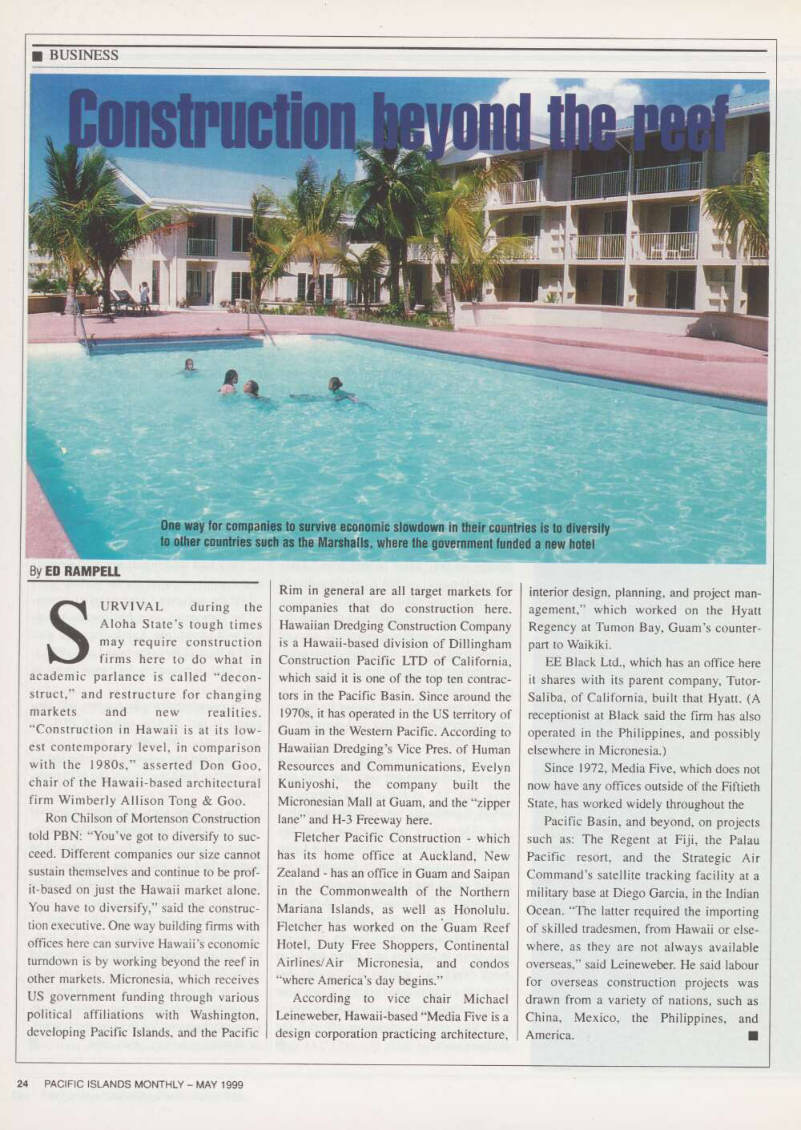
One way for companies to survive economic slowdown in their countries is to diversify to other countries such as the Marshalls, where the government funded a new hotel