System to be closed by 2000
pp. 22-23 · Read in the full issue
Johnston Atoll Chemical Disposal System to be closed by 2000
By Michael Field
ONE of the Pacific’s worst
neighbours is getting
ready to move out - hope
fully with its plutonium,
dioxin and assorted other deadly chemi cals in tow.
The US Army’s Johnston Atoll Chemical Disposal System (JACADS), on a tiny atoll between Hawaii and the Marshall Islands has since 1990 been destroying tens of thousands of mortar shells, artillery shells, rockets and bombs containing mustard gas and sarin nerve agents.
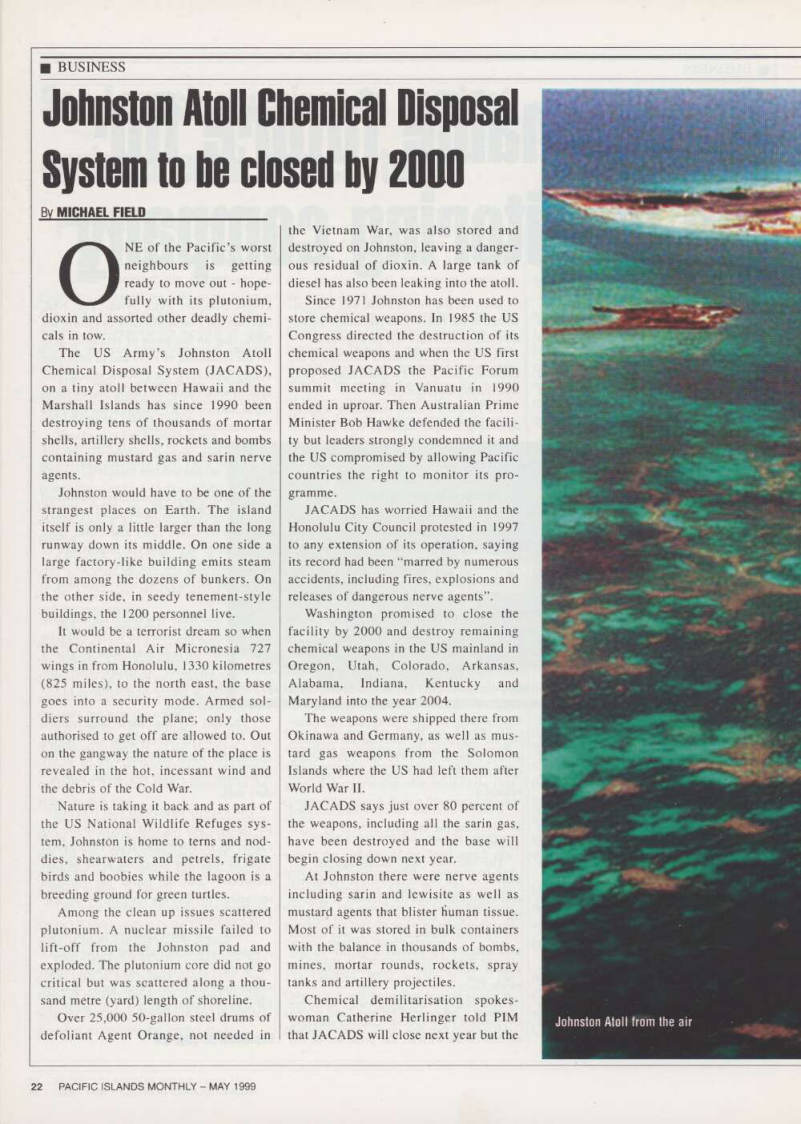
Johnston would have to be one of the strangest places on Earth. The island itself is only a little larger than the long runway down its middle. On one side a large factory-like building emits steam from among the dozens of bunkers. On the other side, in seedy tenement-style buildings, the 1200 personnel live.
It would be a terrorist dream so when the Continental Air Micronesia 727 wings in from Honolulu, 1330 kilometres (825 miles), to the north east, the base goes into a security mode. Armed sol diers surround the plane; only those authorised to get off are allowed to. Out on the gangway the nature of the place is revealed in the hot, incessant wind and the debris of the Cold War.
Nature is taking it back and as part of the US National Wildlife Refuges sys tem, Johnston is home to terns and nod dies, shearwaters and petrels, frigate birds and boobies while the lagoon is a breeding ground for green turtles.
Among the clean up issues scattered plutonium. A nuclear missile failed to lift-off from the Johnston pad and exploded. The plutonium core did not go critical but was scattered along a thou sand metre (yard) length of shoreline.
Over 25,000 50-gallon steel drums of defoliant Agent Orange, not needed in
the Vietnam War, was also stored and destroyed on Johnston, leaving a danger ous residual of dioxin. A large tank of diesel has also been leaking into the atoll.
Since 1971 Johnston has been used to store chemical weapons. In 1985 the US Congress directed the destruction of its chemical weapons and when the US first proposed JACADS the Pacific Forum summit meeting in Vanuatu in 1990 ended in uproar. Then Australian Prime Minister Bob Hawke defended the facili ty but leaders strongly condemned it and the US compromised by allowing Pacific countries the right to monitor its pro gramme.
JACADS has worried Hawaii and the Honolulu City Council protested in 1997 to any extension of its operation, saying its record had been “marred by numerous accidents, including fires, explosions and releases of dangerous nerve agents”.
Washington promised to close the facility by 2000 and destroy remaining chemical weapons in the US mainland in Oregon, Utah, Colorado, Arkansas, Alabama, Indiana, Kentucky and Maryland into the year 2004.
The weapons were shipped there from Okinawa and Germany, as well as mus tard gas weapons from the Solomon Islands where the US had left them after World War 11.
JACADS says just over 80 percent of the weapons, including all the sarin gas, have been destroyed and the base will begin closing down next year.
At Johnston there were nerve agents including sarin and lewisite as well as mustard agents that blister Human tissue.
Most of it was stored in bulk containers with the balance in thousands of bombs, mines, mortar rounds, rockets, spray tanks and artillery projectiles.
Chemical demilitarisation spokes woman Catherine Herlinger told PIM that JACADS will close next year but the
Johnston Atoll from the air
US Army will remain to restore the island to “a condition that will not harm future inhabitants”. That will take another year.
“The new (Environmental Protection Agency) permit requires that once all of the hazardous waste is destroyed or dis posed of, the facility will be shut down, the incinerators and all associated equip ment will be dismantled and shipped off island, and that the Army will clean up any leftover contamination from the haz ardous waste,” she said.
The chemical and explosive residues and stored contaminated waste will be shipped to US landfills.
An unnamed Johnston Island worker has maintained a Web site which appears to give away some of the atoll’s secrets, saying it was an occupational health “hell” with a list of dangers longer than the LA phone directory; hurricanes, tsunamis, the large sharks infesting the local waters, and the sharp coral under foot and birds.
“The Birds are of various varieties and sizes, ranging from the “red-footed booby” to the “great frigate bird.” They nest on the atoll, which is (oddly enough) designated an official wildlife refuge.
The military command takes this regula tion seriously, as they are wont to do, and persecution of any bird has unpleasant consequences, including thousands of dollars in fines.
“The birds repay the favour by harass ing innocent bystanders and pooping on their heads.”
The natural hazards are trivial com pared to the manmade ones, the Web site says, and “JA” as Johnston is referred to, offers “gradually escalating mortality risk. There is a lot of diesel that has leaked into the sea and there is the Agent Orange containing dioxin. Of course, the dioxin seems pretty tame compared to the plutonium.” This came from the crashed rocket. “So now there’s a BIG fence along a thousand-meter length of shore line, with bulldozers and dump trucks at work every day, sorting the “good” dirt from the contaminated stuff in a two-year project. One “little” accident has resulted in a $2l million clean-up effort,” the Website says. ■