Pitcairn looks forward to aviation
p. 18 · Read in the full issue
By Michael Field
1F Martin Wiliams gets his way some time in the next three years it will be pos sible to take a plane to Pitcairn Island, Britain’s last and easily loneliest colony on Earth.
Mr Wiliams is the kind of chap who can deliver for, despite the lack of plumed hat, he is Pitcairn’s new governor and recently, with the help of the French Navy ship Revi he was able to visit his tiny chaige.
Pitcairn governorship is not a full-time Job these days and in the last decade it has become the ex-officio role of the British High Commissioner to New Zealand. Each of them make the effort to get there at least once and some of them find
themselves on epic trips.
The standard method is to hitch a ride on one of the giant containerships leav ing for Europe, via Panama, and paying them extra to drop of the gover nor and his aide. They would not wait and negoti ations were always opened up on getting a ride back.
Some governor’s ended up in Panama; others found passing New Zealand war ships.
Mr Wiliams did what
most people thought the logical alternative was; use the French Navy which routinely shuttles up and down the Tuamoto Archipelago.
Aviation could change that, except Pitcairn is a rugged 450 hectares 2,160 kilometres from Papeete with just 57 people at the other end. The economics are strained at best.
For the last couple of years though multi-mil lion dollar Australian adventurer Dick Smith has had a close friendship with Pitcairn’s best known resident, Tom Christian, and is willing to help them get an airstrip. He funded the first engineer ing study and is talking to island authorities about the next stage.
Mr Williams and an official from the Department of International Development looked at the most promising site for an airstrip of up to 600 metres.
‘Technically there are no gr\at difficulties in construction an airstrip sufficient for light aircraft to make the round trip from French Polynesia to Pitcairn,” he told PIM.
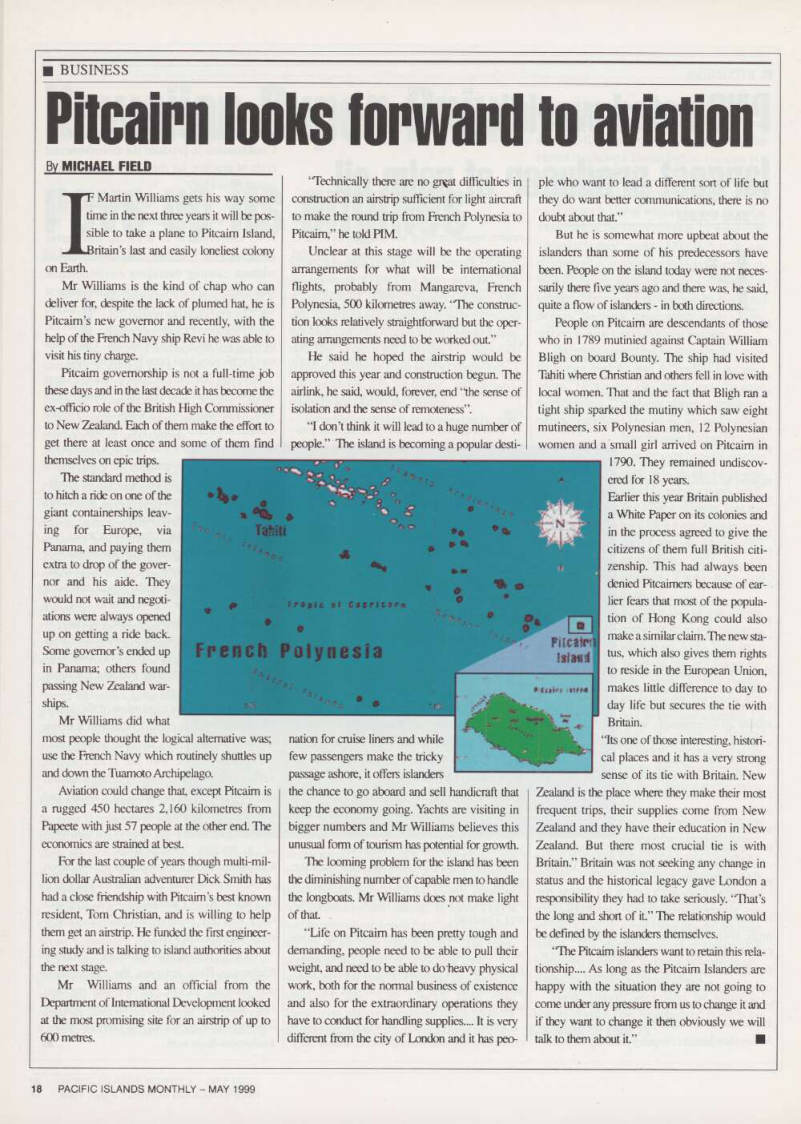
Unclear at this stage will be the operating arrangements for what will be international flights, probably from Mangareva, French Polynesia, 500 kilometres away. “The construc tion looks relatively straightforward but the oper ating arrangements need to be worked out.”
He said he hoped the airstrip would be approved this year and construction begun. The airlink, he said, would, forever, end “the sense of isolation and the sense of remoteness”.
“I don’t think it will lead to a huge number of people.” The island is becoming a popular desti-
nation for cruise liners and while few passengers make the tricky passage ashore, it offers islanders
the chance to go aboard and sell handicraft that keep the economy going. Yachts are visiting in bigger numbers and Mr Williams believes this unusual form of tourism has potential for growth.
The looming problem for the island has been the diminishing number of capable men to handle the longboats. Mr Wiliams does not make light of that “Life on Pitcairn has been pretty tough and demanding, people need to be able to pull their weight, and need to be able to do heavy physical work, both for the normal business of existence and also for the extraordinary operations they have to conduct for handling supplies... It is very different from the city of London and it has peo
pie who want to lead a different sort of life but they do want better communications, there is no doubt about that.”
But he is somewhat more upbeat about the islanders than some of his predecessors have been. People on the island today were not neces sarily there five years ago and there was, he said, quite a flow of islanders - in both directions.
People on Pitcairn are descendants of those who in 1789 mutinied against Captain William Bligh on board Bounty. The ship had visited Tahiti where Christian and others fell in love with local women. That and the fact that Bligh ran a tight ship sparked the mutiny which saw eight mutineers, six Polynesian men, 12 Polynesian women and a small girl arrived on Pitcairn in
1790. They remained undiscov ered for 18 years.
I Earlier this year Britain published a White Paper on its colonies and I in the process agreed to give the i citizens of them full British citi- I zenship. This had always been denied Pitcairners because of ear lier fears that most of the popula tion of Hong Kong could also make a similar claim. The new sta tus, which also gives them rights to reside in the European Union, makes little difference to day to day life but secures the tie with Britain.
“Its one of those interesting, histori cal places and it has a very strong sense of its tie with Britain. New
Zealand is the place where they make their most frequent trips, their supplies come from New Zealand and they have their education in New Zealand. But there most crucial tie is with Britain.” Britain was not seeking any change in status and the historical legacy gave London a responsibility they had to take seriously. “That’s the long and short of it.” The relationship would be defined by the islanders themselves.
“The Pitcairn islanders want to retain this rela tionship... As long as the Pitcairn Islanders are happy with the situation they are not going to come under any pressure from us to change it and if they want to change it then obviously we will talk to them about it.” ■