largest producer of palm oil
p. 17 · Read in the full issue
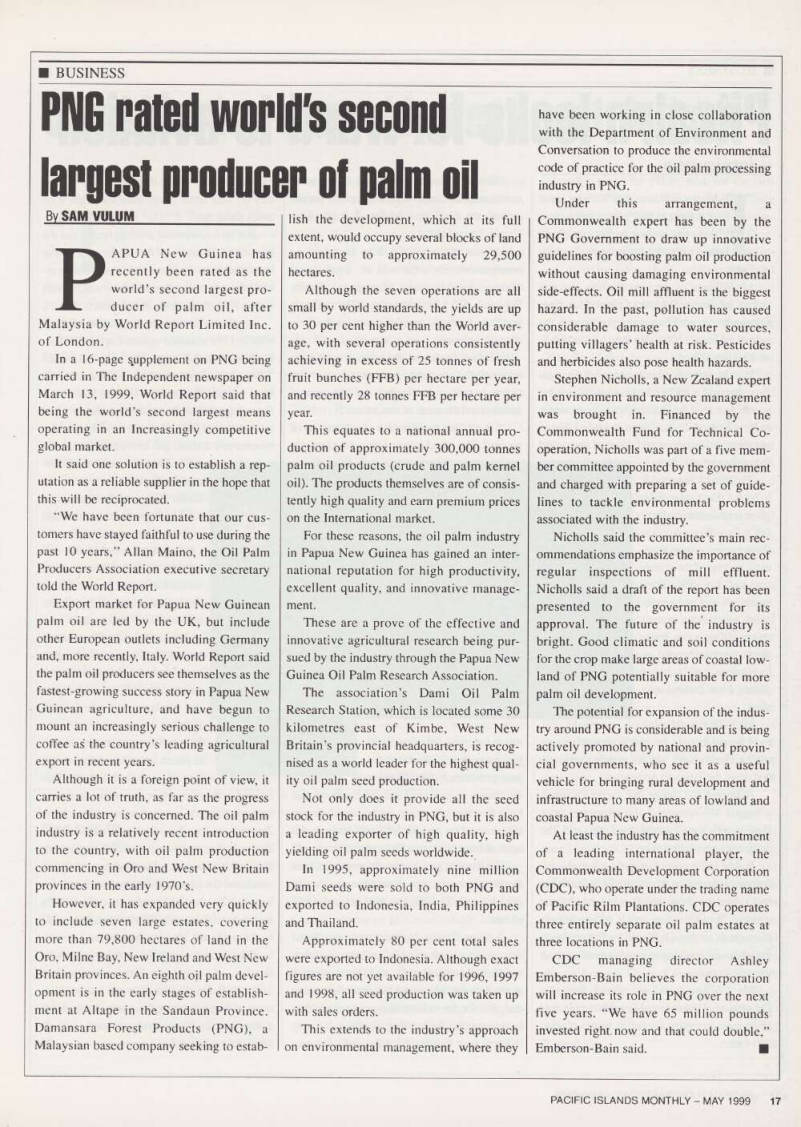
PNG rated worlds second largest producer of palm oil
By Sam Vulum
PAPUA New Guinea has recently been rated as the world’s second largest pro ducer of palm oil, after Malaysia by World Report Limited Inc. of London.
In a 16-page supplement on PNG being carried in The Independent newspaper on March 13, 1999, World Report said that being the world’s second largest means operating in an Increasingly competitive global market.
It said one solution is to establish a rep utation as a reliable supplier in the hope that this will be reciprocated.
“We have been fortunate that our cus tomers have stayed faithful to use during the past 10 years,” Allan Maino, the Oil Palm Producers Association executive secretary told the World Report.
Export market for Papua New Guinean palm oil are led by the UK, but include other European outlets including Germany and, more recently, Italy. World Report said the palm oil producers see themselves as the fastest-growing success story in Papua New Guinean agriculture, and have begun to mount an increasingly serious challenge to coffee as the country’s leading agricultural export in recent years.
Although it is a foreign point of view, it carries a lot of truth, as far as the progress of the industry is concerned. The oil palm industry is a relatively recent introduction to the country, with oil palm production commencing in Oro and West New Britain provinces in the early 1970’5.
However, it has expanded very quickly to include seven large estates, covering more than 79,800 hectares of land in the Oro, Milne Bay, New Ireland and West New Britain provinces. An eighth oil palm devel opment is in the early stages of establish ment at Altape in the Sandaun Province.
Damansara Forest Products (PNG), a Malaysian based company seeking to estab
lish the development, which at its full extent, would occupy several blocks of land
amounting to approximately 29,500
hectares.
Although the seven operations are all small by world standards, the yields are up to 30 per cent higher than the World aver age, with several operations consistently achieving in excess of 25 tonnes of fresh fruit bunches (FFB) per hectare per year, and recently 28 tonnes FFB per hectare per year.
This equates to a national annual pro duction of approximately 300,000 tonnes palm oil products (crude and palm kernel oil). The products themselves are of consis tently high quality and earn premium prices on the International market.
For these reasons, the oil palm industry in Papua New Guinea has gained an inter national reputation for high productivity, excellent quality, and innovative manage ment.
These are a prove of the effective and innovative agricultural research being pur sued by the industry through the Papua New Guinea Oil Palm Research Association.
The association’s Dami Oil Palm Research Station, which is located some 30 kilometres east of Kimbe, West New Britain’s provincial headquarters, is recog nised as a world leader for the highest qual ity oil palm seed production.
Not only does it provide all the seed stock for the industry in PNG, but it is also a leading exporter of high quality, high yielding oil palm seeds worldwide.
In 1995, approximately nine million Dami seeds were sold to both PNG and exported to Indonesia, India, Philippines and Thailand.
Approximately 80 per cent total sales were exported to Indonesia. Although exact figures are not yet available for 1996, 1997 and 1998, all seed production was taken up with sales orders.
This extends to the industry’s approach on environmental management, where they
have been working in close collaboration with the Department of Environment and Conversation to produce the environmental code of practice for the oil palm processing industry in PNG.
Under this arrangement, a Commonwealth expert has been by the PNG Government to draw up innovative guidelines for boosting palm oil production without causing damaging environmental side-effects. Oil mill affluent is the biggest hazard. In the past, pollution has caused considerable damage to water sources, putting villagers’ health at risk. Pesticides and herbicides also pose health hazards.
Stephen Nicholls, a New Zealand expert in environment and resource management was brought in. Financed by the Commonwealth Fund for Technical Co operation, Nicholls was part of a five mem ber committee appointed by the government and charged with preparing a set of guide lines to tackle environmental problems associated with the industry.
Nicholls said the committee’s main rec ommendations emphasize the importance of regular inspections of mill effluent.
Nicholls said a draft of the report has been presented to the government for its approval. The future of the industry is bright. Good climatic and soil conditions for the crop make large areas of coastal low land of PNG potentially suitable for more palm oil development.
The potential for expansion of the indus try around PNG is considerable and is being actively promoted by national and provin cial governments, who see it as a useful vehicle for bringing rural development and infrastructure to many areas of lowland and coastal Papua New Guinea.
At least the industry has the commitment of a leading international player, the Commonwealth Development Corporation (CDC), who operate under the trading name of Pacific Rilm Plantations. CDC operates three entirely separate oil palm estates at three locations in PNG.
CDC managing director Ashley Emberson-Bain believes the corporation will increase its role in PNG over the next five years. “We have 65 million pounds invested right, now and that could double,”
Emberson-Bain said. ■