Samoan film director
pp. 38-45 · Read in the full issue
makes hep mark
By Ed Rampell
SIMA Urale may be the first Samoan female film direc tor. In 1996, Sima’s debut film, “O Tamaiti” (“The Children”), won the prestigious Silver Lion at the Venice Festival - Robert Altman won the Golden Lion (not too shabby company). Sima’s new docu
mentary, “Velvet Dreams”, was a favorite at the November 6-19 Hawaii International Film Festival, where the 47 minute video had its US premiere.
Like the work of Michael Moore (“Roger and Me”) and other con temporary documentarians, “Velvet Dreams” opens up and expands the cinematic syntax of nonfiction film form. “Velvet Dreams” zooms in on the genre of black velvet painting, known for kitschy Elvises and clowns. In particular, Sima focuses on the imagery of barebreasted “dusky maidens” with flowers in their hair, who inhabit tropical Edenic isles. The film also tells the story of a renowned black velvet painter.
However, rather than use a
straightforward, talking head narra
tive structure, Sima ingeniously imposes a faux film noir style on her doco. The unseen narrator (played by Kiwi actor Jeffrey Thomas, who appears in the New Zealand shot “Xena” and “Hercules”), a Sam Spade-like private eye, serves “as an entertainment device, but also to
link the stories and the interviews togeth er,” says the director. The “fake, made-up narrator”, as Sima calls him, falls in love with a nubile naked Native nymph por trayed on velvet. The Bogart sound-alike travels from NZ to Seattle (for a bizarre velvet exhibit) to French Polynesia, and back to NZ again, on an epic Oceanic odyssey to find the model for his velvet vahine.
En route the documentary also has much fun, poking fun at racial and sexual stereotypes. In the end, the private dick never finds his “dusky maiden”, but rather, in a Freudian twist, discovers the painter instead. The painter is a robust 90ish Kiwi named Charlie McPhee, who still delights in barhall carousing and wearing red blaza subtle way, Sima insinuates that
these velvet fantasies exist mainly in the minds of obsessed white men, yearning to escape from civilization and its discon tents, and return to a mythic state of nature.
As the narrator says; “These palagis [Caucasians] sound like dodgy characters.”
Via a quest comparable to that of the characters in the 1941 John Huston classic “The Maltese Falcon”, Sima inventively saves “Velvet Dreams” from being just
another dull, conventional talking header.
The director calls her documentary “a send up,” and makes her nationalistic and feminist points about racism, sexism, and colonialism with a great deal of wit. Like Michael Moore, Sima’s satirical, dead on observations are full of humor, rather than anger, making “Velvet” more accessible to Western audiences.
Sima’s family migrated to Wellington, the capital of New Zealand, from Fagamalu, Savaii when she was six. Savaii is the Samoan island where Robert Flaherty shot his documentary “Moana of the South Seas” in the 19205. Savaii is the larger of the two main islands that com pose the independent nation of Samoa, for merly known as Western Samoa. (Sima is
glad they dropped the Western.) “I actually wanted to go to a school of fine arts, because I loved painting,” says the director of a film about painting.
“But somehow I ended up doing drama, and I ended up at the NZ drama school, Toiwhaakari, in Wellington. I graduated and then did acting for about two years.
And I got fed up with acting, because I was doing a lot of white plays [laughs], and some Marie ones [one of Sima’s early directors was renowned Maori actress Rena Owen, star of “Once Were Warriors”], which were fun. I think you really get sick of acting because you tend to become type cast by other people, and you end up working on other people’s ideas. I think acting can be quite uncreative, and I wanted to create my own stories. I think we have a hell of a lot of stories to tell.”
What really bothered Sima was the lack of Pacific Island works.
“I was doing rehashed plans that were very well known... very pop ular, white plays” - by established
Kiwi playwrights and some bloke named Bill Shakespeare - “but not my kind of plays,” Sima confesses.
So, the Samoan emigrated again - to Australia - where Sima studied film mak ing for three years at the Victorian College of the Arts, Film and Television School.
She hoped film school meant “a bit more control in the directing arena”.
Continued on page 45
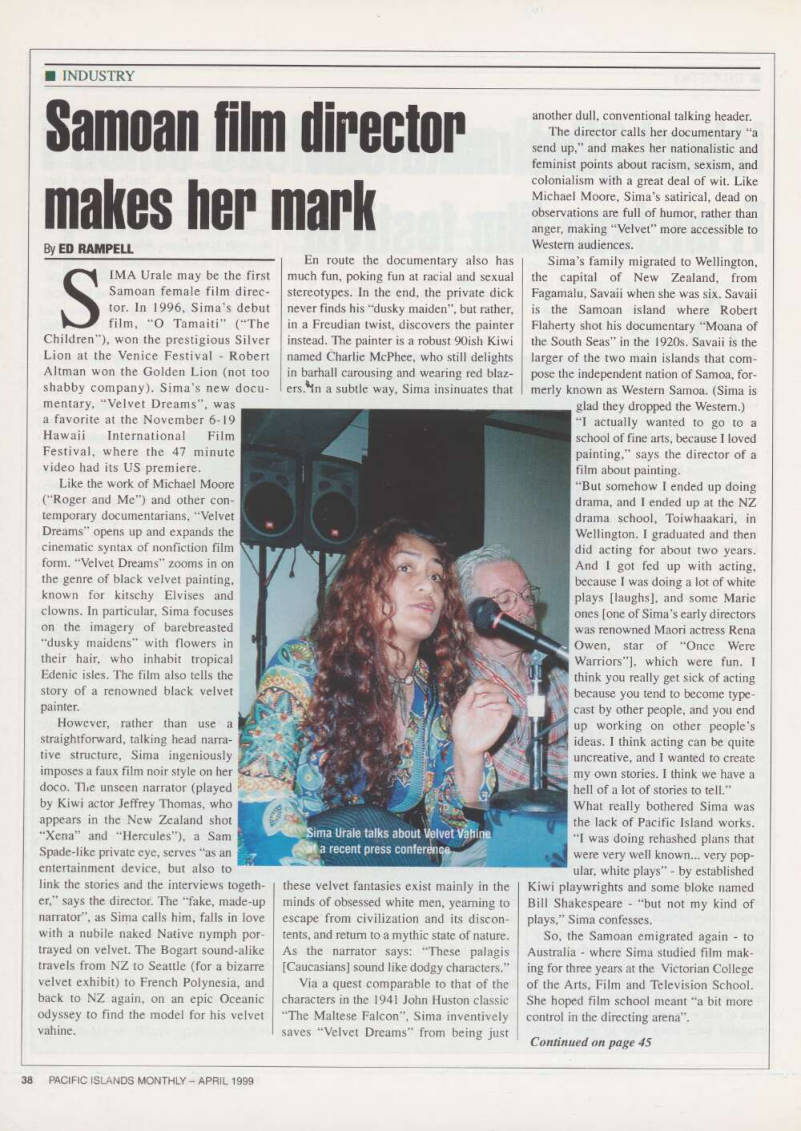
Sima Urale talks about Velvet Vahine at a recent press conference
Continued from page 38
“After graduating from the film school, I returned to NZ and I started working on a film called O Tamaiti, which screened at the Hawaii Festival two years ago,” says Sima.
“The film is all in Samoan and was funded by the NZ Film Commission [a governmental entity], it’s subtitled [in English]. It’s to do with integrity. It would not have been believable if I made a Samoan family speak English... Because this family was... immigrants [in Wellington], they had to speak Samoan.
It’s all about integrity, when you are mak ing films, whether you are true to your characters.”
O Tamaiti was shot on 35 mm film, and is “only 15 minutes long,” says the Oceanic auteur. “It’s quite an art house lit tle piece, and it was shot in black and white. And it’s an unconventional story telling for a Polynesian story or content.
It’s very stylized, very visual and sound orientated. It did very well overseas, it was screened in Sundance and Telluride, and has won eight awards internationally.
“I won the Silver Lion award for Best Short Film [at the Venice Film Festival].
And Robert Altman won the Golden Lion Award, so our films were screened togeth er. That was really cool, it was like the old and the new filmmaker, coming up,” says the 30 year old.
To pay the bills, Sima has shot corpo rate videos. Velvet Dreams was made for television in NZ.
Besides introducing “Velvet Dreams”, Sima participated in the “Interpreting History & Culture: Film making in New Zealand” panel, saying: “As a Pacific Islander in NZ, there have been films like Sons for the Return Home, The Silent One, Flying Fox in a Freedom Tree. I still see it as a Western country, even though it is part of the Pacific”.
Sima added “one of the biggest prob lems with Pacific Island films not hap pening is because there aren’t enough of us interested in filmmaking and writing.
I’m still waiting for others to appear around me. At the moment I can feel quite lonely at times [laughter]”.
What does the film future hold for this Islander auteur? Sima says she has a development deal in the works to direct a feature, but wants to take her time. ■