Pacific cashes in on Hollywood
p. 36 · Read in the full issue
By Micheal Held
Hollywood has been making money out of the Second World War even before the Japanese surrendered in Tokyo bay isn’t it time that the South Pacific cashed in too?
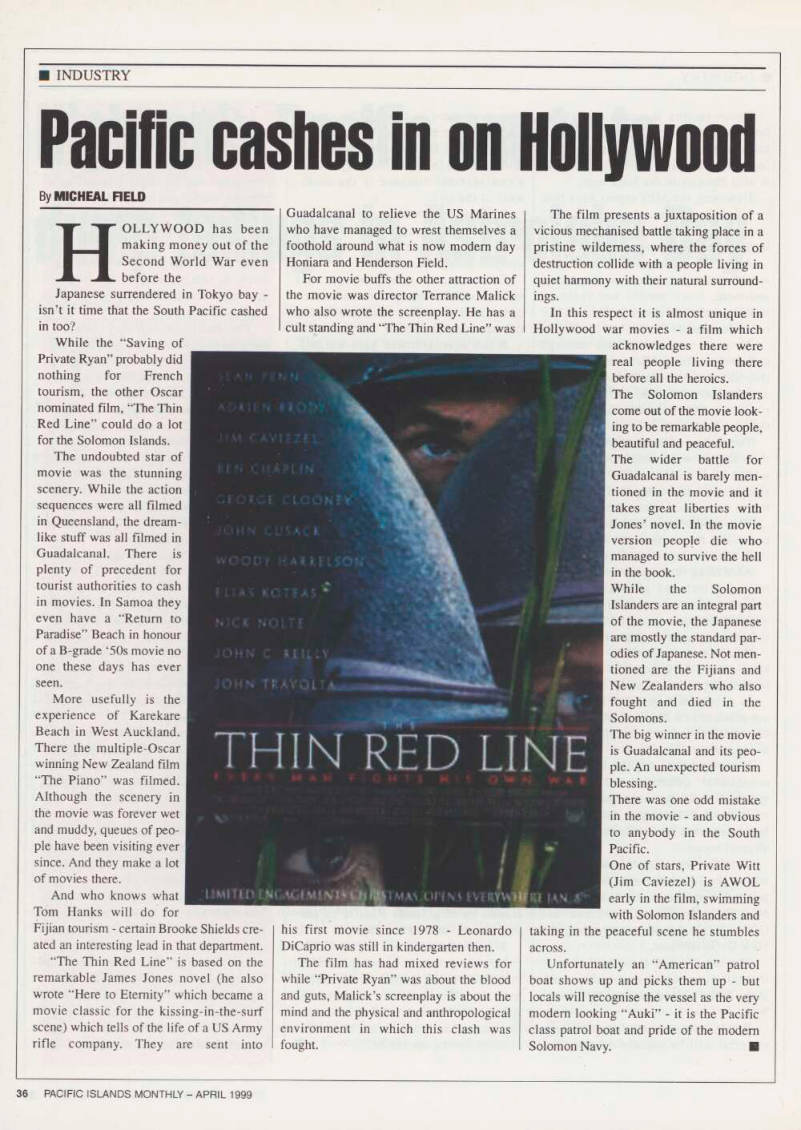
While the “Saving of Private Ryan” probably did nothing for French tourism, the other Oscar nominated film, “The Thin Red Line” could do a lot for the Solomon Islands.
The undoubted star of movie was the stunning scenery. While the action sequences were all filmed in Queensland, the dream like stuff was all filmed in Guadalcanal. There is plenty of precedent for tourist authorities to cash in movies. In Samoa they even have a “Return to Paradise” Beach in honour of a B-grade ‘sos movie no one these days has ever seen.
More usefully is the experience of Karekare Beach in West Auckland.
There the multiple-Oscar winning New Zealand film “The Piano” was filmed.
Although the scenery in the movie was forever wet and muddy, queues of peo ple have been visiting ever since. And they make a lot of movies there.
And who knows what j Tom Hanks will do for
Fijian tourism - certain Brooke Shields cre ated an interesting lead in that department.
“The Thin Red Line” is based on the remarkable James Jones novel (he also wrote “Here to Eternity” which became a movie classic for the kissing-in-the-surf scene) which tells of the life of a US Army rifle company. They are sent into
Guadalcanal to relieve the US Marines who have managed to wrest themselves a foothold around what is now modem day Honiara and Henderson Field.
For movie buffs the other attraction of the movie was director Terrance Malick who also wrote the screenplay. He has a cult standing and “The Thin Red Line” was
his first movie since 1978 - Leonardo DiCaprio was still in kindergarten then.
The film has had mixed reviews for while “Private Ryan” was about the blood and guts, Malick’s screenplay is about the mind and the physical and anthropological environment in which this clash was
fought.
The film presents a juxtaposition of a vicious mechanised battle taking place in a pristine wilderness, where the forces of destruction collide with a people living in quiet harmony with their natural surround
ings.
In this respect it is almost unique in Hollywood war movies - a film which
acknowledges there were real people living there before all the heroics.
The Solomon Islanders come out of the movie look ing to be remarkable people, beautiful and peaceful.
The wider battle for Guadalcanal is barely men tioned in the movie and it takes great liberties with Jones’ novel. In the movie version people die who managed to survive the hell in the book.
While the Solomon Islanders are an integral part of the movie, the Japanese are mostly the standard par odies of Japanese. Not men tioned are the Fijians and New Zealanders who also fought and died in the Solomons.
The big winner in the movie is Guadalcanal and its peo ple. An unexpected tourism
blessing.
There was one odd mistake in the movie - and obvious to anybody in the South Pacific.
One of stars, Private Witt (Jim Caviezel) is AWOL early in the film, swimming with Solomon Islanders and
taking in the peaceful scene he stumbles across.
Unfortunately an “American” patrol boat shows up and picks them up - but locals will recognise the vessel as the very modem looking “Auki” - it is the Pacific class patrol boat and pride of the modem Solomon Navy. ■