Kiribati countdown
pp. 22-23 · Read in the full issue
back on track
By Sophie Foster Hildebrand
There are not many Pacific Island countries that can lay claim to launching rockets into space in their territory, but Kiribati will finally join the ranks of the super powers in that respect.
Straddling the equator, the country is the site of the multi-billion dollar Sea Launch project that provides a unique launch ser vice to boost commercial communications satellites into orbit from a floating platform.
Launches from the equator get the maxi mum push from the Earth’s rotation, requir ing less energy from the booster to reach orbit.
Sea Launch is a multi-billion dollar joint venture involving a Boeing subsidiary from the US and other companies from Russia, Ukraine and Norway. It will use new three stage rockets, fired from a Norwegian-built oil rig platform.
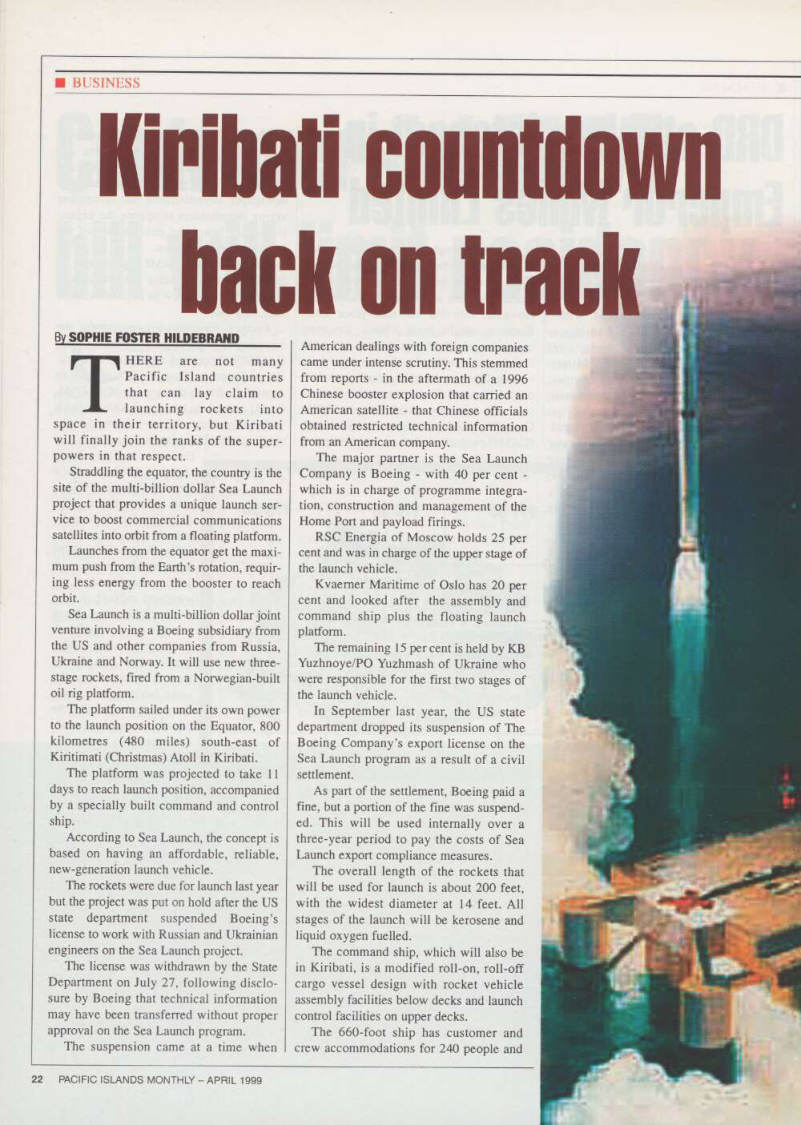
The platform sailed under its own power to the launch position on the Equator, 800 kilometres (480 miles) south-east of Kiritimati (Christmas) Atoll in Kiribati.
The platform was projected to take 11
days to reach launch position, accompanied
by a specially built command and control
ship.
According to Sea Launch, the concept is based on having an affordable, reliable, new-generation launch vehicle.
The rockets were due for launch last year but the project was put on hold after the US
state department suspended Boeing’s
license to work with Russian and Ukrainian engineers on the Sea Launch project.
The license was withdrawn by the State Department on July 27, following disclo sure by Boeing that technical information may have been transferred without proper approval on the Sea Launch program.
The suspension came at a time when
American dealings with foreign companies came under intense scrutiny. This stemmed from reports - in the aftermath of a 1996 Chinese booster explosion that carried an American satellite - that Chinese officials obtained restricted technical information from an American company.
The major partner is the Sea Launch Company is Boeing - with 40 per cent which is in charge of programme integra tion, construction and management of the Home Port and payload firings.
RSC Energia of Moscow holds 25 per cent and was in charge of the upper stage of the launch vehicle.
Kvaemer Maritime of Oslo has 20 per cent and looked after the assembly and command ship plus the floating launch platform.
The remaining 15 percent is held by KB Yuzhnoye/PO Yuzhmash of Ukraine who were responsible for the first two stages of the launch vehicle.
In September last year, the US state department dropped its suspension of The Boeing Company’s export license on the Sea Launch program as a result of a civil settlement.
As part of the settlement, Boeing paid a fine, but a portion of the fine was suspend ed. This will be used internally over a three-year period to pay the costs of Sea Launch export compliance measures.
The overall length of the rockets that will be used for launch is about 200 feet, with the widest diameter at 14 feet. All stages of the launch will be kerosene and liquid oxygen fuelled.
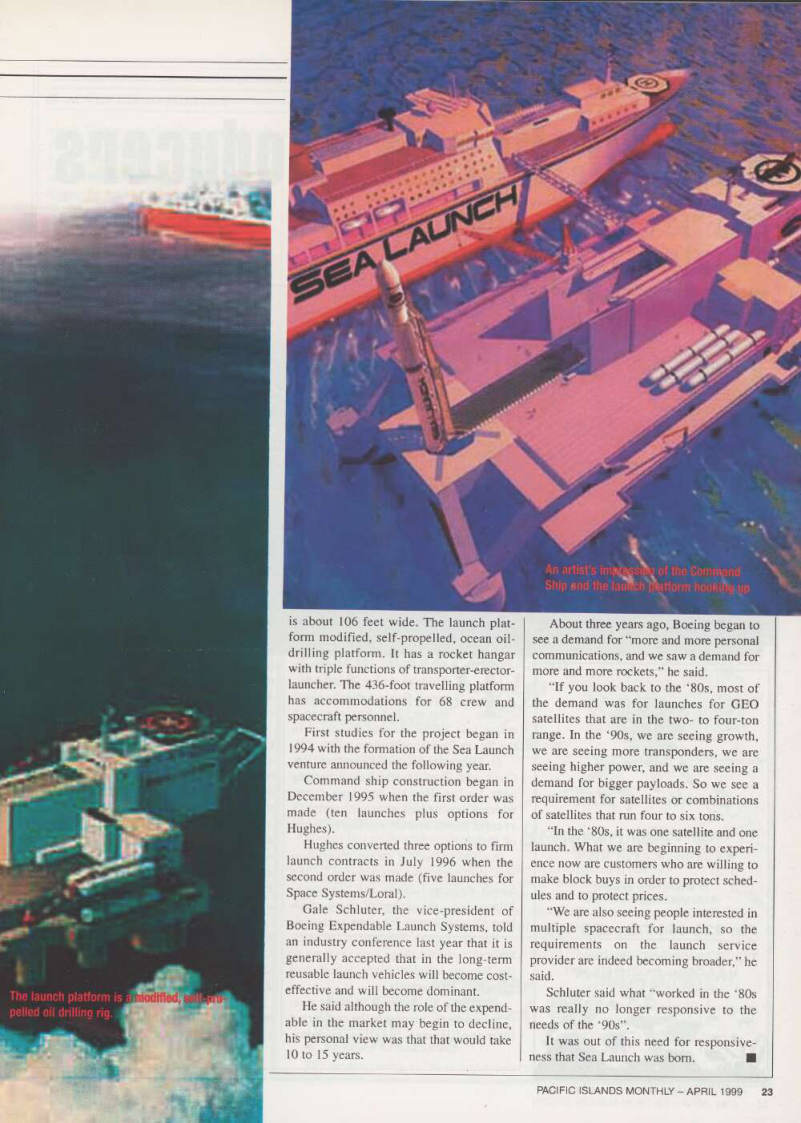
The command ship, which will also be in Kiribati, is a modified roll-on, roll-off cargo vessel design with rocket vehicle assembly facilities below decks and launch control facilities on upper decks.
The 660-foot ship has customer and crew accommodations for 240 people and
is about 106 feet wide. The launch plat form modified, self-propelled, ocean oil drilling platform. It has a rocket hangar with triple functions of transporter-erector launcher. The 436-foot travelling platform has accommodations for 68 crew and spacecraft personnel.
First studies for the project began in 1994 with the formation of the Sea Launch venture announced the following year.
Command ship construction began in December 1995 when the first order was made (ten launches plus options for Hughes).
Hughes converted three options to firm launch contracts in July 1996 when the second order was made (five launches for
Space Systems/Loral).
Gale Schluter, the vice-president of Boeing Expendable Launch Systems, told an industry conference last year that it is generally accepted that in the long-term reusable launch vehicles will become cost effective and will become dominant.
He said although the role of the expend able in the market may begin to decline, his personal view was that that would take 10 to 15 years.
About three years ago, Boeing began to see a demand for “more and more personal communications, and we saw a demand for more and more rockets,” he said.
“If you look back to the ‘Bos, most of the demand was for launches for GEO satellites that are in the two- to four-ton range. In the ‘9os, we are seeing growth, we are seeing more transponders, we are seeing higher power, and we are seeing a demand for bigger payloads. So we see a requirement for satellites or combinations of satellites that run four to six tons.
“In the ‘Bos, it was one satellite and one launch. What we are beginning to experi ence now are customers who are willing to make block buys in order to protect sched ules and to protect prices.
“We are also seeing people interested in multiple spacecraft for launch, so the requirements on the launch service provider are indeed becoming broader,” he said.
Schluter said what “worked in the ‘Bos was really no longer responsive to the needs of the ‘9os”.
It was out of this need for responsive ness that Sea Launch was bom. ■
An artis impression of the Command Ship and the lauch platform hooking up
The launch platfor is a modified, self-pro- Pelled oil drilling rig