Resettlement Of
pp. 46-47 · Read in the full issue
Bikinians resettled on wrong island: US official
By Giff Johnson
Bikini Islanders in the mid-1970s on the former nuclear test site failed because US officials returned the peo ple to a heavily contaminated island, not the one selected by scientists as safe for rehabitation, a former US Atomic Energy Commission official said recently.
Atomic Energy Commission (AEC) sci
enlists had recom mended resettling Eneu Island - not Bikini Island because it had radi ation levels one tenth of those on nearby Bikini Island, said Tommy F. McCraw, who worked for 25 years with the Division of
Operational Safety
and the Office of Health and Environmental Research for the AEC and its suc cessor organiza tions.
McCraw’s com ments - the first by an AEC official
confirming the
bureaucratic and
scientific ineptitude that caused the first resettlement to be aborted in 1978 - were published in a recent issue of the scientific magazine, Health Physics.
A Bikini official expressed little sur prise at the report, which was carried in a front page news article in the Marshall Islands Journal in late January.
The Bikinians have to deal with a mul titude of US federal agencies and getting timely or responsive action has often proved elusive, he said.
After six years on Bikini Island, more than 100 Bikinians were evacuated in a widely publicised event in 1978 after their radiation exposures had reached or exceed ed US federal radiation protection stan dards. Islanders have not returned since except for short visits and recently launched a cleanup program to rehabilitate the atoll, which has 23 islands in a horse-
shoe shape necklace. Bikini was the testing ground for 23 US nuclear weapons between 1946 and 1958. Most of the Bikini population lives in exile on Kili, an island about 400 miles to the south of Bikini.
McCraw said the 1970 s resettlement was aborted through a combination of bureaucratic management problems among
US federal agencies with different agen das, as well as poor communication witlthin the AEC itself.
Resettlement work was commenced 1 in 1968 after President Lyndon Johnsson announced that Bikini was safe for rehabili tation.
“How resettlement failed is that DOOI (Department of the Interior) considered tthe (AEC) Ad Hoc Committee’s recommencda tions to be resettlement options with Emeu the first choice, not firm requirements tlhat must be carried out if resettlement was to succeed,” he said.
DOI was in charge of the resettlement and rehabilitation at Bikini Atoll, whiile AEC provided radiological support and advice and the Department of Defense assisted with logistics support and man aged field operations, he said.
In 1967, a group of scientists, including McCraw, spent six weeks on Bikini Atoll conducting a radiological survey.
“This survey showed that levels of external gamma radiation were about ten times higher on Bikini Island than on Eneu
Island,” McCraw said, adding that it was also estimat ed that the level of cesium 137 in the soil and food crops from these two islands would be about the same, 10-1.
This finding
led theAEC’sAd Hoc Committee to recommend that the first vil
lage, including
planting of food crops, be estab lished on Eneu, not Bikini Island.
McCraw said the AEC was very clear that the first village should be established on
Eneu, not Bikini. “None of the recommen dations said anything about when Bikini Island could be resettled or when food from Bikini Island could be eaten,” he said.
Sometime later, after cleanup and reha bilitation work was underway under the Interior Department’s direction, AEG sci entists went to Bikini Atoll and “to their
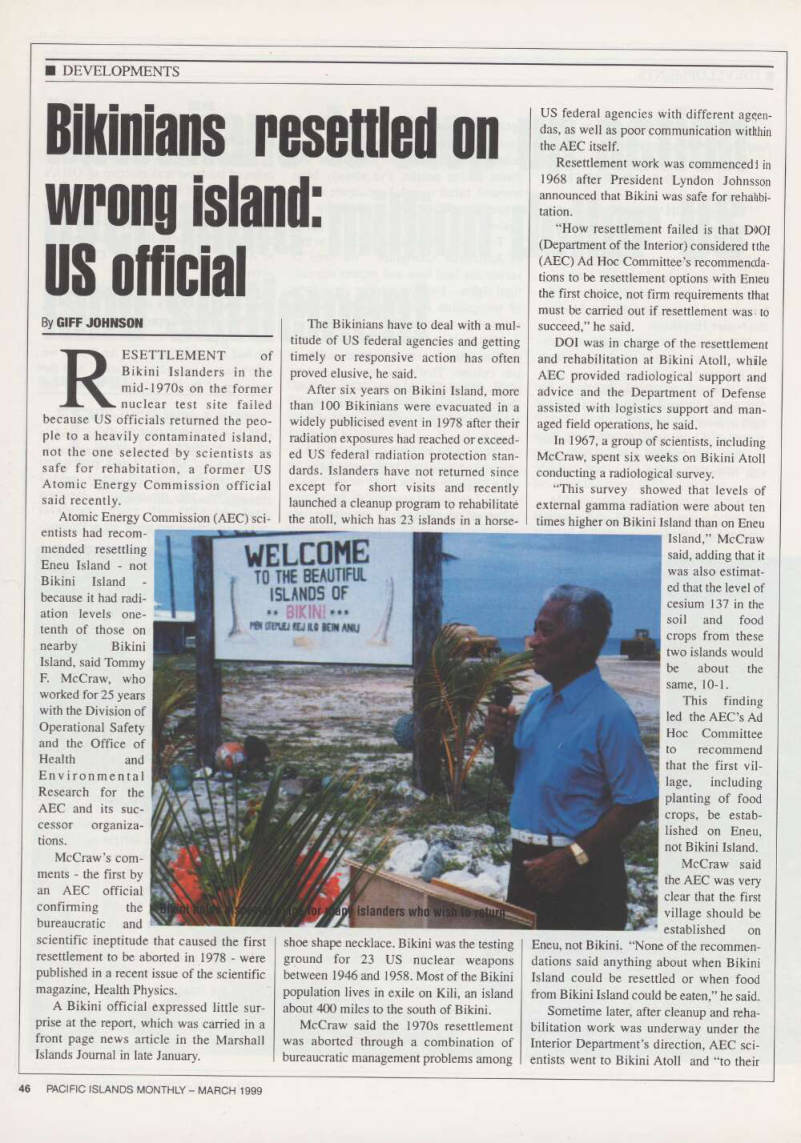
Bikini holds[?] for many islanders who wish to return
surprise they found that 43 houses were under construction on Bikini, hot on Eneu, and thousands of coconut trees were to be planted on Bikini,” he said.
AEC officials expressed their concern to DOI representatives that resettlement recommendations were not being fol lowed.
“The DOI response was that some Bikinians did not have land rights on Eneu and would not allow their homes to be built on someone else’s land,” McCraw said.
The former AEC official said that because the Interior Department was not following AEC recommendations for the resettle ment, the Bikinians - in demanding to live on Bikini and not Eneu - did not under stand why radiation safety standards could be met on one island but not on the other.
“How could they?” he asked, since the radiological information clearly wasn’t being communicated to the group of Bikinians who had moved back. Sceptical of US pronouncements that Bikini was safe, the Bikini Council had, in 1972, voted not to return to Bikini. But the Bikini Council said that individual families want ing to return could do so if they desired.
From theJate 19605, Washington had been
bombarded with bad press over its neglect of the Bikinians living on Kili Island, increasing pressure to launch a resettle ment and resolve the plight of the “nuclear nomads.”
The US Trust Territory administration in the Marshalls was under substantial pressure from Washington to get people to Bikini to show that the resettlement was proceeding as planned.
Ultimately, about 120 people - only a fraction of the total Bikini population actually returned to Bikini.
But McCraw said that in addition to the bureaucratic problems associated with the resettlement, a possible typographical error led the AEC to seriously underestimate the dose of radiation that islanders would get from drinking coconut milk and eating the meat of coconuts, both staple food items in the Marshall Islands.
This is “where one of the most detri mental elements to the success of resettle ment crept in,” McCraw said. The radia tion dose that people would get living on Bikini was calculated based on the assumption that people would eat and drink just nine grams of coconut meat and milk per day - an amount ludicrously small
for people living a largely subsistence life on a remote outer atoll.
“We were never able to determine the original source for this estimate and won dered if there was a typo with a zero miss ing,” McCraw said.
Later observations increased the amount of coconut meat eaten and milk drunk 20-to-60 times, to as high as 600 grams per day, a fact that had a dramatic effect on radiation islanders ingested at Bikini Island and which ultimately led to their evacuation in 1978.
McCraw believes that “resettling Eneu first and planting food crops on this island as recommended could undoubtedly have been carried out within radiation standards.
The experience learned from Eneu could have been invaluable to a later resettlement of Bikini.
“The Bikinians have stated they felt like guinea pigs,” he said. “This is understand able since they were part of a complex pro ject...where there was little precedence.
However, from my perspective it was clear that Bikini Atoll resettlement was a well intentioned project, and it did not fail by design or according to some devious plan.
It failed by default.” ■
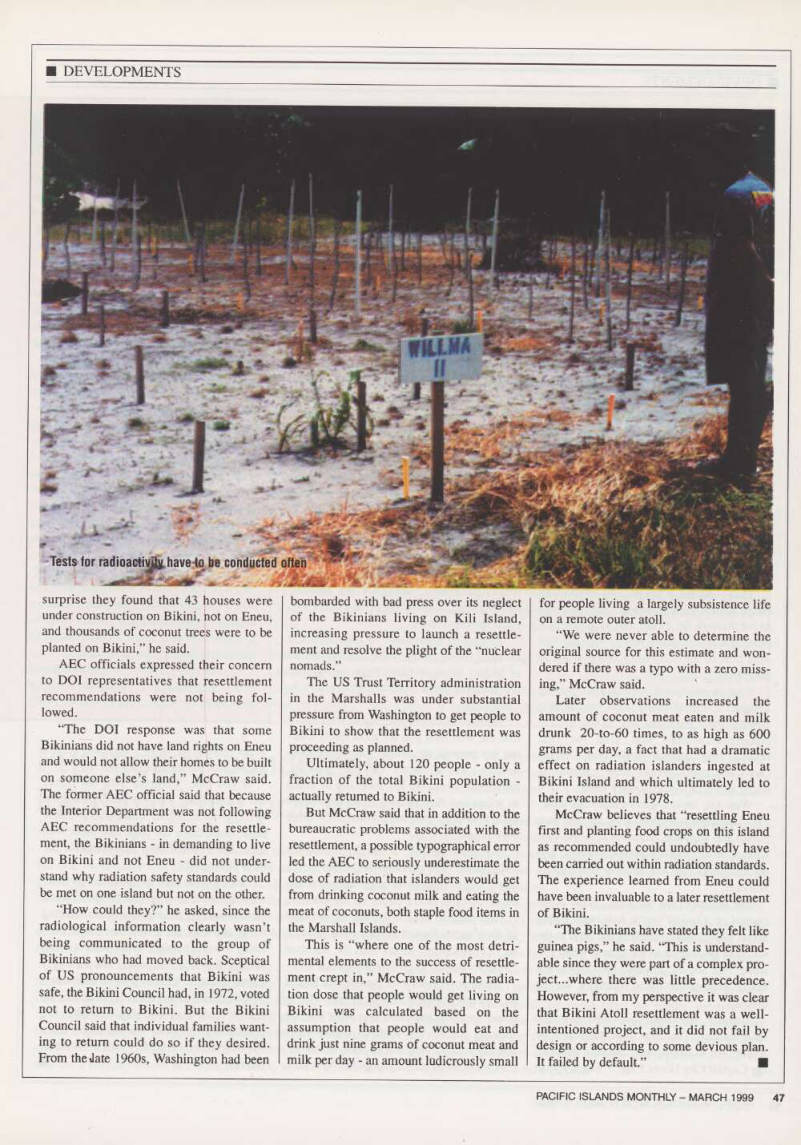
Tests for radioactivity have to be conducted often