No increase in payments for US Pacific missile range
p. 26 · Read in the full issue
US Pacific missile range
THE United States is not interest ed in escalating rental payments for using the Kwajalein missile testing range in the Marshall Islands, a State Department official says.
Emil Skodon, the director of the State Department’s Office of Australia, New Zealand and Pacific Island Affairs, said in an interview in Majuro mid-February that the issue of rental payments for Kwajalein is not on the agenda.
This was because the current agreement can be unilaterally extended by the US for an additional 15 years without re-negotia tion. Skodon was commenting on state ments in the media by Marshalls foreign minister Phillip Muller.
Muller had said that the island govern ment would seek to get “fair market value” for future use of the missile range when the current pact expires in 2001. The two countries begin talks later this year to re negotiate certain economic provisions of a Compact of Free Association.
Skodon said the Marshall Islands gov ernment has not formally approached the US about increasing rental payments for the base - a unique testing facility that the US has spent four billion dollars (A 56.23 billion) developing since the early 19605.
Kwajalein is at centre stage in the field testing of integrated ant.-missile defence systems intended for a missile defence sys- I tern that the US can deploy soon after the millennium.
The current lease payments are estimat ed at about 12.8 million dollars (A$ 19.92 million) annually and “will have grown by almost 50 per cent (during the first 15 years of the Compact),” said Skodon. The US will notify the Marshalls in October, as required by the Compact, if it plans to renew its option for a second 15 years’ use of Kwajalein, he said.
The US wants to “approach the negoti ations in a constructive and innovative way” so that future “economic assistance will be more effective for the benefit of the Marshallese people”.
US aid through the Compact has under written the economy of the Marshall Islands since 1986. US officials estimate that by 2001, about US$BOO million (A$ 1,245.12 million) will have been pro vided.
But US officials have said while the Compact has been a diplomatic and strate gic success story, little advancement was made in developing a more self-reliant
economy. Increasing accountability in the next phase of the Compact is a key issue on the US agenda, Skodon said. “We need to review what’s working and hasn’t worked,” he said.
“We - both sides - need fresh thinking about the most effective way to deliver assistance. There’s no simple answers.
We need to exchange ideas on how to achieve accountability so the delivery of aid is more effective.”
The talks will start in October. Skodon hopes they will not be lengthy because the overall Compact agreement is not up for re-negotiating, only some of the economic provisions.
“We’d like to see the talks take signifi cantly less time than the original negotia tions (which took 17 years),” he said.“We don’t have to look at the whole thing. The first negotiations were designing an inter nal combustion engine. We’re only doing a tune-up.”
Once the talks begin in October, the US will “be ready to move quickly,” Skodon indicated. (AFP) ■
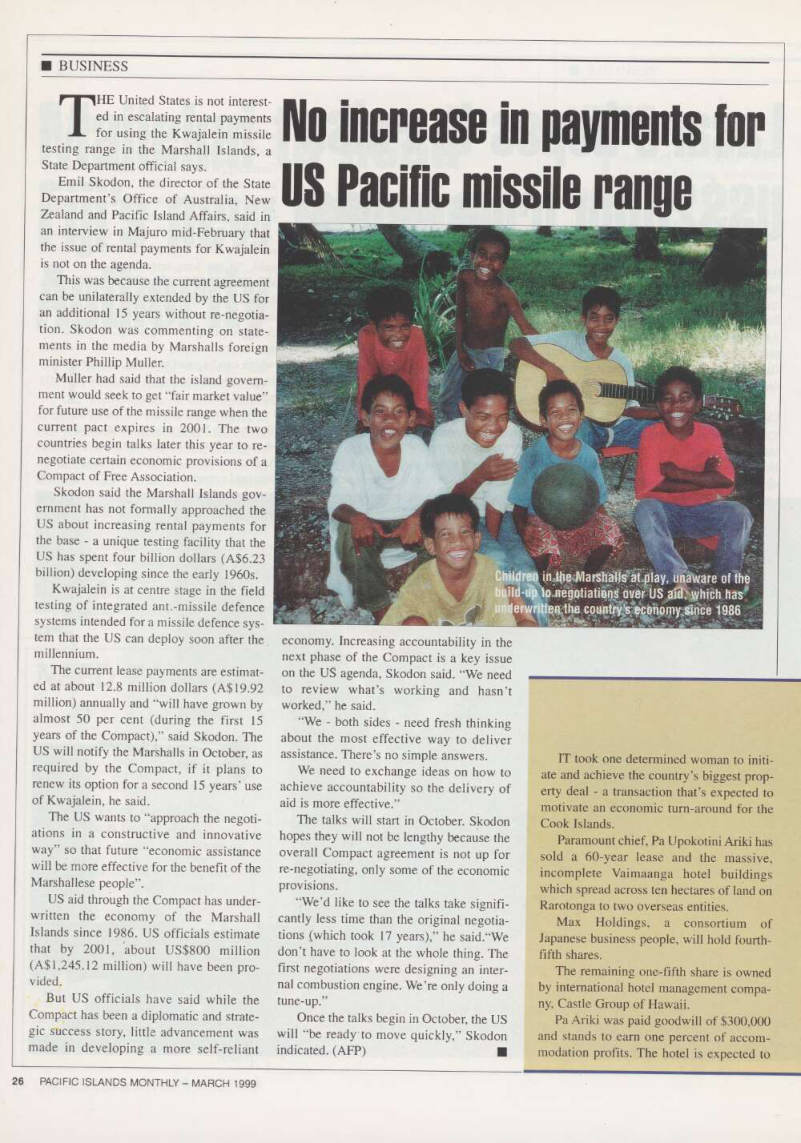
Children in the Marshalls at play, unaware of the build-up to negotiations over US aid, which has underwritten the country’s economy since 1986