Smoky's
pp. 52-53 · Read in the full issue
Yachting
Smoky's Pacific Odyssey
Story and pictures by SALLY ANDREWS
THE safe arrival of Smoky Cape, on December 6, marked the end of a 4,000 mile odyssey for the 7.3 metre yawl. Sailed from Tahiti by own ers Steve and Michaela Moss, Smoky was met by a flotilla of yachts from the Cruising Yacht Club of Australia, the Sydney Heritage Fleet, the Sydney Amateur Sailing Club, the Wooden Boat Association and other supporters.
Why all the fuss? Smoky Cape was built by one of Australia’s great sailors, Jack Earl, who circumnavigated in 1947-48 aboard Kathleen Gillett, a 13.4 metre gaff rigged ketch named for his lovely wife. Ten years later he built another traditional wooden boat, Maris, and in 1973 Smoky Cape.
Jack dreamed of taking his wife to Tahiti, his favourite cruising ground, but Kathleen fell ill and the dream was never realised.
Jack Earl’s love of the Pacific is reflected in
the images of islands, palms and people that fill his magnificent “Log of the Kathleen Gillett”. His logbook, now housed in Sydney’s Maritime Museum, is a lavishly illustrated account of his ocean voyage around the world.
Jack Earl loved the sea and ships. He instigated the now-famous Sydney-Hobart ocean race and was a great maritime artist and adventurer. “Sailing small boats was a liberation. It gave me independence and taught me self-reliance and gave me more self-confidence than anything else I ever did... People talk about Mother Earth. Well, the sea mothered me. It still does. Mind you, it’s very nearly killed me on occasions”.
In the rolling seas between Moorea and Huahine, Smoky’s boom snapped aft of the preventor when the main tried to gibe.
Michaela and Steve diverted to Fareve, entering the pass at noon. From Smoky’s log: “Just as I put the anchor down... a whale sur faced in the channel, showing its beautiful tail in a gentle dive”.
Next day, Michaela and Steve motored round to the village at the far end of Maroe Bay where an old man invited them to tie up
by inserting a piece of linseed-treated
Oregon pine and fastened it with four large thru-bolts.
Meanwhile, ten local children and teenagers came aboard, then twenty, finally thirty! A mere twenty-six feet from bow to stem. Smoky Cape’s waterline disappeared under the load of her human cargo!
“The children were friendly, polite, quiet, except for lots and lots of laughter. They asked many questions about us, the boat, where we slept, how we lived and what hap pens when we’re sailing. They were clever questions amidst a mesh of three languages and three phrase books - English, French and Tahitian”.
Steve and Michaela encountered the worst of their voyage on the leg between Tahiti and the Cooks when they were struck with gale force winds and waves 20-30 feet high. A sea-anchor off the bow helped them ride out the blow, but hand steering for five days was tiring. One thing they learned - Smoky was well-made and strong.
From Rarotonga, Smoky sailed to Vava’u.
Beach barbecues in the company of two big catamarans Susquehanna (US) and Endless Summer (AUS), and with yachts Masina (AUS) and Ishi (US), were interspersed with Tongan feasts and breakfasts at Joe’s Lighthouse Cafe on Vaka’eitu. Along Neiafu’s busy shoreline, colourful carafes of dinghies rafted up to docks while cruising couples enjoyed dinners and drinks at Ana’s, the Sunset Cafe, the Bounty Bar and the Paradise Hotel. One thing’s for sure, you don’t starve in Tonga!
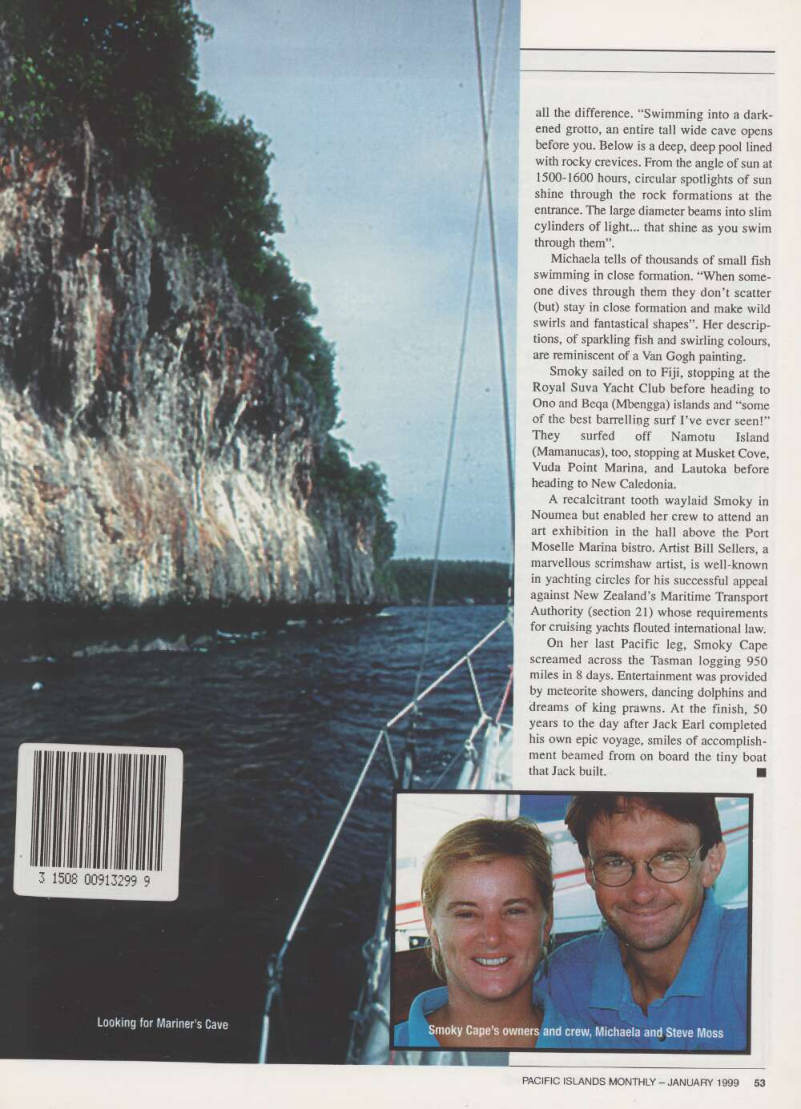
Michaela’s nickname “the Fish” is well deserved. Her account of Mariners Cave (Vava’u) reads: “The cave is large and dark and forty feet deep. There are nooks and crannies lining the walls where fish hide. At the bottom of the cave there is a second entry site and only a few among us had breath to use it. Watching friends exit the cave was spectacular - their hair flowed as they swam into the light. After ten entries and exits escorting people, I was tired but delighted.
“Each entry into the cave is scary and requires swimming through an underwater rock tunnel. Inside, the cave mists up as ocean swells hit the rocks at the entrance and pressure forces the air within the cave to con dense.
Another favourite Tongan swimming hole is Swallows Cave where the lighting makes
all the difference. “Swimming into a dark ened grotto, an entire tall wide cave opens before you. Below is a deep, deep pool lined with rocky crevices. From the angle of sun at 1500-1600 hours, circular spotlights of sun shine through the rock formations at the entrance. The large diameter beams into slim cylinders of light... that shine as you swim through them”.
Michaela tells of thousands of small fish swimming in close formation. “When some one dives through them they don’t scatter (but) stay in close formation and make wild swirls and fantastical shapes”. Her descrip tions, of sparkling fish and swirling colours, are reminiscent of a Van Gogh painting.
Smoky sailed on to Fiji, stopping at the Royal Suva Yacht Club before heading to Ono and Beqa (Mbengga) islands and “some of the best barrelling surf I’ve ever seen!”
They surfed off Namotu Island (Mamanucas), too, stopping at Musket Cove, Vuda Point Marina, and Lautoka before heading to New Caledonia.
A recalcitrant tooth waylaid Smoky in Noumea but enabled her crew to attend an art exhibition in the hall above the Port Moselle Marina bistro. Artist Bill Sellers, a marvellous scrimshaw artist, is well-known in yachting circles for his successful appeal against New Zealand’s Maritime Transport Authority (section 21) whose requirements for cruising yachts flouted international law.
On her last Pacific leg. Smoky Cape screamed across the Tasman logging 950 miles in 8 days. Entertainment was provided by meteorite showers, dancing dolphins and dreams of king prawns. At the finish, 50 years to the day after Jack Earl completed his own epic voyage, smiles of accomplish ment beamed from on board the tiny boat that Jack built. ■
Looking for Mariner’s Cave
Smoky Cape’s owners and crew, Michaela and Steve Moss