Cooks' govt proposes major pearl
pp. 38-39 · Read in the full issue
farm in wildlife sanctuary
By Florence Syme-Buchanan
A GROUP of tiny islets that dot a spectacular lagoon makes up Suwarrow - an untouched sanctuary for native birds, green turtles, untold other marine life and the yachts that call in regularly.
The Cook Islands government’s record of disregarding advice may mean an envi ronmental group’s fight to keep Suwarrow a national park and free of development, may be an exercise in futility.
Active Cook Islands environmentalist Anna Tiraa-Passfield knows this. She doesn’t hold great hopes their Save Our Suwarrow campaign will get serious con
sideration saying the dollar signs popping
up in front of official’s eyes are more important to government.
For over two years ago the Cooks gov ernment has been talking about turning Suwarrow into a major pearl developing site and economic projections were done by the PM’s office.
Knowing that large stocks of wild pearl shells grow in Suwarrow’s massive lagoon and without an EIA, officials decided the atoll is the most suitable place to farm.
After a tendering process, a Hawaiian company was selected to do an EIA - that’s been done and the team have three months to complete their report for government.
The Save Our Suwarrow (SOS) group wants government to make that report pub lic. Because of government’s push for Suwarrow development, there are concerns that the EIA will address the best way to utilise the Suwarrow environment to pearl farm rather than whether this should be done at all.
That’s irrelevant, as far as PM’s office chief of Staff Temu Okotai is concerned, who says, “Pearl farming is farming in the lagoon, what is the concern of these extreme environmental groups?”
Those concerns, says Tiraa-Passfield are whether the EIA will be made public and consultation sought on the team’s find ings, protection of the environment and wild-life and the impact of up to 150 peo ple living there.
Only caretaker, Margaret Marama and her family of four live on Suwarrow,
returning to Rarotonga for the hurricane season between November and May.
Tiraa-Passfield points to the Suwarrow policy plan written by the PM’s office and says this should have been done by the EIA team.
Suwarrow is the biggest bird breeding ground in the South Pacific, says Tiraa- Passfield. It is also a breeding ground for the green turtle and coconut crabs. “The coral and fish in the lagoon is spectacular the environment is pristine.”
She says if people begin living on the outlying islets, they will become like Anchorage island, the main atoll where “very little wildlife breeds.”
World Wildlife Fund rep in the Cooks, Jackie Evans is also concerned about the government’s development plans because it could mean the natural habitat of many native species will be endangered.
Okotai avoided the question of whether the concerns were well-founded, saying instead Tiraa-Passfield and others in the Save Our Suwarrow group should look at
how Pukapuka Island’s environment is conserved by islanders there.
Environmental groups “jump on the band wagon, it’s not unusual for environmental groups to say ‘no development’, I don’t have much time for them,” says Okotai.
In the early eighties, Cabinet declared Suwarrow a national park. However, this was never legislated.
Now Cabinet is going back on its word, but Okotai explains that in the eighties pearl farming was not an important indus try for the country.
Okotai is enthusiastic over Suwarrow’s pearl farming potential and asks, “Do we lock it up, or do we look at developing it the right way...the pearl potential should be developed. We are looking at the well being and aspirations of the people of the Cook Islands and these are the kind of things that environmentalists want locked away,” Okotai says.
He’s “sure that government would take onboard” public concerns over Suwarrow development, but could not guarantee that
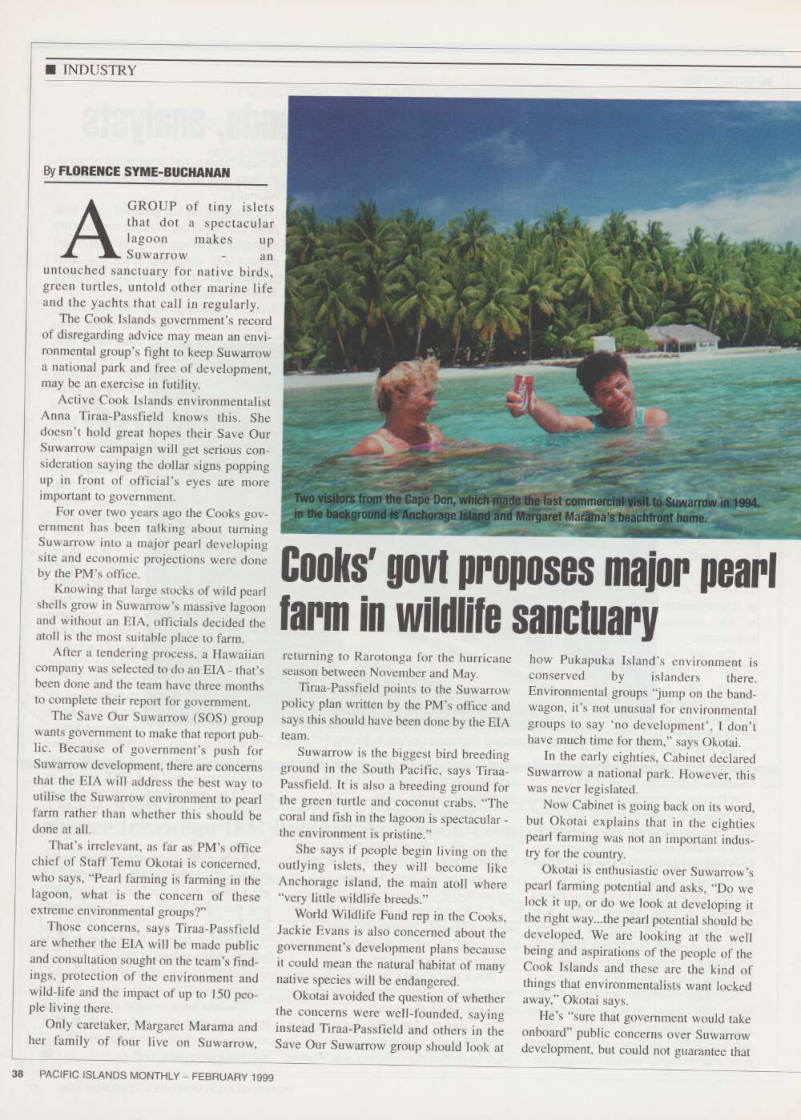
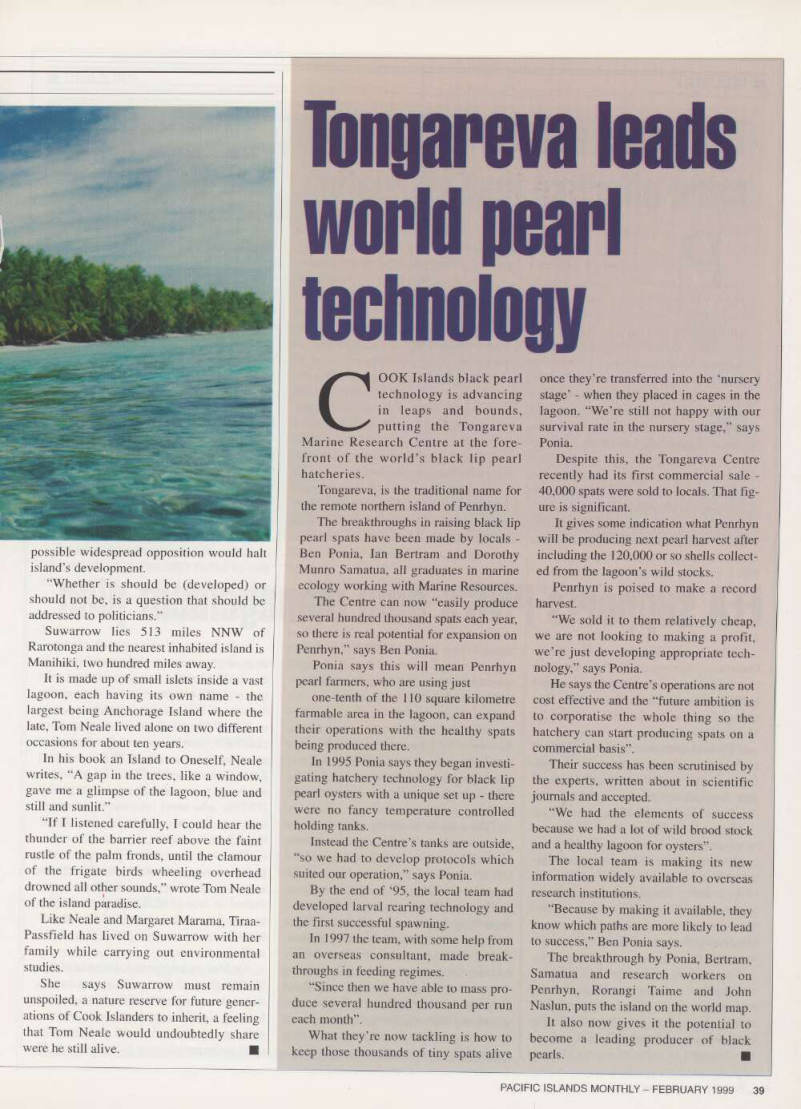
Two visitors from the Cape Don, which made the last commercial visit to Suwarrow in 1994 in the bakground is Anchorage Island and margaret Marama's beachfront home.
possible widespread opposition would halt island’s development.
“Whether is should be (developed) or should not be, is a question that should be addressed to politicians.”
Suwarrow lies 513 miles NNW of Rarotonga and the nearest inhabited island is Manihiki, two hundred miles away.
It is made up of small islets inside a vast lagoon, each having its own name - the largest being Anchorage Island where the late, Tom Neale lived alone on two different occasions for about ten years.
In his book an Island to Oneself, Neale writes, “A gap in the trees, like a window, gave me a glimpse of the lagoon, blue and still and sunlit.”
“If I listened carefully, I could hear the thunder of the barrier reef above the faint rustle of the palm fronds, until the clamour of the frigate birds wheeling overhead drowned all other sounds,” wrote Tom Neale of the island paradise.
Like Neale and Margaret Marama, Tiraa- Passfield has lived on Suwarrow with her family while carrying out environmental studies.
She says Suwarrow must remain unspoiled, a nature reserve for future gener ations of Cook Islanders to inherit, a feeling that Tom Neale would undoubtedly share were he still alive. ■