merge thcni
pp. 30-33 · Read in the full issue

Cover Story
If you can't beat 'em...
The final say on mergers and acquisitions
Story and Pictures by Sophie Foster Hildebrand
IN the 21st Century, there is no doubt that the key words for business and industry will be mergers and acquisitions.
For some businesses, declining margins are leading towards secret and not-so-secret negotiations, to not so much give in to the opposition, as to pool resources.
So far, in the Pacific, local mergers have been the result of parent companies over seas joining, and filtering the decision down to their level.
The Price Waterhouse/Coopers & Lybrant merger had the effect of joining these accounting firms, previously in fierce
competition with each other, in offices throughout the Pacific.
The merger was seen as necessary because of similar mergers by other com petitors in the United States, which severe ly disadvantaged the two companies.
In places such as Fiji however, the merger has effectively given the joint ven ture a major chunk of the market.
The planned Rothmans Holdings and WD & HO Wills merger, which will effec tively form a group that would capture 16 per cent of the world tobacco market, may also have some repercussions in the islands.
Rothmans, with the Winfield, Holiday and
Dunhill under their sleeves, has been in fierce competition with Wills, which holds the Benson & Hedges, Horizon, Stradbroke and Export brand cigarettes.
The issue is one that Fiji’s Fair Trading and Consumer Affairs section will have to address over the next few months.
Colin Fewis of the FTCA says since the issue will be dealt with by Australian author ities, under Australian competition laws sim ilar to that of Fiji, the ministry will adopt a wait-and-see approach.
“The ministry of commerce and industry would be guided by the reaction to the pro posed Rothmans/Wills merger by competi tion authorities in other countries before considering whether any action is desirable or possible under the Fair Trading Decree,” he said.
It is likely that the Australians will not allow the merger to go ahead under their rules for competition.
As it is, the atmosphere for tobacco com panies is not too friendly world-wide, with bans on advertising and other restrictions
being enforced.
In Fiji, an advertising ban is in force for cigarette advertising.
John Nelson, the general manager of the
Central Manufacturing Company, which
produces cigarettes for both Rothmans and Wills, says the ban is restricting competition.
“Advertising bans directly restrict consumer
Westpac Banking Corp (Fiji’s Walu Bay branch, left), and Carlton Brewery Fiji Limited (right) have expanded their bases through acquisitions
information, consumer choice and reduce
competition between major brands.
Our marketing activities are aimed sole ly at adult smokers, to confirm their deci sion to smoke our brands, or to change their brand preference. An advertising ban will reduce free market competition by restrict ing our ability to inform consumers of the choice of products,” he said.
It is in this climate that the planned merger between the parent companies of Fiji’s top tobacco companies is being endorsed.
It is understood that the effect of the merger of the parent companies will not affect the Fiji companies yet, and it may take up to five years for the merger to take effect in the Pacific.
One reason for any merger or acquisition is to increase efficiencies, according to one businessman. Instead of over-servicing a market, a joint operation would mean best cost efficiencies and better utilisation of resources.
This may be the explanation for the Courts Fiji Limited and Bums Philp merger, which saw Courts as the dominant player.
This merger went ahead despite the fact that of all the mergers that Fiji has seen, this particular one seems to have contravened the Fair Trading Act.
Officials say this particular merger should have been closely looked into, because of the fact that they were two of the big three hire-purchase companies in Fiji.
However, because no full investigation was made, the merger has since gone ahead and no further action will be taken against the companies. However, this particular merger illustrates the type of options that
companies may desire to pursue because of
fierce competition eating into profit mar
gins.
Because of the competition, both com panies have had to maintain relatively huge advertising budgets, as well as a price war, as part of their annual expenses in order to keep their brand names competitive.
The banking industry too, has developed because of acquisitions.
Westpac Banking Corp Ltd said acquisi tions were still a key part of its regional growth strategy, but any take-over would be friendly and not an on-market cloaked raid on a rival’s share registry.
In the past 21 months, Westpac had increased its market reach by acquiring Challenge Bank in Western Australia, Trust Bank of New Zealand, and Bank of Melbourne in Victoria. The successful strat egy was partly responsible for its share price rising, closing at a record $11.685 on January 7, as the bank extracted cost sav ings from its new subsidiaries.
In mid-January, Westpac’s group execu tive retail banking, Michael Hawker, said the bank had a “lot of room” for organic growth by improving customer service.
“We look at growing organically or acquis itively to grow our business... That’s very much a part of our strategy and we really are tied to it,” he said.
Mr Hawker said that when Westpac examined a potential acquisition, “we look at what is the investment required, what is the return coming out of that investment and what is the time it’s going to take to come out of that investment”.
Col Lewis, who advises the Fiji govern ment on fair trading and consumer affairs,
said that since 1992, when the Fair Trading Decree was introduced, any mergers that will create dominance of a market of goods ■ and services have been prohibited.
This section of the law was tested when Carlton Brewery proposed to buy majority shares in South Pacific Distilleries In Fiji.
There were concerns raised that this merger would create a virtual monopoly for the Brewery in the alcohol industry.
Mr Lewis says the provision is “very tricky” because it talks about markets, “so you get into having to define what the mar ket is”.
“Is beer in the same market as spirits and so forth? What is dominating a market?
How much market share is there? Do they take more than 80 per cent? So it’s a very complicated area,” he says.
Mr Lewis says that although the market dominance provisions have been in the fair trading act since 1992, “there’s not really the expertise around Fiji to properly admin ister it”.
But he says that that is “not surprising because in most developed countries like in Australia, it’s only in the 1970 s that it came in there and it’s only in recent years that they’ve really got that sort of expertise”.
He says that not a lot has been done and there’s been no action taken against any mergers so far.
As an example, one of the areas where the dominance provision could be applied is with the gas suppliers. Late last year, busi nessman Hari Punja, who owns the gas company operating as Blue Gas, indicated to the media that he was interested in buy ing majority shares in Fiji Gas. That compa ny is currently owned by Boral (majority
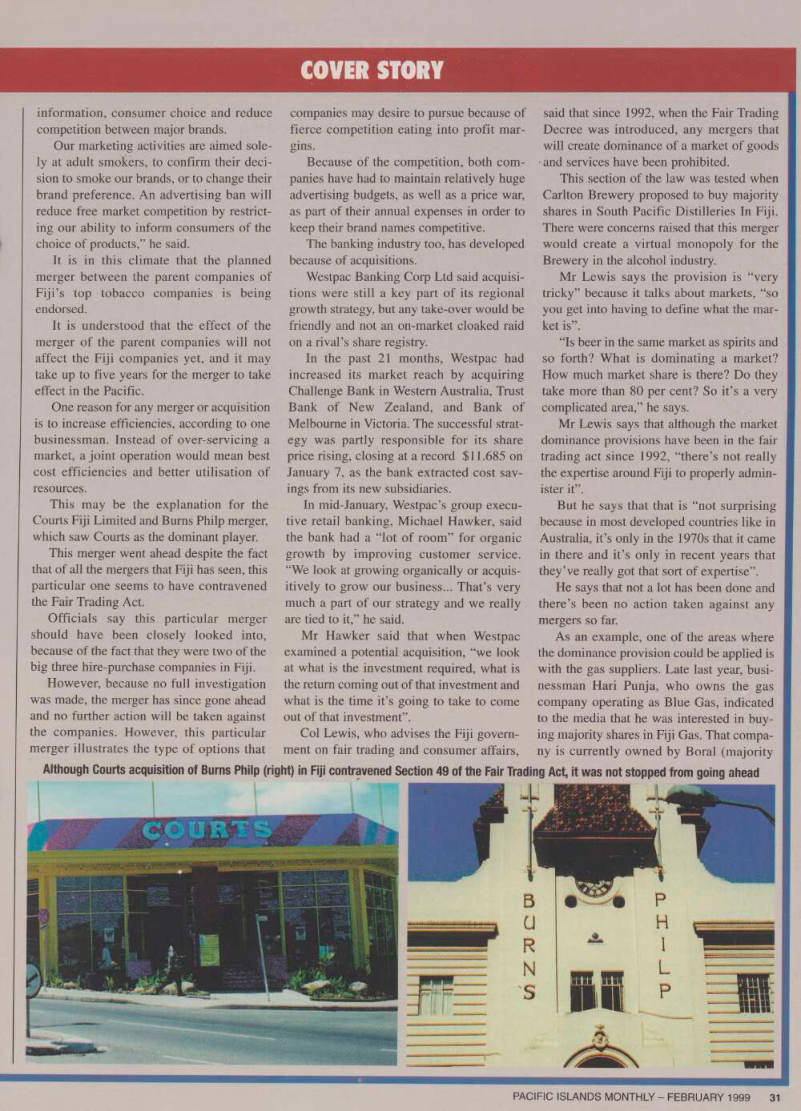
Although Courts acquisition of Burns Philp (right) in Fiji contravened Section 49 of the Fair Trading Act, it was not stopped from going ahead
shares) and several local shareholders. If Boral had agreed to the sale, which it did not, Mr Punja would have then had to deal with the consequences of contravening the dominance provision in the current merger legislation.
When the amendments are passed, how ever, such a deal will probably be allowed to take place, if it transpired that it was “in the public interest”.
As it was, the deal is said to have amounted to normal ongoing talks between the gas companies, and this case is merely quoted as an example.
Officials say that one of the problems with the current fair trading act is makes any sort of dominance of the industries illegal. This has presented a problem to the most dominant business in the country, the government.
It has several monopolies, and is sup posed to be in the process of trying to cor poratise several of them. Fiji’s minister for commerce, trade and public enterprises,
Isimeli Bose told parliament that “in light of experience and to ensure that the decree continues to be effective and suited to evolving market conditions, it is necessary for the competition provisions of the decree to be refined”.
“Of particular significance”, he said, “relating to public enterprise reform pro gramme, is the need to ensure competition in the environment in which public enter prises operate and in particular in review ing conditions for monopolistic competi tion”.
He said the decree prohibits a wide range of practices that were likely to have the effect of substantially reducing compe tition, but it “does not recognise that, in some cases, they may nonetheless, be in the public interest”.
He said there may be benefits through economies of scale that result from an agreement, expansion of employment and growth in export markets.
Mr Bose said in Australia, the issue has
been addressed and legislation does allow agreements, mergers, and other practices that, although possibly having a negative effect on competition, “may in fact result in a public benefit which outweighs the
negative aspects”.
The government has already passed the amendments to the Fair Trading Bill that allow for a similar regime in Fiji. It now has to pass the senate before it can come into force.
Another major change including in the Fair Trading Amendment Bill 1998, is the fact that, when it is passed, any contraven tion will no longer be “an offence” but will
be punished by penalties.
Currently, any contravention of the competition provisions of the decree con stitute a criminal offence and punishment may include imprisonment for up to two years.
Mr Bose said because it was a criminal offence, the standard of proof required was ‘beyond a reasonable doubt’.
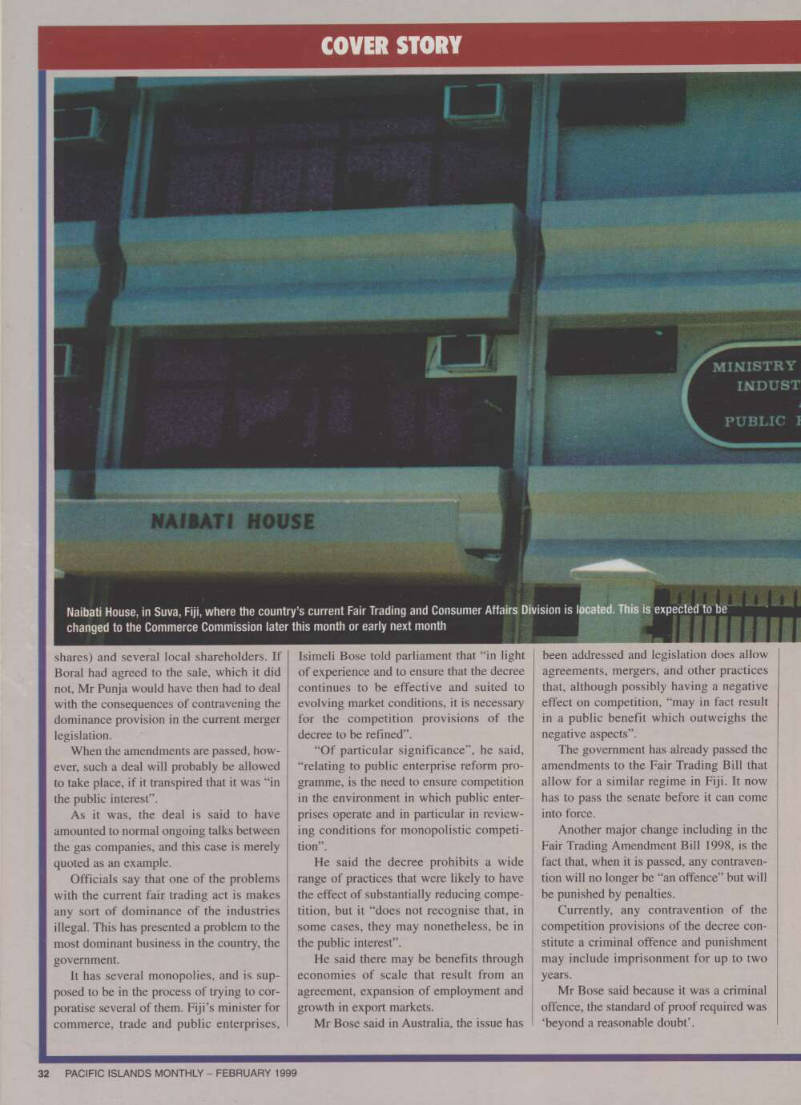
Naibati House, in Suva, Fiji, where the country’s current Fair Trading and Consumer Affairs Division is located. This is expected to be changed to the Commerce Commission later this month or early next month
“In practice, it is an extremely onerous burden to prove a contravention ‘beyond a reasonable doubt’ where the elements of a contravention may include such matters as ‘substantially lessening competition’,” he said.
However, corporations will not get away scot-free. With the passage of the amend ments, a penalty of up to one million dollars may be imposed against a corporation for each contravention of the competition provi sions. Along with the amendments, another bill for the setting of a Commerce Commission, is likely to go ahead.
This Commission will take the place of the current Fair Trading and Consumer Affairs Section of the ministry of commerce, acting independently with the powers of the Bill.
This is likely to be set up at the end of this month or early March and may help pave the way for more mergers and better price controls in both Fiji’s private and pub lic sectors. ■