(Eat chicken)
pp. 26-27 · Read in the full issue
Kai kokorako (Eat chicken) Promoting fowl as a small-scale business alternative
POULTRY keeping
in Third World countries is very often overlooked as an important source of food protein and small-scale cash income.
Well-intentioned aid organisa tions sometimes attempt to intro duce larger, more expensive and complicated animals such as sheep, goats and cattle or unfa miliar ones such as rabbits or guinea pigs for this purpose.
Poultry have been the companions of man almost as long as cats and dogs.
Most people throughout the world are familiar with poultry keeping and chicken meat or eggs as food.
Two simple pidgin words “kai koko rako” have been linked to form a slogan for the most recent attempt to encourage proper poultry keeping and chicken for
better results in Solomon Island vil lages. The training is being provided at the village level, where it is most effective, with the assistance of the Department of Agriculture Poultry Breeding Station at Tenavatu, Honiara.
Initial workshops are being conducted at Munda in the Western Province of the Solomon Islands.
Whilst the training is aimed at the village level where it is sorely needed, selected trainees from these workshops will be used to continue the work in their areas after the ini tial programme.
Eighty per cent of the 350,000 plus pop ulation of the Solomons lives in a subsis tence rural lifestyle where providing your own food is an important daily activity.
Whilst most villages have small flocks of nondescript fowls wandering freely, these birds supply very few eggs and meat chickens because they are not properly cared for and kept safe from predators such as cats, dogs and hawks. Other attempts are made in larger centres to operate small
commercial farms to meet the needs of the people but these have varying degrees of success due to the reliance on expensive imported feeds and chickens.
This is a common situation throughout much of the Third World and Pacific Islands. At the moment the Kai Kokorako programme is concentrated in the Solomon Islands where Russell Parker has a long
association and experience.
It is based on a few simple improved management techniques that will deliver better results from the poultry almost
immediately.
These are to keep poultry safe from predators and weather, and to keep the poultry from wandering away most of the day to lay eggs where they can’t be found.
This means that a special house needs to be built for the poultry but it can be
made simply and cheaply from the same materials and meth ods as the villagers’ houses.
The fowls are kept in these houses for most of the day where they can be fed, watered and the eggs gathered before the fowls are allowed to run free. This means letting them out late afternoon in order for them to find the other neces sary things for their diet and health, green food such as leaves and grasses, insects and scratch
ing in the dirt.
These special houses for the poultry also allow for hens to hatch and grow their chickens safely and with proper feeding so that replacement fowls can be provided.
The KK programme requires supple mentary feeding of the poultry for results but this does not mean that expensive imported feeds are necessary.
All that is needed is a mixed and bal anced diet the same as people. Fruit such as coconuts, bananas,
pawpaw (papaya),
vegetables like yams and potatoes, com, green leaf vegetables and protein such as meat and fish scraps or peanuts and beans.
Only a small quantity of food is required each day -
approximately the
equivalent of an adult person’s meal for a pen of 10 to 20 fowls. A small amount of grated coconut or rice can be used to encourage the fowls back to their house each
evening. Naturally it is also very important that the poultry be provided with fresh drinking water always.
The Kai Kokorako programme is also
very important because by encouraging
better village production of eggs and meat, it reduces the reliance on depleted wildlife as a food source.
The need for extra fruit and vegetables also stimulates garden production and the manure from the poultry houses can be
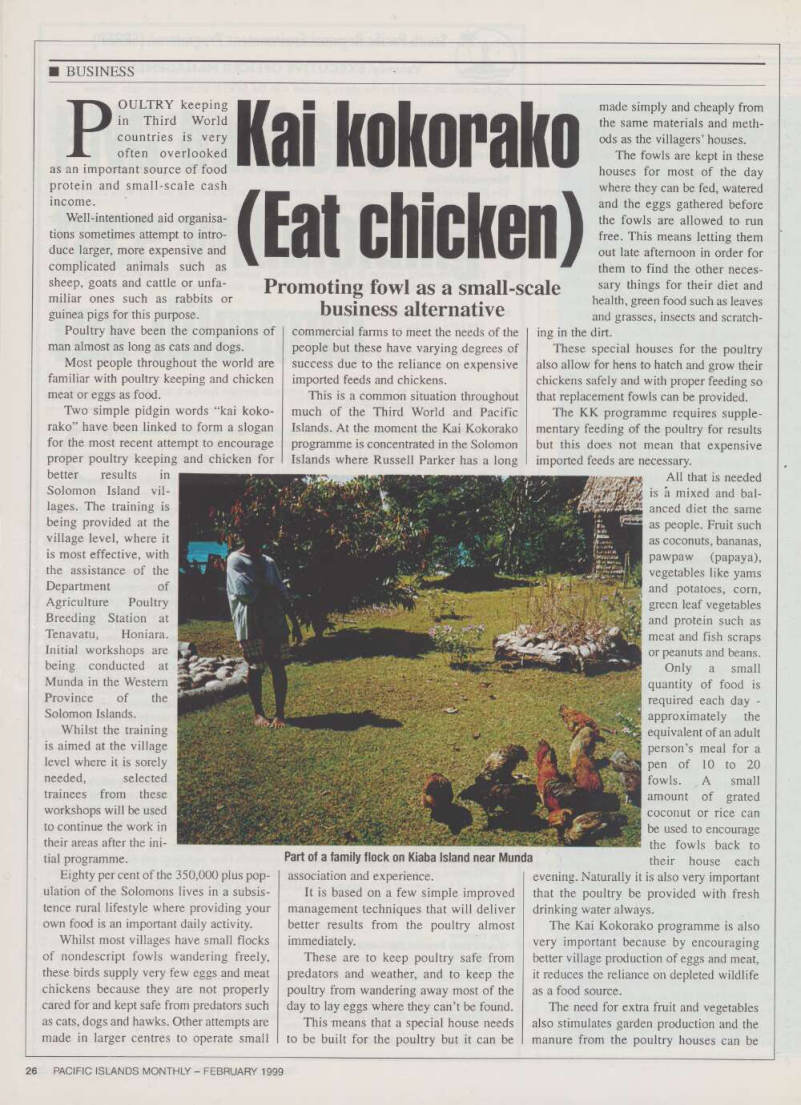
Part of a family flock on Kiaba Island near Munda
used on those gardens. Students at Munda were also left with a small poultry breed ing station to use in ongoing training as well as providing improved breeding stock.
Recipes for poultry feed were also for mulated from local ingredients such as fish
meal and copra cake together with additives such as rice, fruit and vegetables.
Information booklets on village poultry keep ing have been translated into the local language and have been distrib uted locally for the use of the village people.
Another important
part of the poultry
breeding programme
conducted by Russell Parker in the Solomons is the inclusion of the local village fowls in that programme.
These fowls originate from the eastern Solomons area where
there are still wild jungle fowl living. The inclusion of the hardiness and foraging ability of the wild fowls helps provide a village fowl that is more suitable for the conditions and climate in the Solomon Islands.
The Red Jungle Fowl are claimed to be the forebears of most of the domestic fowl breeds of today. As such they are of immense value to both the world food sources and economics.
Over the centuries, these birds have been distributed across the world from their main areas of origin in Asia by explorers, travellers and settlers.
Both natural development and selective breeding have contributed to the numerous varieties of fowl that now exist throughout the world. Inbreeding, hybridisation and genetic engineering efforts in recent decades have taken us even further away from these natural birds, the Jungle Fowl.
Therefore the small pockets of jungle fowl still living in the wild are almost liv ing dinosaurs and as such should be of great interest and value to the world.
These fowl, which roam free on islands such as Santa Cruz in the Solomon Islands or Santo in Vanuatu, have the added attrac tion of prompting the question of whether
they arrived through ancient human popu lation migrations or unsuccessful colonisa tion by 16th century Spanish explorers.
The wild jungle fowl of Santa Cruz are known to outwardly resemble their coun terparts in nearby Vanuatu and Fiji although DNA testing would probably be
the only sure way of confirming any con nections.
Did these birds arrive from the north west with the Austronesian migration or from the North with the Polynesians?
Were they further dispersed by inter
island trading trips?
If so then why are these birds found only in the Eastern Province of the Solomons and not throughout the whole group? Perhaps these fowls did arrive with Mendana’s ill-fated second voyage from Peru in 1595 and were gradually dispersed into nearby Vanuatu through canoe travel.
The wild pigs in the Eastern Solomons have also been attributed to Mendana but perhaps their origins were along the same path as the fowls!
Literature does refer to the fact that Mendana’s men clashed with the local peo ple because the Spaniards did not want to pay for the pigs they took. This seems to mean that the pigs were already there.
As Mendana and many other explorers of the time had either sailed through South America or the Philippines, both of which were under strong Spanish influence at the time, it is most probable that some or all the poultry carried at the time was collect ed at their embarkation ports.
If they were collected in the Philippines', the fowls would have had a strong Asian or jungle fowl background. If they were brought from South America, they would have either had Mediterranean origin or from the older local species - one of which laid a blue shelled egg. Again
DNA testing, although an expensive scientific tool, would be neces sary to provide more evidence for origins of these fowls.
Whether the fowl that exist in these islands were from Asian jungle fowl or Mediterranean origins, considering the many centuries that they roamed free, it is not unreasonable to expect that, whichever they were, they still reverted to the original jungle fowl type.
Populations of feral fowls in the north-east of Australia are exam
ples of how quickly these birds revert to their original jungle fowl colouring and appearance if left to their own devices for a few decades.
So several centuries of free breeding in the jungles of the Pacific were sure to result in the birds we see today.
European settlers and traders have, per haps, contributed a little to the bloodlines of these wild birds, through their importa tion of fowls from Australia or New Zealand.
However, there has been no major European habitation in the Eastern Solomons where these jungle fowl flour ish. The continued survival of these wild fowls is not only of environmental, genetic and historical importance, but also as a source to toughen the survival characteris tics of village poultry in the islands.
Only small areas of land are required to set up successful poultry breeding activi ties so the Kai Kokorako programme is especially suited to many of the Pacific Islands that are small, overcrowded and have poor soil.
These practical village poultry breeding
services provided by Russell Parker are available to interested people throughout the Pacific. ■
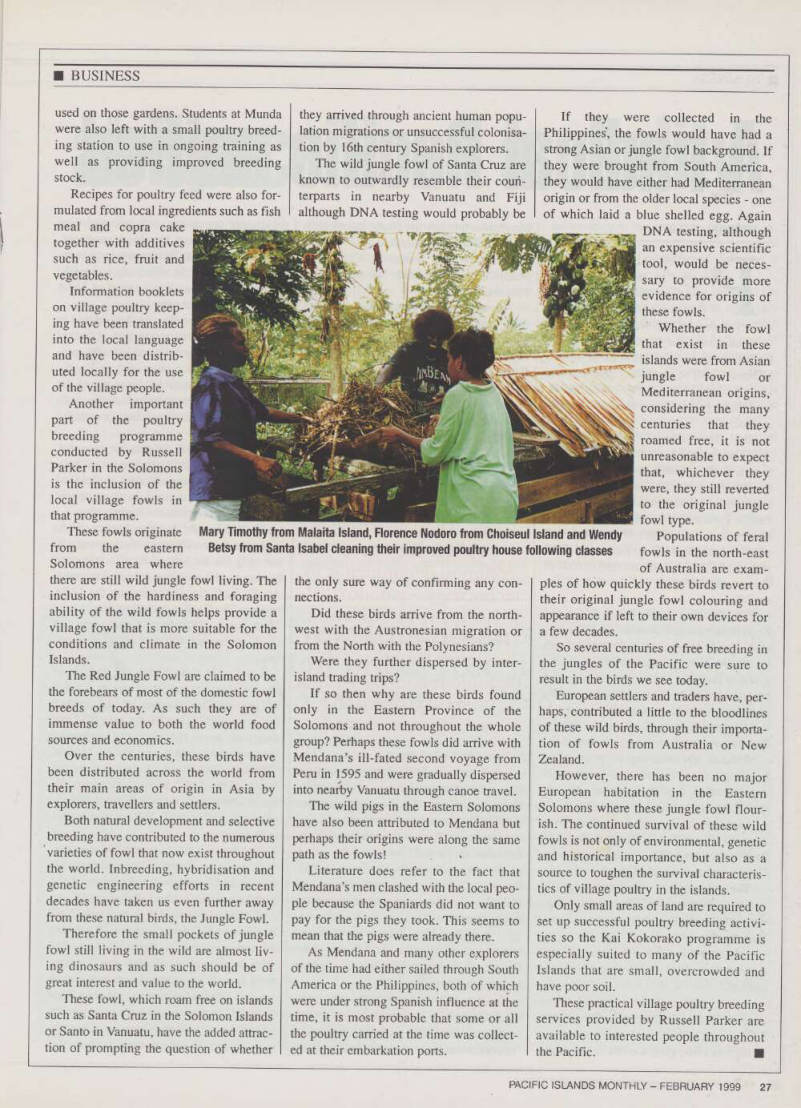
Mary Timothy from Malaita Island, Florence Nodoro from Choiseul Island and Wendy Betsy from Santa Isabel cleaning their improved poultry house following classes