Pentagon approval
p. 18 · Read in the full issue
Aloha awaits Pentagon approval for Marshalls ’ air service
By Giff Johnson
DESPITE Continental Micronesia’s reduction in flights to the Marshall Islands and Federated States of Micronesia, and claims that the route is a money-loser, Aloha Airlines is planning to launch air service in competition with Continental. Approval of landing and refuelling rights at Johnston Island is the “only real obstacle” to Aloha starting ser vice to the Marshall Islands and FSM, according to the Honolulu based airline’s vice president for planning and development.
If Aloha enters the market, it would be the first US-based air carrier in more than 10 years to compete with Continental on this north Pacific route. Aloha vice president for planning and devel opment, Jim King, said in an interview that he expects a decision
from the US Department of Defence by the end of January on the airline’s request for
landing and refuelling rights
at Johnston - an island used by the military for destroying World War II vintage nerve gas. It is located roughly mid way between Honolulu and Majuro, and stopover privi leges are necessary for Aloha’s fleet of Boeing 737 aircraft, which cannot make the 2,200 mile haul from
Honolulu to Majuro non-stop. The Marshall Islands government has gone to bat to assist Aloha to get Defence Department approval for landing at Johnston - no easy accomplishment and something that has frustrated Continental Micronesia over the years because its service was limited to four stopovers weekly at Johnston when previously it had six flights (three east and three west-bound).
If Aloha is successful, Continental would “be surprised and very disappointed,” said Continental vice president for promo tions and sales Wally Dias.
Continental Micronesia has “unsuccessfully negotiated with the Department of Defence for years to increase the amount of authorised landings we could make on Johnston,” he added. The US military is doing the bare minimum for Continental as it is. In early January, a Continental island hopper was 24 hours delayed leaving Honolulu because of mechanical troubles.
When Continental requested refuelling, Johnston Island offi cials refused, forcing Continental to cancel the flight until the reg ularly scheduled service three days later. “The Marshall Islands
government has kindly used their contacts within the US Department of Defence in Washington to get Aloha’s request for Johnston fuel stops reviewed,” King said. “This review if current ly going on, and we have high hopes that it will result in Aloha’s receiving permission to stop at Johnston”. If Aloha can get land ing rights at Johnston, its planned route is Honolulu-Johnston-
Majuro-Kwajalein-Pohnpei round-trip, said King.
“Our planning time line is 45 to 60 days following receipt of landing rights at Johnston,” he said.
Opening of service to the islands would also involve modifica tions to the planes, crew training and marketing of the new ser vice, he said. King said that Aloha has been interested in serving the Marshall Islands and Micronesia for some time “and we have been holding increasingly serious talks with government offi cials”. Aloha is currently operating a weekly air service connect ing Honolulu with Christmas Island in Kiribati, and is considering increasing that to twice weekly depending on the Japanese gov ernment increasing its presence at Christmas.
It is also discussing extension of the service through to Tarawa, a development that King says the Kiribati government is very keen to see happen, but one that would require “a heavy econom ic subsidy”.
The reduction in service by Continental from three to two weekly flights last September has caused repeated pileups of mail and cargo in Honolulu, forcing the US Postal ’Service to charter flights to get mailed delivered to the Marshall Islands.
Despite the frequent back log of mail and cargo, Continental says that two flights weekly - with an added third flight during peak summer and Christmas periods - provides adequate seating capacity for passen gers. “The current market demand does not appear to support additional capacity,”
Dias said in explaining Continental’s decision to stick with the two flight
schedule in 1999. Continental officials have also frequently said that they do not make money on this “island hopper” route, despite now having a high per-mile ticket cost. The discounted fare for the 2,200 mile Majuro-Honolulu route is $837, compared to fares less than half that for routes of a similar distance"between Honolulu and the US west coast.
Aloha’s King said that his airline “would not be interested in starting this service (to the Marshalls and FSM) unless we believed it was going to be economically viable for us. The fact that our main base of operations is already in the Pacific and our choice of the thrifty twin-engine, two-pilot Boeing 737 may be two reasons that our financial projections look better than Continental’s”. But Continental is gearing for a switch to the Boeing 737 as part of a massive aircraft re-fleeting program start ed last year. By the end of 1999, Continental will have received 115 new Boeings and a portion of the new 737-800 series jets will go into service on the Micronesia route by mid-2000.
Dias said the new generation of jets will likely allow Continental to bypass Johnston Island. ■
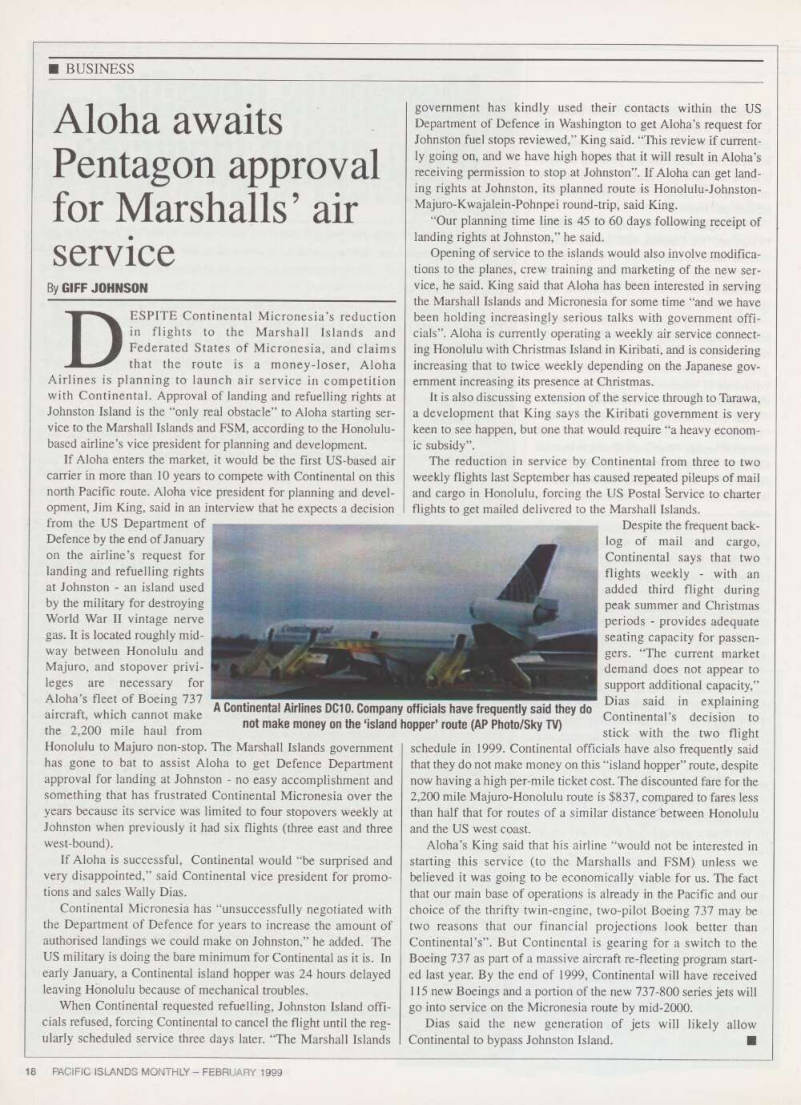
A Continental Airlines DC10. Company officials have frequently said they do not make money on the ‘island hopper’ route (AP Photo/Sky TV)