gold
pp. 10-12 · Read in the full issue

Special Report
A moder-day gold rush
By Andrew Kilvert
ANEW wave of economic migrants in Irian Jaya, pouring in to search for gold, has sparked con cern for the rights of local people.
Thousands of migrants from the Indonesian Islands of Java and Bali are flooding into the contested Indonesian province of Irian Jaya in search of gold.
This is creating further tensions between the Papuan population and the Indonesian authorities in this already
troubled province.
Many Irianese or West Papuans see this latest wave of migration as a fur ther setback to their aspirations for independence from the 30-year Indonesian military rule.
As with previous waves of Indonesian migration there is also con
cern that it will result in further dis possession of local peoples from their traditional lands.
The military authorities in Irian Jaya do not recognise traditional land own ership and continue to evict local peo ple from land that is wanted by the mil itary for settling migrants or resource extraction.
The flow of migrants in search of gold has been increasing steadily since the collapse of the Indonesian Rupiah in April 1998.
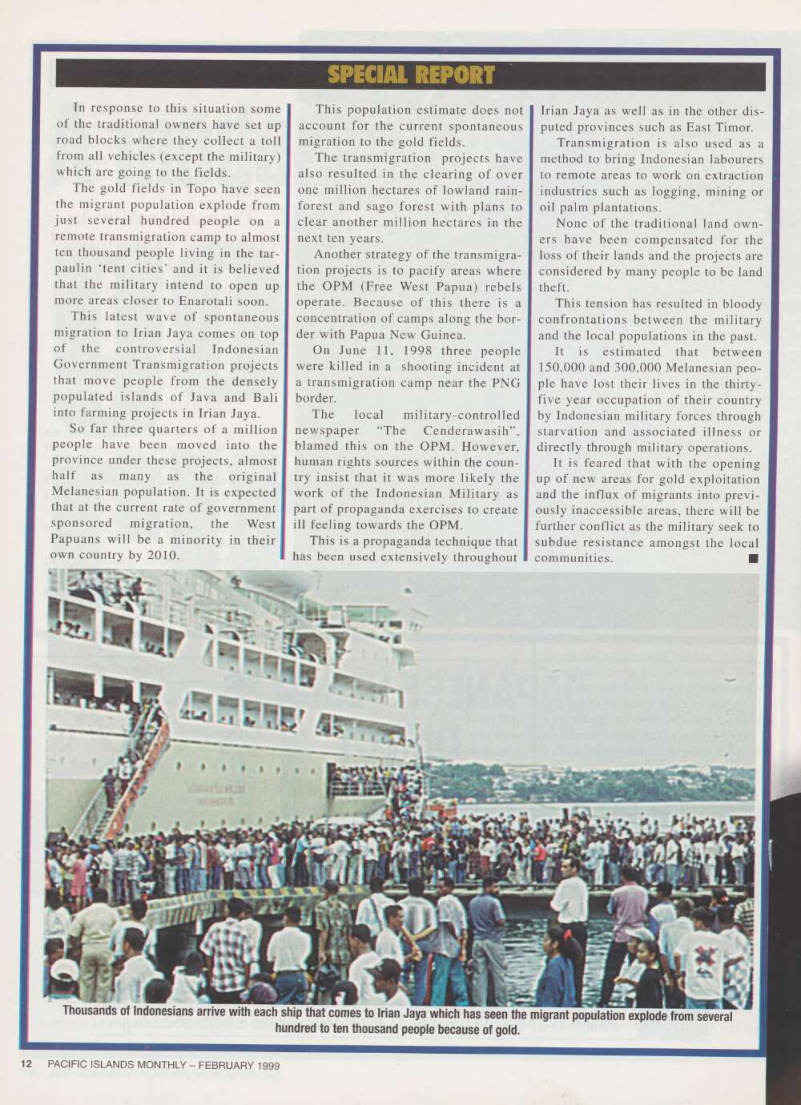
There are two weekly passenger ships from Java that bring thousands of people in search of fortune or relief from poverty, usually only to find the squalor of the gold fields is even worse than the conditions they left in Java.
This mass migration has resulted from the collapse of the Indonesian currency that has reduced to almost a seventh of its original value. In local
terms the value of gold appears to have increased seven-fold because its value is pegged to the global market.
In the capital city of Jayapura there are red slips down the mountain sides where bags of gold bearing earth are slid down to the gold panners below.
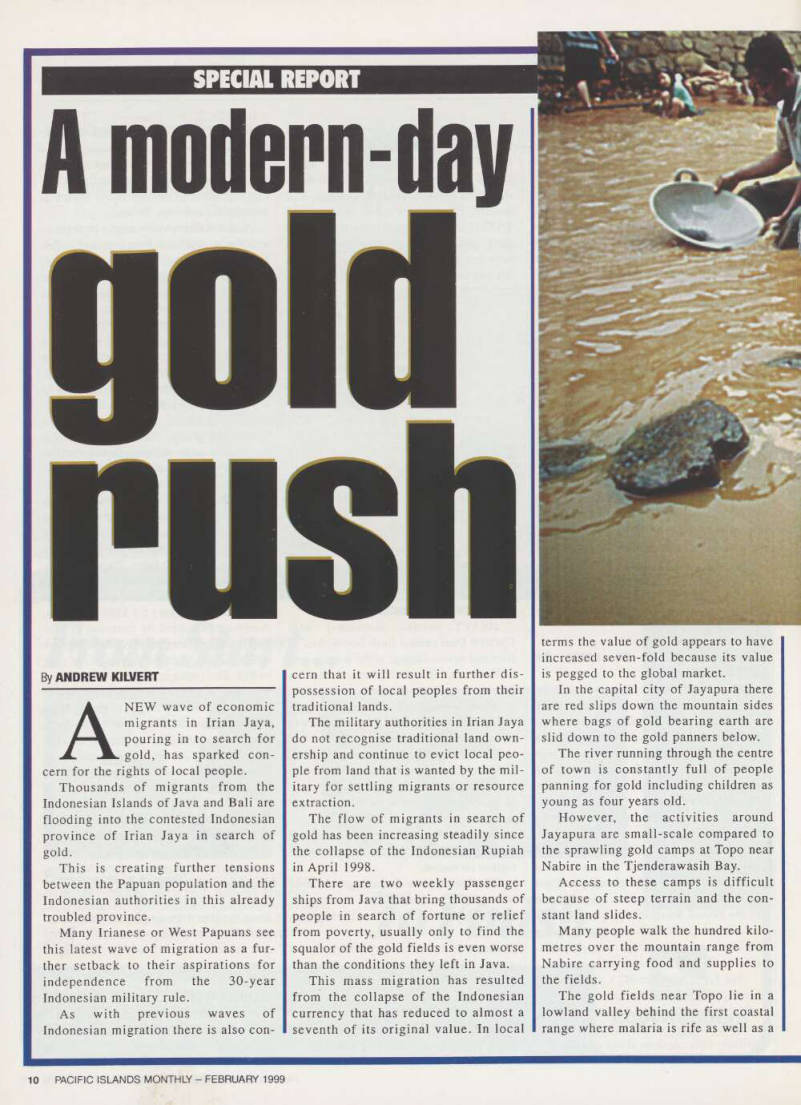
The river running through the centre of town is constantly full of people panning for gold including children as young as four years old.
However, the activities around Jayapura are small-scale compared to the sprawling gold camps at Topo near Nabire in the Tjenderawasih Bay.
Access to these camps is difficult because of steep terrain and the con stant land slides.
Many people walk the hundred kilo metres over the mountain range from Nabire carrying food and supplies to the fields.
The gold fields near Topo lie in a lowland valley behind the first coastal range where malaria is rife as well as a
number of waterborne diseases. They consist of rough tarpaulin shanties that spread off through the jungle. These camps are surrounded by the fine red mud that covers everybody and clouds the rivers.
Transmigration is
also used as a method
to bring Indonesian
labourers to remote
areas to work on
extraction industries
such as logging,
mining or oil palm
plantations.
The gold fields are controlled by the military who provide road access and then sell leases to the gold miners.
As well as profiteering from the selling of licenses the military also profit from the provision of other ser vices to the fields, such as prostitution and alcohol.
This has angered the traditional land owners who receive nothing as their traditional lands are mined and their rivers polluted.
Indonesians pan in the hope of finding gold in the contested provinge of Irian Jaya.
In response to this situation some of the traditional owners have set up road blocks where they collect a toll from all vehicles (except the military) which are going to the fields.
The gold fields in Topo have seen the migrant population explode from just several hundred people on a remote transmigration camp to almost ten thousand people living in the tar paulin ‘tent cities’ and it is believed that the military intend to open up more areas closer to Enarotali soon.
This latest wave of spontaneous migration to Irian Jaya comes on top of the controversial Indonesian Government Transmigration projects that move people from the densely populated islands of Java and Bali into farming projects in Irian Jaya.
So far three quarters of a million people have been moved into the province under these projects, almost half as many as the original Melanesian population. It is expected that at the current rate of government sponsored migration, the West Papuans will be a minority in their own country by 2010.
This population estimate does not account for the current spontaneous migration to the gold fields.
The transmigration projects have also resulted in the clearing of over one million hectares of lowland rain forest and sago forest with plans to clear another million hectares in the next ten years.
Another strategy of the transmigra tion projects is to pacify areas where the OPM (Free West Papua) rebels operate. Because of this there is a concentration of camps along the bor der with Papua New Guinea.
On June 11, 1998 three people were killed in a shooting incident at a transmigration camp near the PNG border.
The local military-controlled newspaper “The Cenderawasih”, blamed this on the OPM. However, human rights sources within the coun try insist that it was more likely the work of the Indonesian Military as part of propaganda exercises to create ill feeling towards the OPM.
This is a propaganda technique that has been used extensively throughout
Irian Jaya as well as in the other dis puted provinces such as East Timor.
Transmigration is also used as a method to bring Indonesian labourers to remote areas to work on extraction industries such as logging, mining or oil palm plantations.
None of the traditional land own ers have been compensated for the loss of their lands and the projects are considered by many people to be land theft.
This tension has resulted in bloody confrontations between the military and the local populations in the past.
It is estimated that between 150,000 and 300,000 Melanesian peo ple have lost their lives in the thirty five year occupation of their country by Indonesian military forces through starvation and associated illness or
directly through military operations.
It is feared that with the opening up of new areas for gold exploitation and the influx of migrants into previ ously inaccessible areas, there will be further conflict as the military seek to subdue resistance amongst the local communities. ■
Thousands of Indonesians arrive with each ship that conies to Irian Jaya which has seen the migrant population explode from several hundred to ten thousand people because of gold.