reform a
p. 55 · Read in the full issue
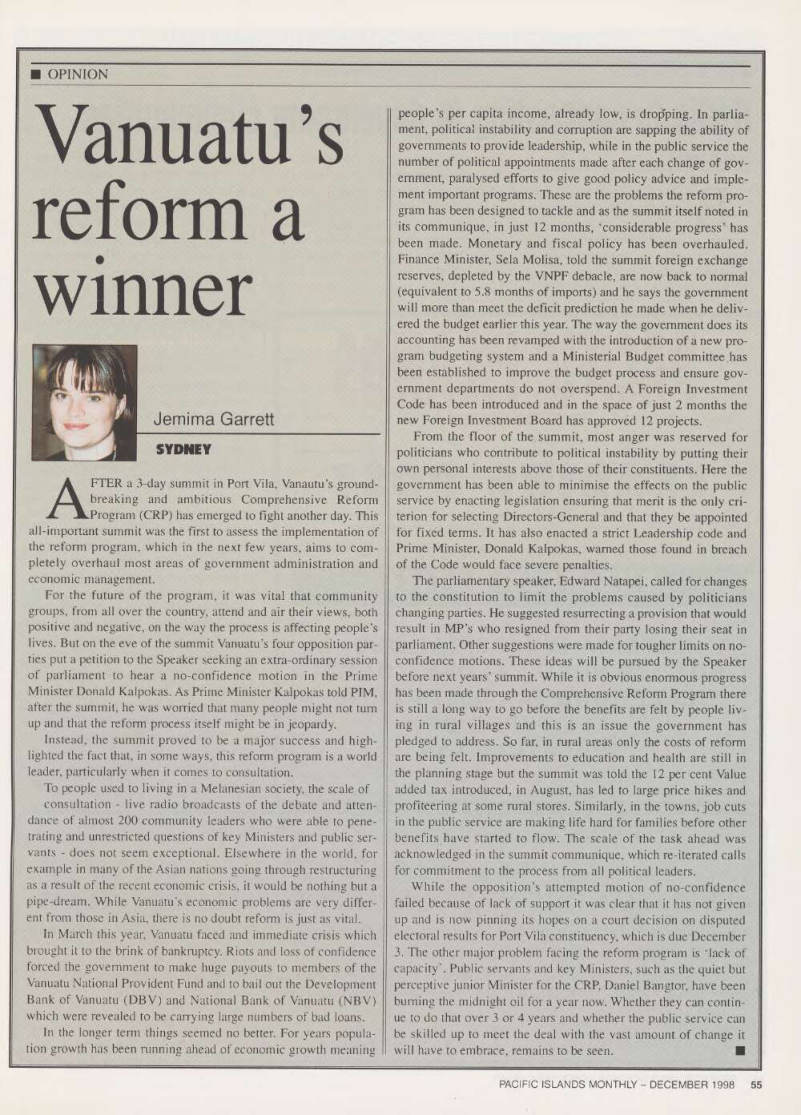
Vanuatu’s reform a winner
Jemima Garrett
Sydney
AFTER a 3-day summit in Port Vila, Vanautu’s ground breaking and ambitious Comprehensive Reform Program (CRP) has emerged to fight another day. This all-important summit was the first to assess the implementation of the reform program, which in the next few years, aims to com pletely overhaul most areas of government administration and economic management.
For the future of the program, it was vital that community groups, from all over the country, attend and air their views, both positive and negative, on the way the process is affecting people’s lives. But on the eve of the summit Vanuatu’s four opposition par ties put a petition to the Speaker seeking an extra-ordinary session of parliament to hear a no-confidence motion in the Prime Minister Donald Kalpokas. As Prime Minister Kalpokas told PIM, after the summit, he was worried that many people might not turn up and that the reform process itself might be in jeopardy.
Instead, the summit proved to be a major success and high lighted the fact that, in some ways, this reform program is a world leader, particularly when it comes to consultation.
To people used to living in a Melanesian society, the scale of consultation - live radio broadcasts of the debate and atten dance of almost 200 community leaders who were able to pene trating and unrestricted questions of key Ministers and public ser vants - does not seem exceptional. Elsewhere in the world, for example in many of the Asian nations going through restructuring as a result of the recent economic crisis, it would be nothing but a pipe-dream. While Vanuatu's economic problems are very differ ent from those in Asia, there is no doubt reform is just as vital.
In March this year. Vanuatu faced and immediate crisis which brought it to the brink of bankruptcy. Riots and loss of confidence forced the government to make huge payouts to members of the Vanuatu National Provident Fund and to bail out the Development Bank of Vanuatu (DBV) and National Bank of Vanuatu (NBV) which were revealed to be carrying large numbers of bad loans.
In the longer term things seemed no better. For years popula tion growth has been running ahead of economic growth meaning
people’s per capita income, already low, is dropping. In parlia ment, political instability and corruption are sapping the ability of governments to provide leadership, while in the public service the number of political appointments made after each change of gov ernment, paralysed efforts to give good policy advice and imple ment important programs. These are the problems the reform pro gram has been designed to tackle and as the summit itself noted in its communique, in just 12 months, ‘considerable progress’ has been made. Monetary and fiscal policy has been overhauled.
Finance Minister, Sela Molisa, told the summit foreign exchange reserves, depleted by the VNPF debacle, are now back to normal (equivalent to 5.8 months of imports) and he says the government will more than meet the deficit prediction he made when he deliv ered the budget earlier this year. The way the government does its accounting has been revamped with the introduction of a new pro gram budgeting system and a Ministerial Budget committee has been established to improve the budget process and ensure gov ernment departments do not overspend. A Foreign Investment Code has been introduced and in the space of just 2 months the new Foreign Investment Board has approved 12 projects.
From the floor of the summit, most anger was reserved for politicians who contribute to political instability by putting their own personal interests above those of their constituents. Here the government has been able to minimise the effects on the public service by enacting legislation ensuring that merit is the only cri terion for selecting Directors-General and that they be appointed for fixed terms. It has also enacted a strict Leadership code and Prime Minister, Donald Kalpokas, warned those found in breach of the Code would face severe penalties.
The parliamentary speaker, Edward Natapei, called for changes to the constitution to limit the problems caused by politicians changing parties. He suggested resurrecting a provision that would result in MP’s who resigned from their party losing their seat in parliament. Other suggestions were made for tougher limits on no confidence motions. These ideas will be pursued by the Speaker before next years’ summit. While it is obvious enormous progress has been made through the Comprehensive Reform Program there is still a long way to go before the benefits are felt by people liv ing in rural villages and this is an issue the government has pledged to address. So far, in rural areas only the costs of reform are being felt. Improvements to education and health are still in the planning stage but the summit was told the 12 per cent Value added tax introduced, in August, has led to large price hikes and profiteering at some rural stores. Similarly, in the towns, job cuts in the public service are making life hard for families before other benefits have started to flow. The scale of the task ahead was acknowledged in the summit communique, which re-iterated calls for commitment to the process from all political leaders.
While the opposition’s attempted motion of no-confidence failed because of lack of support it was clear that it has not given up and is now pinning its hopes on a court decision on disputed electoral results for Port Vila constituency, which is due December 3. The other major problem facing the reform program is Mack of capacity'. Public servants and key Ministers, such as the quiet but perceptive junior Minister for the CRP, Daniel Bangtor, have been burning the midnight oil for a year now. Whether they can contin ue to do that over 3 or 4 years and whether the public service can be skilled up to meet the deal with the vast amount of change it will have to embrace, remains to be seen. ■