disorder
pp. 30-31 · Read in the full issue
Cover Story
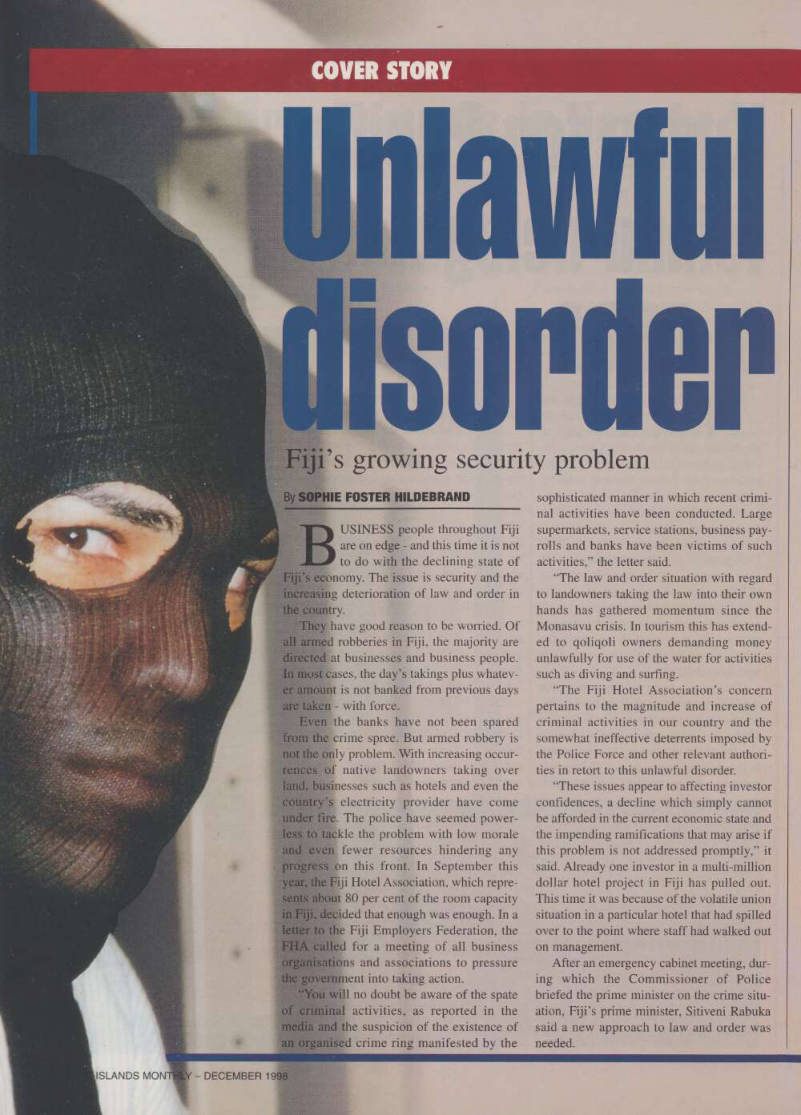
Unlawful disorder Fiji’s growing security problem
By Sophie Foster Hildebrand
Business people throughout Fiji
are on edge - and this time it is not to do with the declining state of Fiji’s economy. The issue is security and the increasing deterioration of law and order in the country.
They have good reason to be worried. Of all armed robberies in Fiji, the majority are directed at businesses and business people.
In most cases, the day’s takings plus whatev er amount is not banked from previous days are taken - with force.
Even the banks have not been spared from the crime spree. But armed robbery is not the only problem. With increasing occur rences of native landowners taking over land, businesses such as hotels and even the country’s electricity provider have come under fire. The police have seemed power less to tackle the problem with low morale and even fewer resources hindering any progress on this front. In September this year, the Fiji Hotel Association, which repre sents about 80 per cent of the room capacity in Fiji, decided that enough was enough. In a letter to the Fiji Employers Federation, the FHA called for a meeting of all business organisations and associations to pressure the government into taking action.
“You will no doubt be aware of the spate of criminal activities, as reported in the media and the suspicion of the existence of an organised crime ring manifested by the
sophisticated manner in which recent crimi nal activities have been conducted. Farge supermarkets, service stations, business pay rolls and banks have been victims of such activities,” the letter said.
“The law and order situation with regard to landowners taking the law into their own hands has gathered momentum since the Monasavu crisis. In tourism this has extend ed to qoliqoli owners demanding money unlawfully for use of the water for activities such as diving and surfing.
“The Fiji Hotel Association’s concern pertains to the magnitude and increase of criminal activities in our country and the somewhat ineffective deterrents imposed by the Police Force and other relevant authori ties in retort to this unlawful disorder.
“These issues appear to affecting investor confidences, a decline which simply cannot be afforded in the current economic state and the impending ramifications that may arise if this problem is not addressed promptly,” it said. Already one investor in a multi-million dollar hotel project in Fiji has pulled out.
This time it was because of the volatile union situation in a particular hotel that had spilled over to the point where staff had walked out on management.
After an emergency cabinet meeting, dur ing which the Commissioner of Police briefed the prime minister on the crime situ ation, Fiji’s prime minister, Sitiveni Rabuka said a new approach to law and order was needed.
“The Commissioner of Police gave us a very clear situation report of what’s going on but at the end of which he said he was quoting from a report which was written 23 years ago,” the prime minister said.
“So the situation now is no different from what it was 23 years ago. The only dif ference now is that we are trying to do something about it. It may involve the injec tion of funds, it may involve the injection of expertise... it may also involve the injection of a whole new approach to the fight against crime,” he said. Fiji’s finance minister, Mr Jim Ah Koy, in presenting his 1999 budget to parliament, admitted that the country has a problem with law and order.
“We are all concerned about the rising lawlessness in this country. In recent weeks, we read in the newspapers the increasing instances of robberies and violence. This is a serious development that we must address immediately. This lawlessness damages our reputation and shatters investor confi dence,” he said.
The biggest concern, of course, is the impact such a situation will have on invest ment. Mr Ah Koy says “for many invest ment prospects, law and order has become the main cornerstone of investment attrac tion”. “There is a strong body of evidence around the world that asseverates that con cessions are rather low on the list of priori ties for investors. Many other factors pre cede concessions like stability, certainty, consistency, good governance, good pay ment system, law and order and so forth,” he said. To tackle the problem, the govern ment has allowed for an additional alloca tion to the Police Department of $5.8 mil lion from $36.4 million to $42.2 million for 1999. The Police Department would also have access to $2.2 million set aside in the Budget for Anti Corruption and an addition al provision of $450,000 annually was made for the operation of the Prisons Department for the next three years. But even Mr Ah Koy admitted that “the problem of law and order is not going to be solved by money alone”.
“It requires a multifaceted approach and some serious thinking and planning. To avert the breakdown of law and order we must ensure that the economy continues to grow to provide the economic safety net; strengthen our traditional ties and the fami ly support unit,” he said. The government solution also calls for an improvement of the education system with attitudinal train ing and developing laws to be supportive of
such a solution. The relevant departments in Government must build up their capacities and their management to ensure that the funds provided are used effectively and the
programmes are implemented properly.
“I would like to call on each and every one of us to stand up and band together against crime. We must have zero tolerance against people who are involved in criminal activities. And we must send out a strong message that crime does not pay as we will safeguard our communities from this destructive force,” he said. The chief execu tive of the Fiji Hotel Association, Ms Olivia Pareti, says “what’s worrying is not only the increase in the number of crimes that are reported such as robberies or burglaries or whatever, but it seems also to be a very pro fessional crime ring that’s operating around the country and the targets for this, apart from the households, are businesses”.
“That’s very worrying for us and we have to take some drastic steps. We are inviting our members to be very, very care ful now, and not to be complacent”. For Fiji’s booming tourism industry, the issue is one that it cannot take lightly. Image is what counts. “It’s bad enough from where we see it, as Fijians living in the country, so can you imagine what our visitors think of it when they come in and see the dark side of Fiji,” Ms Pareti says, “once if they stayed here for two weeks, they might see such incidents once or twice in the paper, but now there’s just pages and pages of it every day”. “We want to project this image of a safe and secure destination to come to. You don’t want to have your hotels with lots of security guards patrolling like a few years ago. A few years ago we were saying why do we need all these security guards when the first person you see greeting you as you come into a resort is a security guard. Now it’s a necessity to have that and it’s not cre ating a good image for us,” Ms Pareti says.
With tales of harassment of tourists and lately, reports of the banned drug, marijua na, being made available for tourists, the FHA has made the security situation a pri ority for the industry.
“What we have done is that within our own organisation we discuss this on a regu lar basis and also with government through the high-level consultative forum which the minister of tourism puts together, and also through the Fiji Visitors Bureau. I can tell you that every meeting we discuss the law and order situation,” Ms Pareti says. The solution, as far as businesses see it now, is
to band together. “We should have a collec tive effort to try and work against this because it is not only our industry but the livelihoods of everybody and we should be concerned about it. It could be you next, nobody knows these days. Nobody is safe.
“There’s a lot more people that are law abiding citizens in this country and we are letting a minority over-rule this. I think if the law-abiding citizens get together and say enough is enough is enough, then we will probably be getting uphill. But at the moment we don’t seem to have the
willpower or maybe not enough willpower
to tackle the crime,” she says.
Because of police problems with fund ing and other issues, businesses got togeth er last year to pay for extra police to patrol the streets of Nadi because there was harassment of tourists. This was one exam ple of where an industry-led solution worked, and the problem has been con trolled, Ms Pareti says.
Control and common-sense also the key words when it comes to protecting busi nesses, says the chief executive of the Fiji Employers Federation, Mr Ken Roberts.
“The most important thing, if you are thinking about it from a planning point of view, is exercise your common-sense. Look at your buildings, look at your compound, see how you store your cash, how you carry your cash, the staff you entrust with cash.
Are you able to get police checks on your staff?” he says.
Mr Roberts adds that quite often staff unwittingly give away information that gives other people the idea for a robbery.
“The old expression that the Americans dreamed up in the last war, loose lips sink ships, is so true because that’s exactly the problem. Here we are a very free society and people talk about anything and every thing - around the grog bowl, over a few beers or whatever - and there are so few secrets. Only let those people know in your business who need to know,” he says. Mr Roberts says that while the increase in armed robberies was concerning, “by the same token it is not something that we wish to talk up”. He said in most cases, people were aware that it exists and what steps they could take to try and negate the increase in crime. There is no doubt that crime is bad for business. However, what the govern ment must remember is that, with the national general elections looming next year, crime could also be bad for re-election. ■