APEC officials
p. 27 · Read in the full issue
stumble over fisheries
IT could have been a mouth watering discussion - about tuna, halibut and salmon. But fish gave officials at the 10th meeting of the Asia-Pacific Economic Cooperation (APEC) forum a serious belly-ache, said Malaysia’s International Trade Minister Rafidah Aziz.
“This is not so simple as, ‘I offer you fish, I offer you forests’. It is very compli cated,” she said. Fisheries was one of the two issues threatening to deadlock trade
talks between 21 nations. The other was forest products. The United States and Japan had refused to budge from their posi tions on fisheries and forests.
Washington wanted Japan to open its market, while Tokyo refused, saying it would hurt Japanese fishermen and timber traders.
Waving a huge sheaf of papers filled with figures, Rafidah said officials had pored over tariffs of various kinds of fish so that countries could reach an agreement
on opening their markets. “I want you to be aware 'of the magnitude,” she told reporters after she had said how tariffs for fish differed in each country based on whether the fish was dead or alive - and whether its liver and entrails had been taken out. Tariffs on fish also varied on whether they were meant to be eaten by humans or pets, said Rafidah.
Duties were different if the fish was chilled or sliced into fillets.
For more than five minutes, Rafidah read out the different categories of fish from one page.
Then she said: “God knows what they mean - but they are all trout”.
She said salmon and halibut varied on the customs duties they attracted depend ing on whether they had been swept up in nets in the Pacific or the Atlantic oceans.
“My God, what is this, they are in all kinds of conditions - live, dead, salted and chilled,” she said, looking surprised as she read some of the tariff variations.
Rafidah’s comments came after minis ters from the APEC nations failed to break an impasse on traiff reductions.
They instead moved to more routine discussions, leaving fish and forest prod ucts for cabinet ministers to take up later.
Trade ministers and officials met in Kuala Lumpur ahead of the summit.
However, the APEC ministers later abandoned attempts to strike a deal on free trade in nine key sectors and will send the matter to the World Trade Organisation
(Wto).
“The financial crisis has had a chilling effect on the package that we put together in Vancouver last year,” Canada’s trade minister Sergio Marchi said.
He said minister from the 21-member Asia Pacific Economic Cooperation forum had been unable to agree on the early vol untary sectoral liberalisation (EVSL) scheme.
"We were not able to make any progress, and our plan B’ is to move it (EVSL) to the WTO, to hopefully shop it around as broadly as possible with an aim to move forward by the end of 1999,”
Marchi said.
The decision effectively throws a deci sion on early liberalistion in the nine sec tors, ranging from energy and chemicals to medical equipment and toys, to the next summit in Auckland, New Zealand.
Opening up fish markets also hangs in limbo. ■
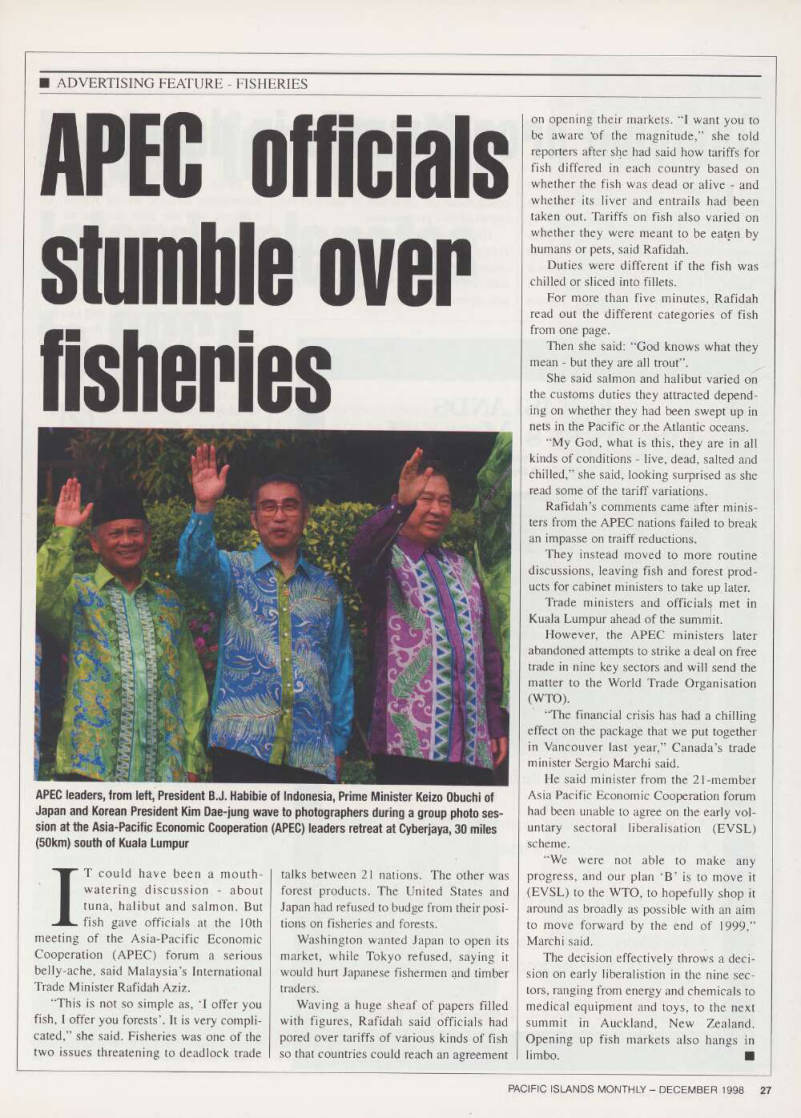
APEC leaders, from left, President B.J. Habibie of Indonesia, Prime Minister Keizo Obuchi of Japan and Korean President Kim Dae-jung wave to photographers during a group photo ses sion at the Asia-Pacific Economic Cooperation (APEC) leaders retreat at Cyberjaya, 30 miles (50km) south of Kuala Lumpur