New Caledonia prepares to turn accord into law
p. 20 · Read in the full issue
THE strong ‘yes’ vote in favour of a deal giving the Pacific territory of New Caledonia greater autono my from France has eased the threat of renewed social tension, analysts said. Official results released mid- November showed 71.86 per cent of New Caledonians voted for the accord, which paves the way for the creation of a new assembly and a new referendum in 15 to 20 years on a formal split with France. The official election body also announced that 74.23 per cent of the nearly 107,000 eligi ble voters cast ballots.
The vote significantly eased social ten sion of recent weeks that forced a heavy police presence around the capital Noumea. Businessmen were also looking to the future, after maintaining a low pro file during the referendum.
Chamber of Commerce and Industry president Michel Quintard said New Caledonians now had "20 years in front of them of considerable freedom and the financing (by Paris) for those freedoms”.
He predicted that despite the problems for the crucial nickel industry it could look
forward to a boost in tourism, New Caledonia’s number two earner.
An official committee was to meet to begin turning the accord with the French government approved in the referendum, into law. With representatives of pro and anti-independence parties taking part, it is to draft a legal document based on the accord that will then be voted into law.
The leading pro-independence party, the Kanak National Socialist Liberation Front (FLNKS) has said it will ensure the law reflects the substance and the “spirit” of the agreement.
Once it becomes law new elections will be held for the territory’s congress which in turn will be able to elect a new executive to replace the high commission. The accord was brokered in two years of nego tiations by French officials and is aimed at preventing a repeat of the 1980 s, when pro independence groups launched a campaign for independence and triggered bloody clashes between native Melanesians and European settlers. The FLNKS and the anti-independence Rally for Caledonia in the Republic both signed the Noumea accord with French Prime Minister Lionel
Jospin in May. Both parties then cam paigned for a ‘Yes’ vote.
The highest proportion of ‘Yes’ votes were in the two Kanak majority provinces, North province and the Loyalty Islands where 86.79 per cent and 95.47 per cent voted yes respectively.
In South province around Noumea, where most ethnic European groups live, turnout was a strong 80.71 per cent, but with fewer ‘Yes’ votes, only 62.99 per cent.
Since 1958, New Caledonia has had eight different statutes within the French republic, the present one being the fruit of the 1988 Matignon Accord, which ended several years of separatist violence.
Around 45 per cent of the population are native Melanesians and a third of European descent. Most of the others are from the tiny French Pacific territory of Wallis and Futuna, and Asian nations such as Indonesia and Vietnam.
The separatist groups are dominated by Melanesians, who say they have been dis criminated against in key appointments and do not get a fair share of the wealth generated by New Caledonia’s huge nickel reserves. (AFP) ■
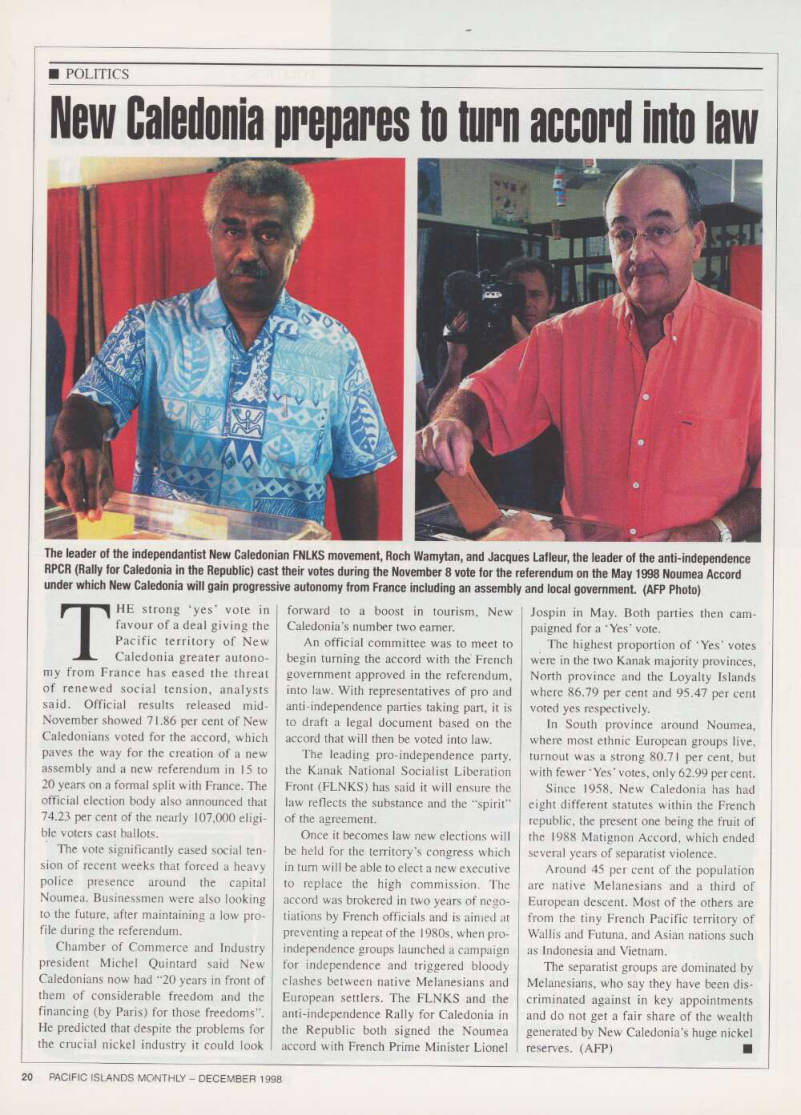
The leader of the independantist New Caledonian FNLKS movement, Roch Wamytan, and Jacques Lafleur, the leader of the anti-independence RPCR (Rally for Caledonia in the Republic) cast their votes during the November 8 vote for the referendum on the May 1998 Noumea Accord under which New Caledonia will gain progressive autonomy from France including an assembly and local government. (AFP Photo)