sea levels affect Pacific
pp. 10-11 · Read in the full issue
Special Report
Changing climate and sea levels affect Pacific countries now
ON low-lying atolls in the Pacific, people have had to rad
ically change the way they
grow crops, because rising sea levels are seeping into the soil, making it too salty to grow staple crops such as taro, pulaka and yams.
In Tuvalu, farmers used to dig pits in the sandy soil, fill them with compost and plant their root crops. Now, however, increasingly brackish water is poisoning taro planted in pits in low-lying areas.
Some farmers have relocated their planta tions to somewhat higher land, but there is only limited land available in this nation of atolls. Instead, many people now grow their taro in tin containers, which they fill with compost and soil before planting the taro. Throughout the Pacific, culturally and
spiritually important sites are being eroded
by the rising seas. In the Marshall Islands, Tuvalu and Kiribati, burial grounds near the coast - sacred places where people do not go except to pray - are crumbling into the ocean. Second World War graves on Majuro atoll in the Marshall Islands are slowly being eroded by wind and surf, which breaches the sea walls and strews debris over the headstones. In Niue and Palau, where the dead lie in caves near the ocean, people are now discussing moving their ancestors further inland because of the threat from the rising ocean.
As well as slowly rising sea levels which are eroding coastal roads and other infrastructure, countries like Kiribati, Tuvalu and the Marshall Islands also suf fered unusual storm surges in February 1997 and again this year, where the tide just kept on coming in. destroying sea walls, bridges and roads and flooding houses and plantations. In Kiribati, the bridges linking Tarawa and Betio were destroyed. Kiribati has now established a task force to oversee management of a $U5253,000 fund for
reconstruction of causeways, roads and other infrastructure destroyed by coastal erosion.
On Majuro atoll in the Marshall Islands, the airport has been flooded on several occasions recently, despite an eight-foot sea wall. Throughout the Marshall Islands, coastal erosion is evident everywhere.
While some erosion in more populated parts can be blamed on inappropriate land use practices, the coasts of outer islands that have had no development are also crumbling into the sea. Like virtually all Pacific island countries, the Marshall Islands are ill-equipped to deal with sea level rise. An extensive sea wall protec tion system would cost more than SUSIOO million for Majuro atoll alone, disregarding the protection needs of the other 28 atolls in the Marshall Islands.
The Marshall Islands’ total gross domes tic product is just SUSBO million, more than half of which comes from grants from the United States which could terminate as early as 2001. Even if it were economic to build a sea-wall to protect Majuro, it would not be feasible; a sea wall around the atoll would kill the inner lagoon ecosystem.
This would have flow-on effects on the tuna fishery, which depends in part on fish which spend their juvenile period in the lagoon. Rising sea levels have already swamped some motu (small islets) in the Pacific. In Kiribati, the motu of Tebua Tarawa used to be a landmark for fisher men. Now it is gone. In Tuvalu, the motu of Tepuka Savilivili has lost its coconut trees and its sandbanks and the ocean is slowly moving up its remaining rock. In most of the Pacific, land tenure systems mean peo ple living on a coastline that is disappear ing beneath their feet cannot move inland, because that land belongs to other families.
So people on the coast in countries like Kiribati and the Marshall Islands are trying
to reclaim their family land, dumping trucks or other old equipment into the sea and then piling rocks around them to try to build up their patch of land once more.
Outsiders think this is pollution: in reality, it is an attempt to survive in a changing world.
The Pacific’s climate is changing, as countries like Federated States of Micronesia, Fiji, the Marshall Islands, Papua New Guinea, Samoa and Tonga are only too well aware. All these countries have been hit hard by recent devastating droughts. In Fiji, drought wiped out some two-thirds of this year’s sugar cane crop, which normally provides 40 percent of export earnings. Tonga’s squash crop, which produces about half that country’s exports by value, was more than halved.
In Papua New Guinea, Australia spent more than SA3O million delivering food aid to people in isolated areas in the highlands and low-lying islands, many of whom were close to starvation. The drought substan tially reduced Papua New Guinea’s impor tant coffee harvest. In FSM, almost 40 atolls ran out of water and the capital, Pohnpei, was reduced to living off brackish underground water and shipping water to
neighbouring atolls.
In the Marshall Islands the United States brought in desalinisation plants to provide water for the population. In Samoa, fires sparked by the unusually dry conditions destroyed large areas of forest on the island of Savaii. Pacific people traditionally depended on the ocean to supply most of their protein requirements. Over the cen turies they developed a wealth of knowl edge about when and where to fish.
In recent years, however, the fish have not been found where traditionally they would be expected. The currents have changed, and so have the locations of the fish. In Papua New Guinea, for example, on Manus Island, people traditionally catch large hauls of tuna in October. They use this not only for their own sustenance, but also to sell to the country’s fish markets. Last year the tuna did not arrive.
Throughout the Pacific, malaria and dengue fever, both mosquito-borne dis eases, are increasing. In Papua New Guinea, for example, the past ten years have seen outbreaks of malaria in the high lands, 2000 metres above sea level, where previously it was too cold for malarial mos quitos to survive. The same is true of the
highlands of the Solomon Islands, where malaria has also begun to appear. Malaria and dengue fever are starting to appear in New Caledonia.
Previously there was no malaria there and virtual ly no dengue. But now, at some times of the year, there are outbreaks of malaria and dengue fever in New Caledonia.
Fiji and Samoa also are now suffering out breaks of malaria and dengue fever which are far more severe than they have ever been before. For some, the battle against a changing climate and ris ing sea levels has become too much, particularly when these are combined with population pres sures. Environmental refugees are already a reality in the Pacific. Kiribati has begun an internal reset tlement programme, moving people from Betio to the outer islands. Niue recently accepted seven families from Tuvalu who decided to escape from the increasing risks of living on a low-lying atoll.
The world’s climate scientists have already said human greenhouse gas emissions are having a dis cernible effect on global climate.
While the Pacific does not have the expertise to say that the changes it is experiencing now are a direct result of greenhouse gas emissions, it does know that it is vulnerable now, and that there is a considerable probability that the risks will only increase in future. The Kyoto Protocol to the United Nations Framework Convention on Climate Change, which provides for an overall 5.2 percent reduction in greenhouse gas emissions by developed countries, goes nowhere near the 60 - 80 percent reductions which the Intergovernmental Panel on Climate Change has said are needed. As far as the Pacific is concerned, the sooner countries start making the reductions they have committed to, and accept that much stronger reductions will be needed, the better the Pacific’s chances of surviving the next millenni um. -This is part of a paper provided by SPREP rgarding global warming. ■
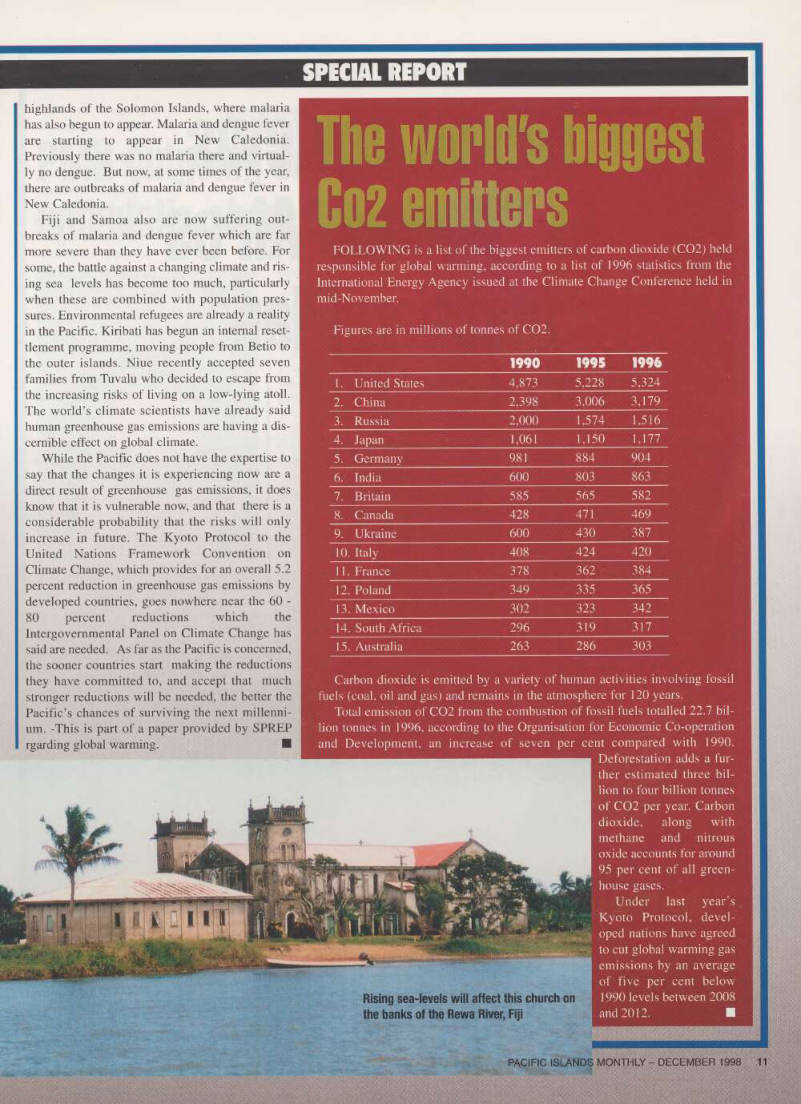
Rising sea-levels will affect this church on the banks of the Rewa River, Fiji