"Good as gold"
pp. 52-53 · Read in the full issue
Yachting
"Good as gold" in God's own
Story and pictures by SALLY ANDREWS
CLOUDS, snagging on the moun tainous spine that runs the length of New Zealand, have given the country its nickname: “Land of the Long White Cloud”. But when a large high settles over the country, it robs the sky of cloud and brings blue days and flat seas.
On a perfect summer day such as this, filled with sunshine and light and variable winds, we sailed around Cape Brett past the infamous “Hole in the Wall” - an enormous natural rock tunnel through which boats can navigate. Nearby, mobs of hungry seabirds and frightened fish made the water boil.
Gannets dived yellow-head first into the sea, like kamikaze pilots. Cape Brett marks the eastern entrance into the Bay of Islands.
The Bay of Islands has long been consid ered a sailor’s paradise. Even whalers enjoyed their R&R here amongst the Bay’s 144 islands, all of which lie within the con fines of a large protected bay. Cruising boats of the nineties clear into the Bay of Islands at tiny Opua, where MAP (quarantine), immi gration and customs formalities are quick
and painless.
Conveniences include a general store, launderette, hot showers, and the hospitality of the Opua Cruising Club. One of the more outstanding personalities at Opua is Colleen - the local postmistress. Along with an incredible memory for names and faces, Colleen has a phenomenal amount of patience and understanding of cruiser’s needs.
In the good old days, arriving boats side tied three or four deep along the Opua Wharf - q-flags and courtesy flags waving, laundry flying. The colours and languages of up to thirty foreign boats made it a real bustling if temporary international community. In this party atmosphere, locals always stopped to say “Welcome home!”
Now, however, it’s modem times - user pays and you don’t get much. Yachts are booted off the dock immediately after clear ance. But this isn’t necessarily all bad. If you’re keen for a good night’s sleep, you’re far better off away from the madding crowd.
Inside Te Puna Inlet, for instance, you’ll find delicious shellfish and peaceful anchor ages.
Sailing up nearby Kerikeri River - where the. sounds of the birds and the smell of the
flowers are heavenly - is also a good option.
Accessible only at high tide, the Kerikeri basin overflows with tranquillity and colo nial charm.
The Bay of Islands is one of my favourite stopovers, as it has been for other voyagers since Captain Cook named it in 1769. Cook’s botanist, Joseph Banks, described in his log: “...the bay itself (is) beautiful, with many good anchorages, the hills and valleys around it, forests and cultivations beautiful
also”. The temperate climate and secluded anchorages attract cruising sailors who want to spend cyclone season out of the tropical belt. Now a protected Maritime Park, the waters are warm enough to swim in and abound with sea life, including whales, dol phins and penguins.
After a few days (which soon become weeks) of hanging out at Opua or shopping in historic Russell or Paihia, it’s time to leave the “city-life” and move on to quieter anchorages. One of the bigger islands, Urupukapuka, offers sandy beaches and a self-guided archaeological trail that runs
right round the island. My favourite hide away is Roberton (or Motuarohia) Island Here, in the channel between Roberton and mainland, Captain James Cook anchored his bark “Endeavour” in 1769. Imagine our thrill when a full-size replica of cook’s Endeavour hove into view one day, more than two cen turies after the fact.
From the top of the pa (Maori fortifica tion) at Roberton Island, the view is spectac ular - twin lagoons, Fellowship anchored off the southern one. There is an underwater nature trail for snorkellers, a guided “swim trek”. Perfectly camouflaged in the tideline
on the stony beach, dotterel lay their eggs. A hundred-year-old sailboat is slipped on the ways in front of a house set in amongst love ly gardens - fruit trees (citrus, feijoas, peach, apple), huge old palm trees, huge old Moreton Bay fig tree, big vegetable garden with peas, carrots, potatoes, lettuce and asparagus.
On the outskirts of the Bay, the walking track at Oke Bay winds around the scenic reserve at Rawhiti Peninsula to Kaimarama Bay. Hungry and fantasising about Tip Top ice-cream (or even a marmite sandwich) and a cold drink, I realised I should have packed some lunch. There’s not much hope of find ing a shop in the bush! Or so 1 thought until there, at the far end of the trail, I found a small settlement and store. Naturally, my pockets were empty. I had to feast on the coastal scenery instead - it was free.
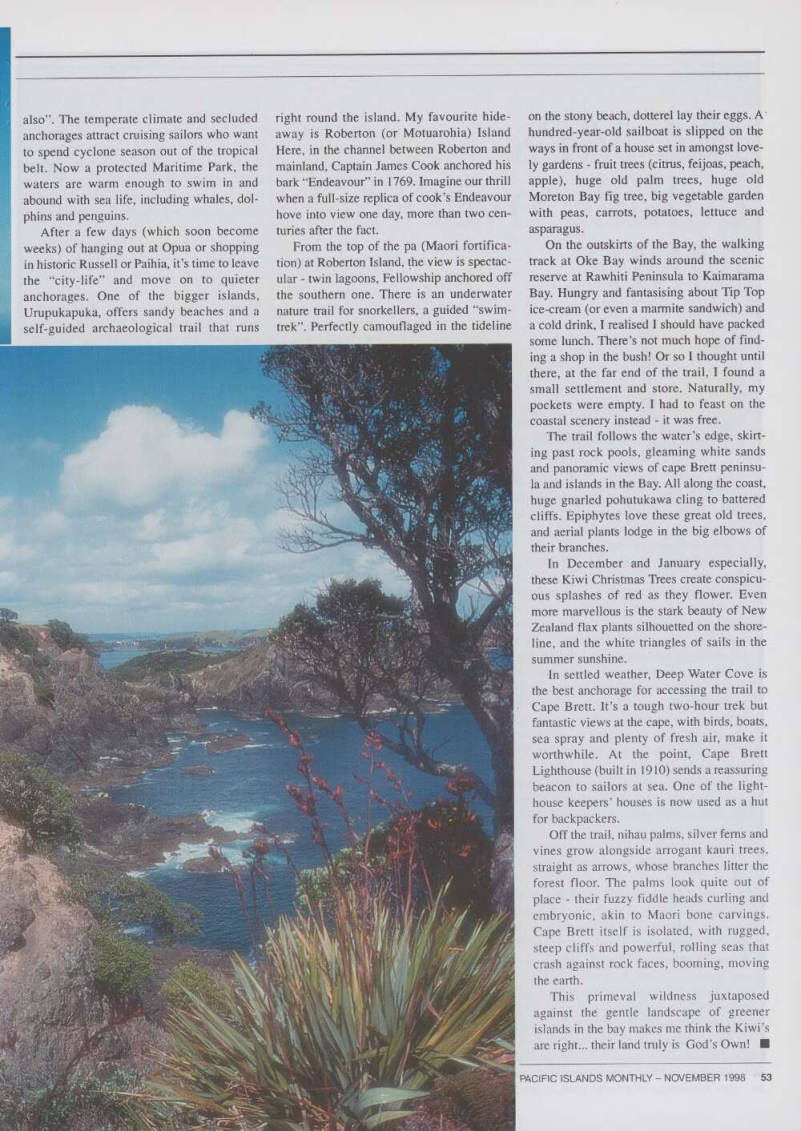
The trail follows the water’s edge, skirt ing past rock pools, gleaming white sands and panoramic views of cape Brett peninsu la and islands in the Bay. All along the coast, huge gnarled pohutukawa cling to battered cliffs. Epiphytes love these great old trees, and aerial plants lodge in the big elbows of their branches.
In December and January especially, these Kiwi Christmas Trees create conspicu ous splashes of red as they flower. Even more marvellous is the stark beauty of New Zealand flax plants silhouetted on the shore line, and the white triangles of sails in the summer sunshine.
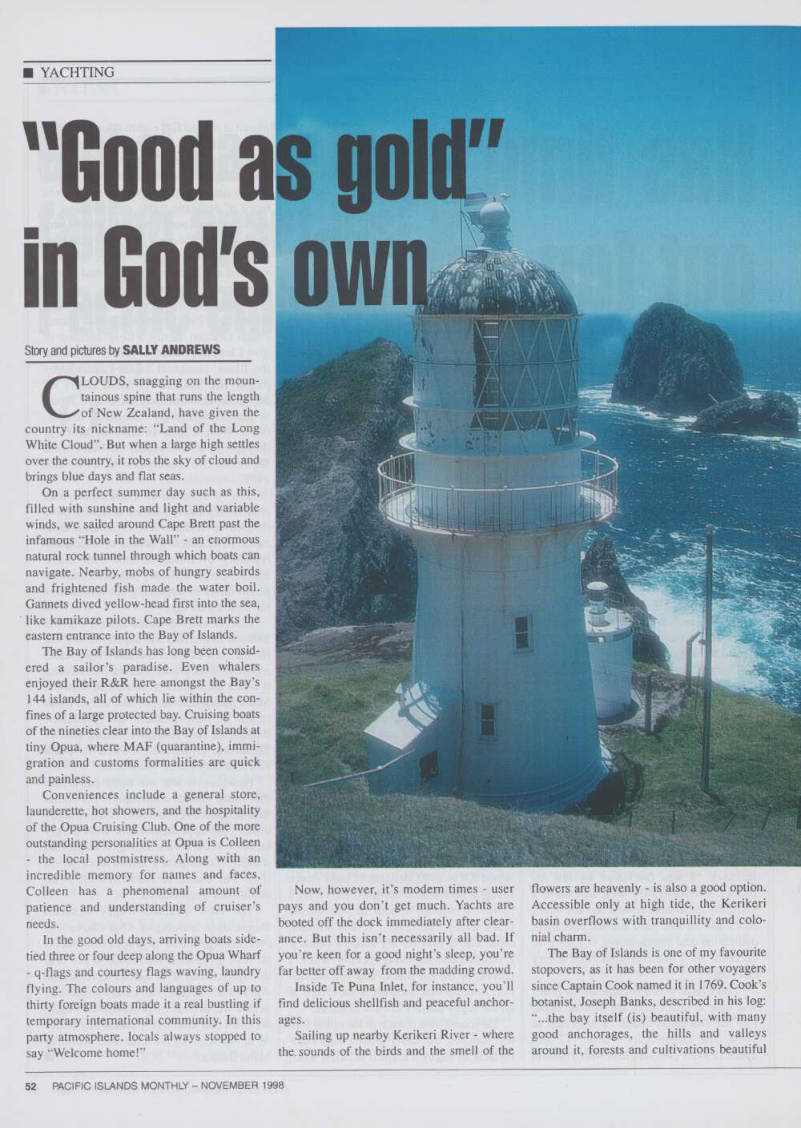
In settled weather, Deep Water Cove is the best anchorage for accessing the trail to Cape Brett. It’s a tough two-hour trek but fantastic views at the cape, with birds, boats, sea spray and plenty of fresh air, make it worthwhile. At the point, Cape Brett Lighthouse (built in 1910) sends a reassuring beacon to sailors at sea. One of the light house keepers’ houses is now used as a hut
for backpackers.
Off the trail, nihau palms, silver ferns and vines grow alongside arrogant kauri trees, straight as arrows, whose branches litter the forest floor. The palms look quite out of place - their fuzzy fiddle heads curling and embryonic, akin to Maori bone carvings.
Cape Brett itself is isolated, with rugged, steep cliffs and powerful, rolling seas that crash against rock faces, booming, moving the earth.
This primeval wildness juxtaposed against the gentle landscape of greener islands in the bay makes me think the Kiwi’s are right... their land truly is God’s Own! ■