The Cooks and economic reform
pp. 41-42 · Read in the full issue
economic reform
By Lisa Williams
The year 1995 was a landmark one for the Cooks’ government.
It marked a turning point in pol icy, where leaders finally realised their backs and the national budget, were up against the wall. They gave in to pressure from outside aid donors, the Asian Development Bank, and the signs of an economy in crisis.
There had already been financial trou ble looming in the Cooks, with banks noticing millions of investment dollars moving out of the country - a sign that the engine of growth, the private sector, was
breaking down.
An economic reform programme based on structural adjustment models of the 80’s was brought in along with troops of highly paid experts to implement the policies.
Part one of the reform process meant downsizing the public sector that meant saying good-bye to the false economy propped up by government salaries and working on a balanced economy propped up by a vigorous private sector.
It took two years for government to actually admit what some of its own well paid economists had been touting for some time, albeit quietly; the country was living beyond its means.
Three thousand Cook Islanders were made redundant, with money from New Zealand aid poured into ensuring the pri vate sector would be ready to absorb the displaced. Many placed into Transition paid heed to the chance for a new life over seas and they took it.
In 1998, the Cooks is in the midst of Phase two of the reforms - implementing private sector growth and setting up the Development Investment Board to repre sent the fresh look to investment promo tion in this corner of the Pacific. It is no accident that fresh faces complement the new set-up. DIB Chief Executive Rohan Ellis comes from a Tourism background,
accustomed to highlighting all that is pos itive - making lemonade out of lemons, as the song goes. Ellis has made a lot of lemonade since he took on the DIB chal lenge less than a year ago.
“The private sector were identified as the engine for growth of the Cook Islands economy - that’s when the Development Investment Board was set up,” says Ellis, “we are about facilitating trade develop ment and new investment from overseas; increasing or improving the chances of our private sector taking the ball and running”.
“The downsizing has made our job more challenging,” admits Ellis. “We’re trying to stimulate the private sector to expand, but it has to be understood that
with 3000 people displaced, they’ve lost
their regular source of income and that’s a loss to domestic purchasing power.”
Small shops - dotting the main and outer islands, were first to notice. The mer
chandising industry is suffering, although
there was a time in there when retailers noticed locals were spending more money on food.
“In terms of our growth industries, any one here who wants to maintain their nor mal level of sales has realised that because we’ve got a shrinkage here, they have to go looking for new export markets and new export consumers,” says Ellis.
Best example of that surge for outside spending power at the moment is in Apparel, with award winning fashion house TAV’s taking resort wear to the Pacific in an aggressive marketing push driven by owner-director Ellena Tavioni.
And then there is the black gold of Polynesia - cultured pearls, with the Cooks end of the supply curve realising big pro motional dollars have to spent to make a name for Cook Islands pearls.
“Our black pearls are pretty secure,” he says of industry that has held a forum focused on the year 2000.
“They’re moving towards that goal, their wheels are turning quite well,” he
says. He would like to see Agriculture given the same boost, a new breath of fresh air that would help lagging morale after taro and pawpaw exports took a dive because of drought conditions earlier in the year.
Ellis says despite all the gloomy fore
casts that things have to get worse before they can get bet ter, growth and business con fidence are slowly on the
upswing.
“If you speak to a retailer or wholesaler here they’ll say the economy is bad,” he says, “of course the economy is bad. We’ve just lost a sizeable chunk of spenders and a lot of that chunk has left to go over seas. Of those who are here, many are still sceptical about
spending up large. They’re
not as confident as they once were. In effect, people have wised up. We used to live on credit, loaning ourselves up
to the hilt, buying nice cars and everything else. People have started downsizing their credit, so to speak.”
And when people begin making wiser spending choices, the banks are happier.
In feedback from both the ANZ and Westpac banks here Ellis says both agree with the growth forecasts.
“They’re fairly confident. They’ve said they have a lot of money they’d like to hand out in terms of loans. They stand behind private sector growth.”
The problem is that locals still don’t seem to be cottoning on to bank-talk and well-structured business plans.
“That’s been a long standing criticism by banks - that we’re not organised,” says Ellis, “while the ideas our people have are wonderful, the business plan is not struc tured enough to give the bank confidence to loan the money to them. Hence, the excessive interest rates now because there’s a lot of risk involved.”
Bank worries over risk and how that affects interest may be one side of the coin - another is how potential investors feel about bringing their well-saved dollars to the Cooks.
“Investors fear that they don’t know enough about the Cook Islands. The South Pacific in general is a dark area in the world - there’s not a lot of information on it,” says Ellis, adding what there is out
there has pretty much been painted by a Western media weeding out corruption in Paradise. With that image in mind, investors, “don’t know where they stand or what sort of guarantees they have,” says Ellis, “should they decide to invest in the Cooks? Will their investment dollars
in Pacific Island countries be secure or if they cross paths with a minister in power does that mean they’ll get their operating license revoked?”
The Cooks may look as it’s standing on a rock waving a red flag to the entire uni verse to invest, but Ellis says selective marketing aimed at bringing in two types of investors is a better approach in the long term. There are the ‘lifestyle’ investors who want a quiet spot to settle or retire, and there are the ‘cultural affini ty’ types who want to see ethnic island roots strengthened and celebrated.
It is niche marketing rather than mass that will work for us in the end, argues Ellis. Nono exports are being looked at, as is the market for locally made Chilli sauce. The DIB has been lucky this bud get. Where many departments have had to sacrifice, Ellis gets a big boost in spend ing power, as if to acknowledge the DlB’s front line role in being an information oasis for investors thinking of taking the
dip. Working on existing government reg
ulations and conditions to make the atmosphere “more conducive to new investment” has not won the DIB the uni versal support it would have liked.
While locals have lauded the introduc tion of a new income tax regime, there are those disgruntled that the new system doesn’t differentiate between Cook
Islanders and non-Cook Islanders.
“We’ve had Cook Islanders complain about that,” says Ellis of the lack of spe cial incentives for locals in business. He blames poorly-informed opinions for any flak, saying that led to DIB being seen as “a conduit for foreign investment, hand
ing out exemptions for
everybody. Little did they know, if they had asked us, that the exemptions that apply to foreigners also apply to Cook Islanders. It’s a level playing field.”
Company tax rates in the Cooks could well threaten the pedestal which Fiji’s incentives rest on. A foreign company operating in Fiji will pay 43.5 per cent com pany tax, says Ellis. Here the rate is a flat 20 per cent.
And then there is the question of whether it was really a good idea to with draw the Cooks dollar.
“The big question is do we want to maintain association with New Zealand and receive 12 million worth of aid or do we want to declare ourselves a totally independent country, establish our own currency and be open to donor agencies like the European Community?” says Ellis. He is following a train of thought already popular with the Cooks Prime Minister - that as an independent nation the Cooks will qualify for more aid than they could every gain in years of squab bles with New Zealand. But there is the tricky passport question, and that NZ is home for many Cook Islanders who have never seen their mother country.
Like many in the tourism industry, Ellis believes one thing has to happen before Cook Islanders can shake off reform depression. We need to sell the Yaimaanga Hotel. “If we can complete a sale for that hotel and have it operating by next year, that would be a milestone for tourism, and that would impact on our people. Our people have a lot of pride in this place. When we see things advance, we all want to be a part of it and jump on the bandwagon.”
The big question is whether the Cooks is as reformed as it likes to think it is. Ellis says it is, arguing that the reforms are cre ating a new work ethic in Cook Islanders an ethic that may be long overdue. ■
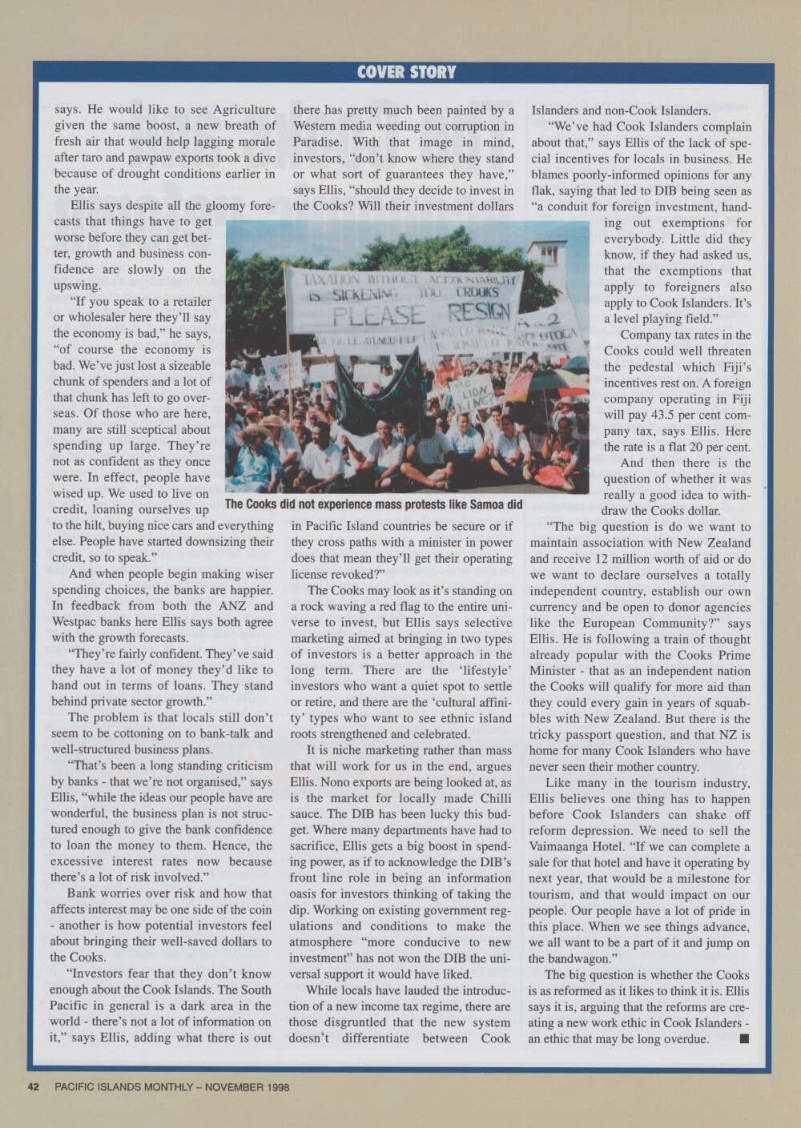
The Cooks did not experience mass protests like Samoa did