Bringing Paringa
pp. 28-29 · Read in the full issue
Business
Bringing Paringa On home
By Florence Syme-Buchanan
UNDER COVER, the art works slipped into the country and, quietly, went up on the National museum walls and on its floor - the first part of a Pacific journey was over. The artwork had come “home”.
Then museum curator, Johannah Wilson who organised the Paringa Ou exhibition sat back and waited for the public’s reaction.
It came - and praise was heaped on the New Zealand based Cook Islanders for coming home and shar ing their works, their artistic gifts, their “paringa ou” with their people.
For the established Cook Islands artists, the exhibition was a “spiritual journey moving towards a contempo rary vision”.
“As New Zealand-Cook Islanders artists, we are exploring the duality we find ourselves in. Many of us were born in New Zealand, some have never been to the Cook Islands,” said well-known painter lan George who organised the exhibition.
“So this journey of our artwork takes on a special significance. It is a spiritual return to our home”.
A spiritual journey home that’s never been made before. And this Pacific voyage was no simple under taking with some pieces being large, others very delicate, all very precious.
As journalist Marcia Tetevano wrote after viewing the exhibition: “As I stepped into the emotion room, I was hit by a number of them the objects hung from the walls, star ing into my soul and sensing my
innermost thoughts.
One saw my darkest secrets, the other my deepest fears, then came the one which brought incredible joy and
another which lent great beauty. Until I turned and saw a piece that almost drew tears, and finally, I fell in love”.
There are disturbing paintings by Rob George, a cheerful wall-hanging by creative duo Kay George and Mii Quarter, poignant sepia photographs by Riki Tangaroa and stunning sculp tures by well-established artist Richard Shortland-Cooper.
A striking piece that speaks with raw passion by newcomer Nia Val Ngaro is also sad - there is a poem etched on the work about broken hearts. “My inspiration
in doing this piece was in concern to Cook Islands women like myself, who have been physically and emo tionally abused by their male partners,” writes Nia Val Ngaro.
Some of the works, such as that by Sylvia Marsters, reflect the influence of New Zealand workshops by famous Samoan artist Fatu Feu’u.
Amongst the many pieces, some by new artists and others who have carved a reputa tion in New Zealand, were works by Michael Tuffery. Although not a Cook Islander, the presence of Tuffery, one of the Pacific’s most prominent artists, lends emphasis to the exhibition’s status and
diversity. Canterbury
University Pacific island art lecturer Karen Stevenson artic
ulates the inspiration behind the artists. “Pacific people, their arts and culture, have become Pasifika - a unique blend of island naivety and
urban sophistication.”
Stevenson said “it is from this world many contemporary Pacific artists emerge, asserting both New Zealand and Pacific identities.
Pacifika addresses both the urban reality of many islanders and their attempts to balance notions of identity and loss, migration and place, youth and age, tradition and change.
These contrasts create ambiguity and the need to challenge, to experi ment, to find one’s place”.
The exhibition found a warm place in the hearts of art-lovers in Rarotonga before journeying on to Fiji where it remains at the Fiji Museum until November 6. It then returns to New Zealand to give inspiration and, no doubt, motivation to many other aspiring Pacific artists to find their “place” there. ■
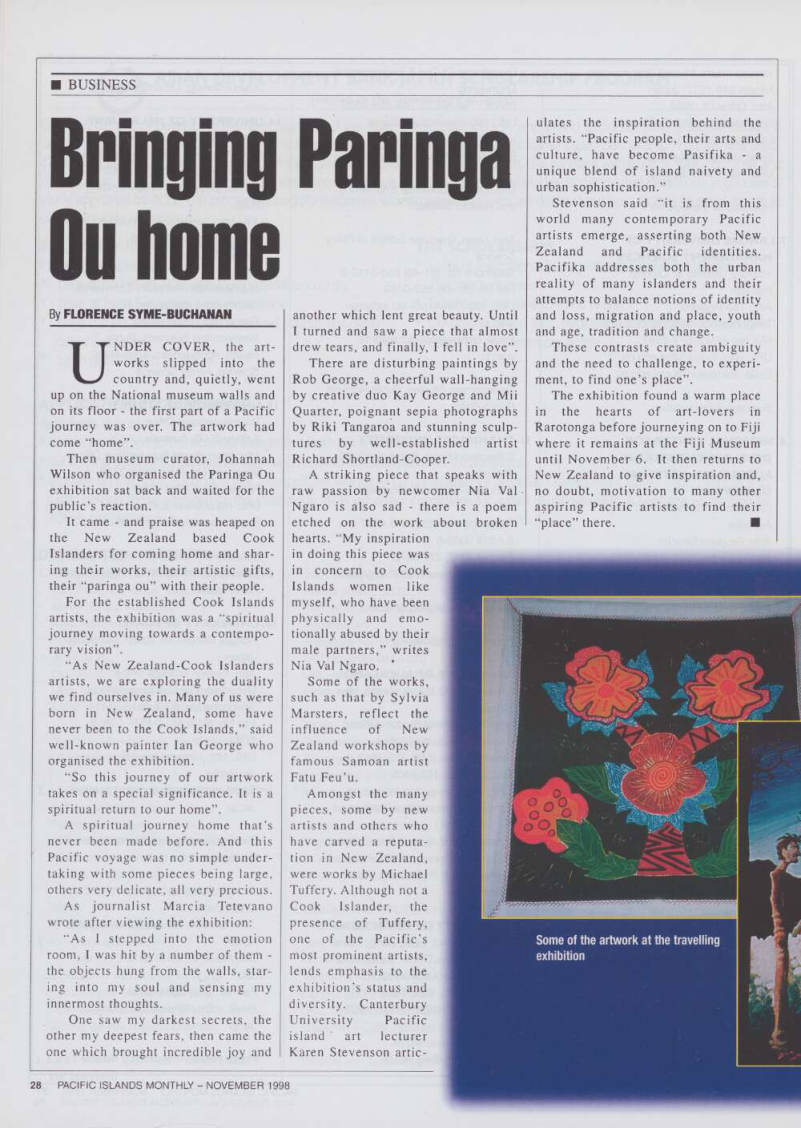
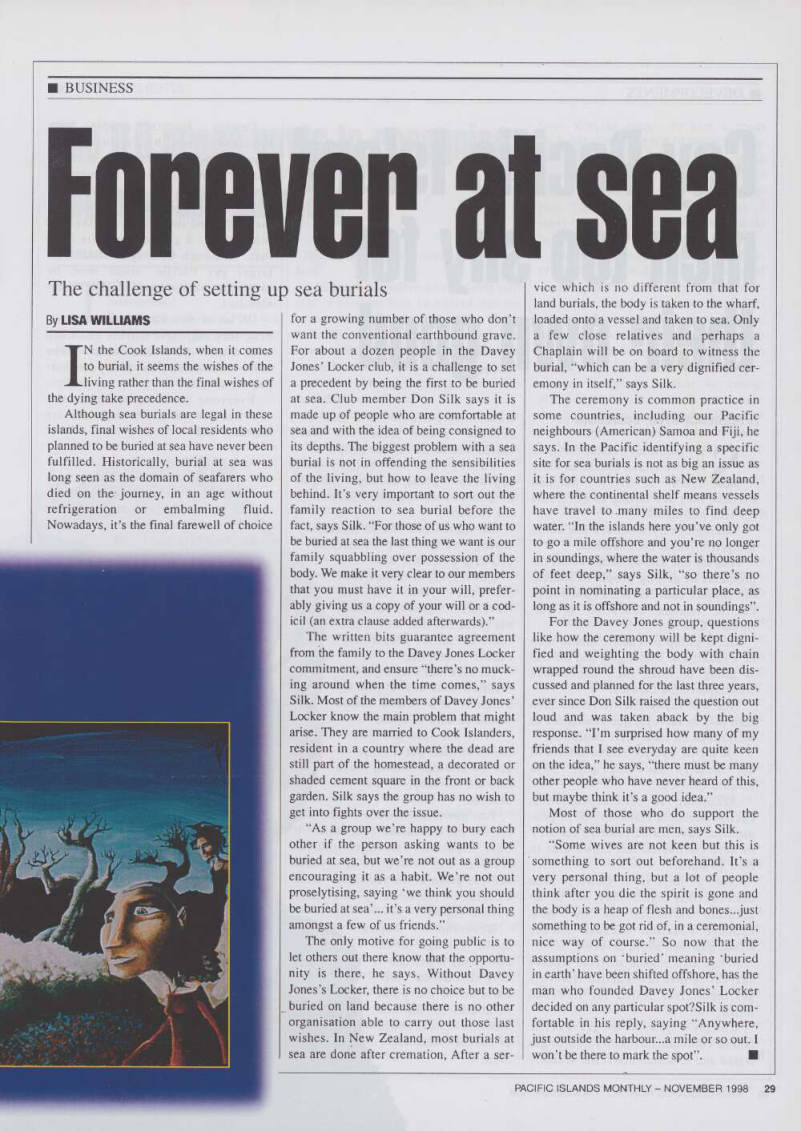
Some of the artwork at the travelling exhibition