Searching for peace
p. 12 · Read in the full issue
Focus
Searching for peace in troubled East timer
By Jennifer Lin, Krt
DILI, East Timor, KRT - In the blush of dawn, the faithful file into the courtyard of the bishop’s house by the sea for Sunday Mass in trou bled East Timor. Standing in the shade of a broad mango tree, they listen as Roman Catholic Bishop Carlos Belo tells them of the need for healing in their homeland, a former Portugese colony that Indonesia has ruled with brutality for 23 years.
As Belo, a Nobel peace laureate, speaks of reconciliation, Timorese guerrillas, broth ers and fathers of some of these very church-goers, continue their jungle battle for independence. Armed with weapons stolen from Indonesian troops, they hide under a cloak of plants from the prying searchlights of Indonesian military heli copters.
The 23-year resistance to Indonesian rule continues. But for the first time in East Timor’s violent history, there is cautious hope that Belo’s call for peace will be answered. The downfall of Indonesian President Suharto in May has brought change to East Timor, which Indonesia invaded in 1975 and annexed a year later.
The military has eased repressive rule.
Some combat troops have been sent home.
And for the first time, East Timorese are talking forthrightly about independence, expressing views that would have gotten them jailed just a few months ago.
In the boldest protest to date, more than 200,000 people took to the streets of the provincial capital of Dili last June, demand ing that they should decide for themselves what is right for east Timor. ‘’This is a new era of peace and dialogue,” said Belo, who shared the 1996 Nobel Peace Prize with exiled resistance leader Jose Ramos-Horta.
It is an uneasy calm, however. At night, soldiers in black camouflage carrying semi automatic weapons still patrol the streets of Dili. In villages far from the capital, people still are nervous about talking to a Western reporter. In the past, such contact would
have brought immediate interrogation and possible punishment. "After Suharto stepped down, we were more brave about talking about politics. But it is not really open,” said Alberto, who would speak to a foreigner only while driving around in the back seat of a car.
With Suharto gone, however, the Indonesian government of President B. J.
Habibie has signalled that it wants to resolve the East Timor issue. Suharto had one view of East Timor; it belonged to Indonesia, and the military had his blessing to use whatever means necessary to stamp out resistance. Today, 200 to 400 guerrillas make up the armed wing of the Timorese independence movement. They are out
gunned by thousands of Indonesian troops.
East Timor has been a black mark on Indonesia’s international reputa tion since the invasion. More than 10,000 Timorese died in fighting and another 200,000 died in the first three years of occupation from disease and hunger. Critics accused Indonesia of genocide for allowing so many Timorese to starve to death. Portugal broke off diplomatic relations, and the United Nations refused to recognise Indonesia as the legitimate authority.
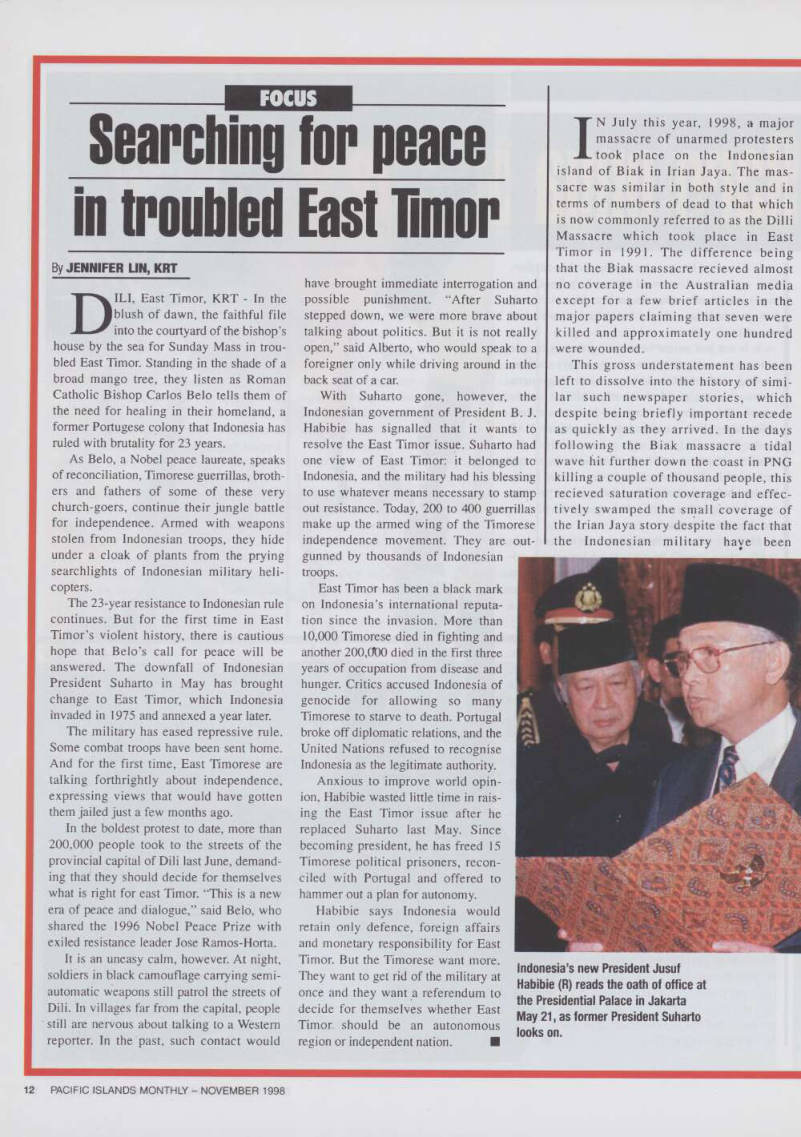
Anxious to improve world opin ion, Habibie wasted little time in rais ing the East Timor issue after he replaced Suharto last May. Since becoming president, he has freed 15 Timorese political prisoners, recon ciled with Portugal and offered to hammer out a plan for autonomy.
Habibie says Indonesia would retain only defence, foreign affairs and monetary responsibility for East Timor. But the Timorese want more.
They want to get rid of the military at once and they want a referendum to decide for themselves whether East Timor should be an autonomous region or independent nation. ■
IN July this year, 1998, a major massacre of unarmed protesters took place on the Indonesian island of Biak in Irian Jaya. The mas sacre was similar in both style and in terms of numbers of dead to that which is now commonly referred to as the Dilli Massacre which took place in East Timor in 1991. The difference being that the Biak massacre recieved almost no coverage in the Australian media except for a few brief articles in the major papers claiming that seven were killed and approximately one hundred were wounded.
This gross understatement has been left to dissolve into the history of simi lar such newspaper stories, which despite being briefly important recede as quickly as they arrived. In the days following the Biak massacre a tidal wave hit further down the coast in PNG killing a couple of thousand people, this recieved saturation coverage and effec tively swamped the small coverage of the Irian Jaya story despite the fact that the Indonesian military have been
Indonesia’s new President Jusuf Habibie (R) reads the oath of office at the Presidential Palace in Jakarta May 21, as former President Suharto looks on.