Vijay's victory is region's
pp. 45-46 · Read in the full issue
Sports
Vijay's victory is region's top sporting achievement
By Atama Raganivatu
VIJAY Singh’s recent suc
cess at the United States PGA golf tournament must rank as the finest moment in Pacific Islands sports.
The PGA, one of professional golf’s four annual major tournaments, is amongst
the blue ribbon events of the international sports calendar and always receives world wide media coverage.
The region’s other great sporting achievements have either been harvested in less internationally significant sports, gained in the colours of other countries, or, in the case of Tongan Olympic hero Paea Wolfgramm, by a sportsman just failing to
reach his intended goal.
Singh’s accomplish ment is all the more meritorious as it was realised after he overcame a setback that would have sunk the careers of weaker personalities and came due to his almost obsessive will to succeed.
Singh’s strong-mind edness became evi dent at an early age when he constantly defied his father, Mohan, to practice at the Nadi Airport golf course rather than attending school.
Mohan’s concerns were understandable.
He had briefly dab bled in professional golf with minimal success and minimal financial returns before settling for less glamorous though considerably safer employment as an airport engineer.
Although remaining a keen amateur (he captained the Nadi Airport Golf club),
Mohan was anxious for his son not to har bour any "fanciful” ideas over earning a living from golf and instead urged him to study to gain “a proper job”. How Mohan, who today lives in New Zealand, must now give thanks for that youthful disobedience.
Apart from being as proud as only a parent can be about Vijay’s feats, Mohan has received the finest available treatment for a
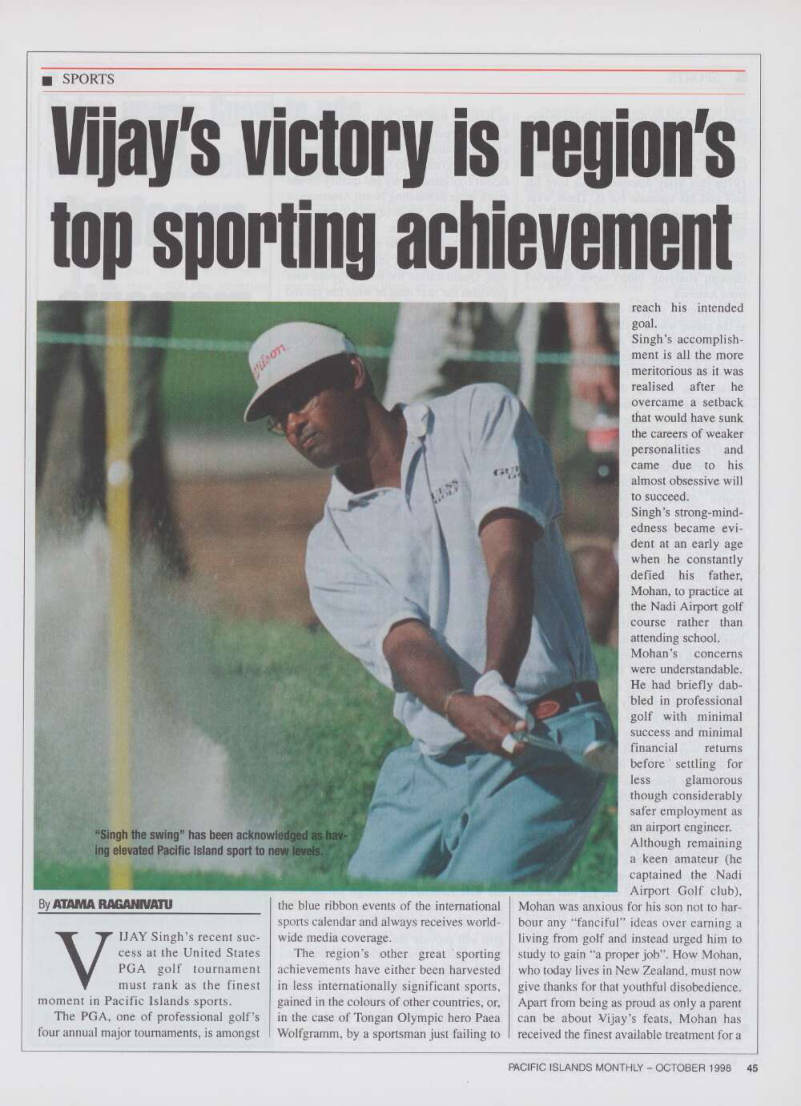
“Singh the swing” has been acknowledged as hav ing elevated Pacific Island sport to new levels.
series of persistent health problems thanks purely to Vijay’s financial aid.
It was at the Nadi Airport club’s rudi mentary nine-hole course in the early 1970 s that Vijay discovered his love for golf and his aptitude for it. There were hardly any qualified golf coaches in Fiji in those days and no television.
The one practical way open for young Singh to improve his technique was through studying video tapes imported from America.
He quickly singled out Tom Weiskopf as the player whose style he admired most and attempted to copy every aspect of the 1973 British Open champion’s game.
So well did Singh emulate Weiskopf’s prowess in driving the ball long and straight that his tee shots regularly out stripped the Nadi course’s fairways and, when the area was clear of planes, he would hammer balls the length of the adja cent airport’s runway!
The opening of the Pacific Harbour course offered a greater challenge.
Nevertheless, he quickly outgrew local amateur competition. In 1982, aged 19, Singh turned professional.
Unfortunately, he struggled in the Asian Tour’s cut-throat environment. His scores were often high and his pay cheques piti ful. Then, in his third season on the paid circuit, came the infamous “Cheating Incident”. Upon completing a round in the Indonesian Open, it was ascertained that Singh claimed a shot fewer on his score card than he had really scored.
Despite vehemently protesting he had merely made an innocent mistake (and one common in all levels of golf), the Fiji Islander was suspended. Singh remains bit ter when recalling the incident and blames a malicious Indonesian dignitary for his humiliation. Such is the sense of rancour he maintains that he steadfastly avoids competitions staged in Asia.
Banished from the tournament scene yet eager to remain a golf professional, Singh, literally, went into the wilderness.
He was just offered one job that would keep him involved in the sport following his suspension - as a professional at a club deep in the Borneo jungle. And so, for two years, Singh spent his mornings instruct ing oil and timber company executives and his afternoons and evenings practising, practising, and practising.
The Indonesian mishap instilled into Singh a fervent desire to reach the top and
in Borneo, free from any distractions, he took the opportunity to hone his proficien cy over countless, uninterrupted, hours.
Unwilling to return to Asia and having suf ficient confidence to try and qualify for the much more demanding North American or
European tours, Singh began his comeback
on Africa’s Safari Tour.
After becoming the top money winner there, he felt himself ready to fry bigger fish. Qualification for the European tour provided the next rung of what has proved to be a lofty ladder.
Having notched up several prestigious wins in Europe, Singh moved on to the biggest and most lucrative arena in golf, the North American tour, in 1993.
Following his initial season in that rarefied atmosphere, he was named “Rookie of the Year”. In the subsequent four years, Singh was a regular winner. In 1997, he topped the leaders’ board at the end of both the Memorial Tournament and Buick Open on the North American tour, as well as tri umphing in the World Match Play Championship in England.
However, doubts remained upon Singh’s ability to capture any of the four
major championships. Ultimately, a
golfer’s standing is based upon his perfor mances at the British Open, US Open, US Masters and US PGA, and many golf experts dismissed Singh’s claims to be a contender for these due to the single cru cial flaw in his game. Singh’s technique from tee to green is near perfect, gaining him the nickname “Singh the Swing”.
His dedication to preparation has already become the subject of legend and his temperament can not be faulted. What prevented Singh from joining the very elite of golf, those authorities insisted, was a weakness in his putting.
Singh himself acknowledged this possi
ble Achilles Heel with long hours on the
practice greens and by constantly changing
his putting technique.
It was with a cross handed grip, adopt ed seven weeks earlier at the suggestion of his wife Ardena, that Singh putted with great efficiency at the US PGA Championship. Only time will tell if this grip will provide the key to further glory for the golfer whose first name means “vic tory” in Hindi.
Even if it does not, he can be content for having elevated Pacific Islands sport ing achievement to a level few believed was possible a scant time ago. ■