A tight ship
pp. 38-42 · Read in the full issue
Cover Story
‘Several experts agree that the prob lem is not so much the number of vessels servicing the region but the way that the region is servicing these vessels’
By Sophie Foster Hildebrand
A QUARTER of a century ago, leaders from around the region got together to decide a matter of strategic importance for develop ment in the Pacific - regional shipping.
At the time, all acknowledged the difficulties the region faced because of the perceived lack of control over regular, cheap ship ping services, and the implications this had on trade.
“It is a truism that without an integrated transport system between the islands of the region the chances are slim indeed that commerce and industry in the islands can be developed,” a 1974 SPEC paper said.
“If a regional inter-island service can be operated on the basis of economic viability, it will help towards alleviating the econom ic isolation of most of the islands and new markets may be creat ed, but if such a regional shipping line is not viable and whether or not the operation is sustained or not, it will cause criticism and disappointment. Here then lies the challenge”.
Paradoxically, at this year’s South Pacific Forum Leaders’ meeting in Micronesia, shipping was not on the agenda, even though it was considered critically important by most senior offi cials.
For government members who are trying to bring the shipping issue to the forefront, frustration is building.
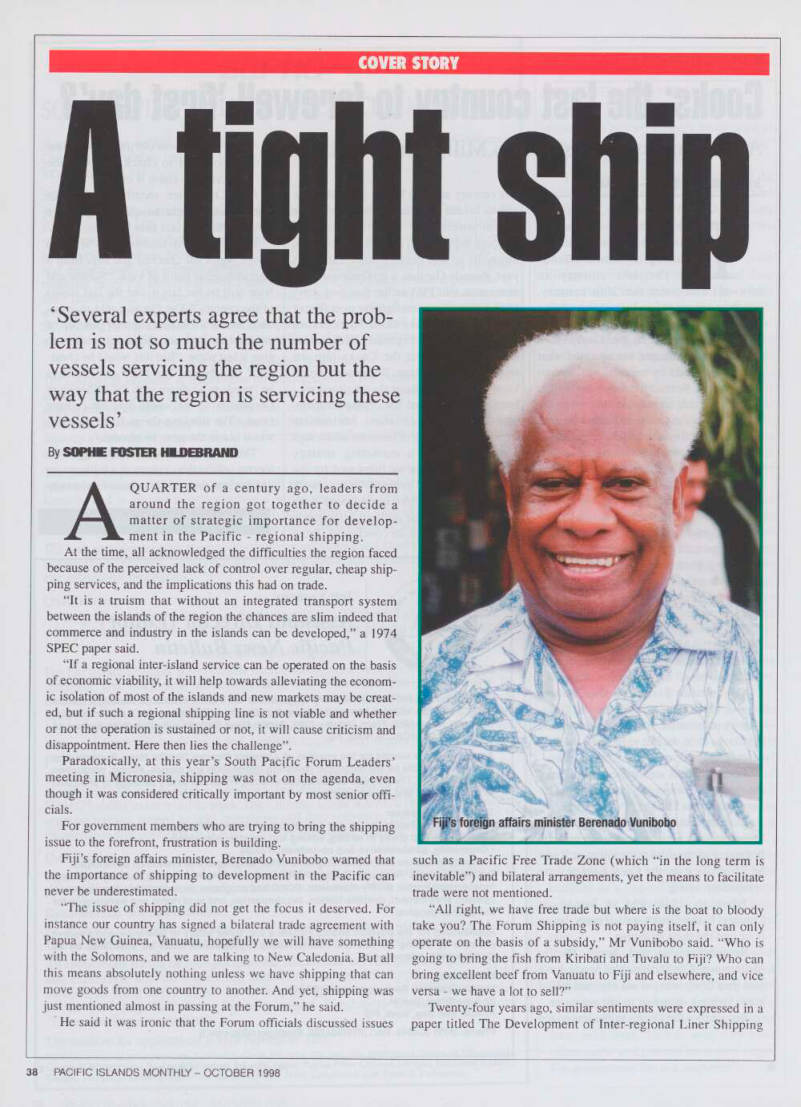
Fiji’s foreign affairs minister, Berenado Vunibobo warned that the importance of shipping to development in the Pacific can never be underestimated.
“The issue of shipping did not get the focus it deserved. For instance our country has signed a bilateral trade agreement with Papua New Guinea, Vanuatu, hopefully we will have something with the Solomons, and we are talking to New Caledonia. But all this means absolutely nothing unless we have shipping that can move goods from one country to another. And yet, shipping was just mentioned almost in passing at the Forum,” he said.
He said it was ironic that the Forum officials discussed issues
such as a Pacific Free Trade Zone (which “in the long term is inevitable”) and bilateral arrangements, yet the means to facilitate trade were not mentioned.
“All right, we have free trade but where is the boat to bloody take you? The Forum Shipping is not paying itself, it can only operate on the basis of a subsidy,” Mr Vunibobo said. “Who is going to bring the fish from Kiribati and Tuvalu to Fiji? Who can bring excellent beef from Vanuatu to Fiji and elsewhere, and vice versa - we have a lot to sell?”
Twenty-four years ago, similar sentiments were expressed in a paper titled The Development of Inter-regional Liner Shipping
Fiji’s foreign affairs minister Berenado Vunibobo
Operations in the South-West Pacific (A Pooling Scheme).
“Why is cement imported from Europe and Japan into some of the islands whereas there is a cement factory with over capacity in Fiji?
“Why are bananas imported from Ecuador into New Zealand whereas the South Pacific Islands (Tonga, inter alia) can offer bananas over a much shorter distance?
“Why are fertilisers exclusively imported from abroad and why is there no fertiliser factory in any of the islands?
“Why is there a sudden dearth of lamb and mutton in Suva, with New Zealand (Auckland) being a mere 1300 miles away?” the paper said.
But as many professionals in the shipping industry have stated, both now and in the past, “there is no simple solitary answer to these and many other questions of this nature”.
The SPEC paper said, “it is no doubt a matter of communica tion in the first place, however, to assert that a Regional Shipping Line would solve these problems forthwith would be an oversim plification of the problem”.
These words have rung true almost two decades after the estab lishment of the Forum Shipping Line. Problems such as access to
markets through regular shipping still plagues importers and
exporters throughout the region.
At the time, the freight rates to the South Pacific islands were high. Some business people say they are still high.
The reasons for this, experts say, apply both in the past and today - in part because of geographical conditions and the low ton nage shipped.
Mr David Aidney of Williams and Goslings, a freight forward ing service based in Suva, says the rates depend on the amount of traffic that is going through the region. When there are several big operators, the rates become almost ridiculously low.
“It goes through cycles. We are just mopping up after a freight war. The rates came tumbling down. There were carriers out to basically kill each other. One particular carrier lost about $4 mil lion on the Australia to Fiji run because they were so caught up in the freight war. It was quite disastrous because when they realised they were losing so much, they had to shut it down,” he said.
Mr Aidney said exporters and importers should realise that “freight wars are fine but it’s very short-term gain”.
“Someone is going to fall out, someone is going to drop by the wayside and then you’ll have fewer services and then you’ll start
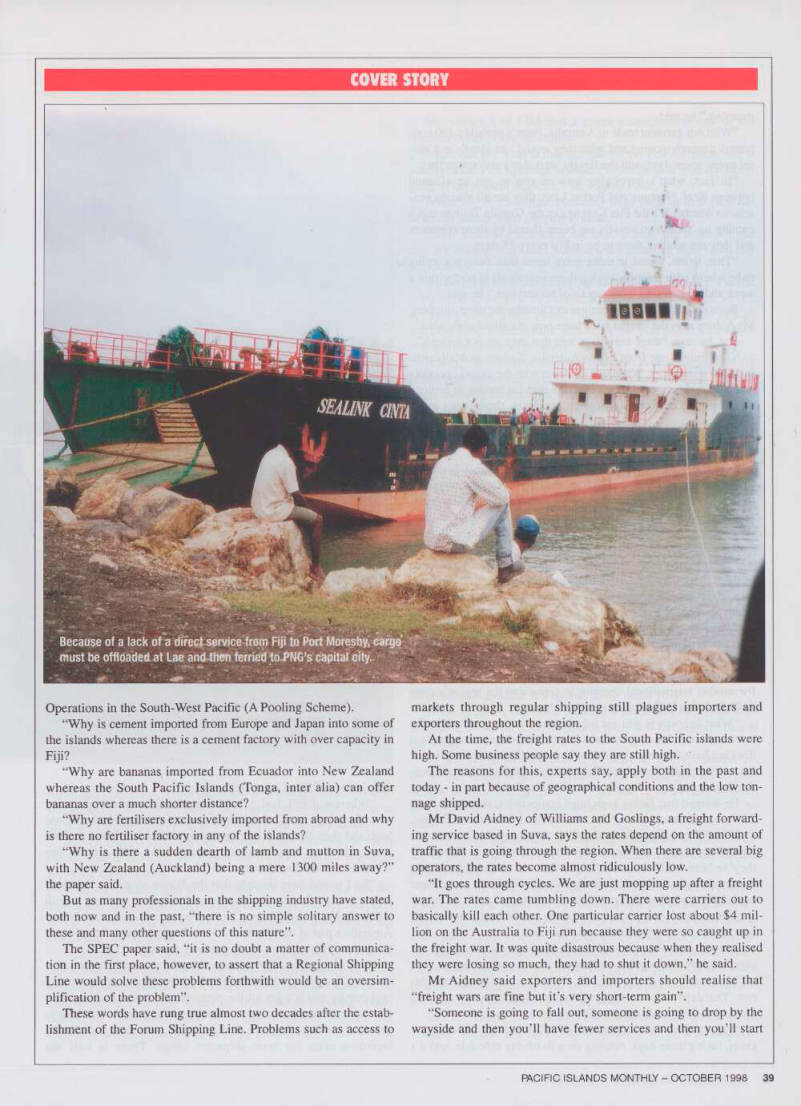
Because of a lack of a direct service-from Fiji to Port Moresby, cargo must be offloaded at Lae and then ferried to PNG’s capital city.
moaning,” he said.
“With our garment trade to Australia, there’s probably 100 con tainers a month moving and what they would like ideally is a ves sel every seven days, and the freight wars don’t encourage that.
“In fact, what’s happening now is you’ve got an alliance between Reef, Neptune and Forum Line, they are all sharing ves sels, so whether it’s the Fua Kavenga or the Captain Tasman that’s coming up, those two vessels are being shared by three operators and they are spacing them to be in Fiji every 15 days.
“That, to me, seems to make more sense than everyone trying to be a hero with shippers having three vessels all in port within a week and then having three weeks of no services,” he said.
Because of the current arrangement among the three shippers, Mr Aidney says the freight rates have now stabilised somewhat.
But, he says, “there are still moans that they are not enough”.
“The freight rate from Fiji to Australia, Sydney or Melbourne is $l3OO a container. When you sit down with the vessel operators and take in their stevedoring costs, the cost for renting or hiring a container, the cost of discharging containers, there is not much left”.
Mr Aidney said often it gets down to basic economics, because “a vessel won’t call in here unless it can make money”.
Captain Dr Peter Heathcote, who is the Regional Maritime Legal Advisor at the Secretariat of the Pacific Community, says the Pacific Forum Line is doing better than they were in the past.
“From what I gather they are back in a profit mode now, and they seem to be doing better,” he said, “they’re in a difficult spot because they have a political role to play”.
“Their shareholders are the Pacific Island countries and some of them think they are not getting anything out of it. So they put on a feeder service up to Micronesia along Tuvalu but that wasn’t totally successful”.
“Anyway, the Forum Line is now back in the black. I think its mandate is more commercial but with a sensitivity to the politics involved,” he said.
But PFL may be in for another freight war soon, if a proposal for another international operator to come into the region’s most trafficked area (NZ-Aust-Suva) goes ahead.
“What happens is you get a new carrier coming in hungry for market share. It has to go out and buy market share, so normally it does not have too much consideration with the cost or the return,”
Mr Aidney said. “But where Fiji has to be careful is that competi tion is fine but providing it’s all for the long haul”.
He warned that facing such huge competitors, that carry up to 1500 containers at a time, PFL could be in for another rough time.
“The NZ to Fiji market is already over-tonnaged so someone is going to go broke, and that is my concern for Forum. Obviously they’ve been in the business longer than me so they know what they’re doing but my concern is that it probably doesn’t cost these big boys too much to divert and the economies of scale are usual ly different between running one of those vessels and running your own vessel like the Forum Samoa,” he said.
One way that PFL can capitalise on its regional knowledge, he says, is to provide regular services to countries of the region.
“The way I see this is that PFL should become a regional car rier. The days of competing against the big boys out of New Zealand to Fiji or Australia to Fiji are gone,” he said.
“I mean these vessels (Australian/NZ) are doing 21 knots, 18 knots, taking three days, running on a fixed-day schedule, and it’s
very hard for PFL to compete.
“Whereas if PFL had a fixed-day schedule out of here, going around to the islands - you could do the Apia-Pago-Nuku in one loop and then the other loop going up to Honiara-north to PNG and back down - then providing they could offer a fixed day schedule, it would work very well,” he said.
“So I would have thought that the Forum should be focusing on becoming a Pacific Island regional carrier, and working in with all these big guys. There’s all this pride, you know, they say Australia’s part of the Forum and New Zealand’s part of the Forum but it has to come down to economics,” he said.
“The wheelbarrow I’ve been pushing for a couple of years now is trying to develop Fiji into the hub of the Pacific. It’s got every opportunity and it’s got all the potential. But what I’m saying is that we can’t sit on our butts and expect it to happen. We have to get out there and market it. Port Authority have done by offering incentive rates for trans-shipment cargo. There is half the
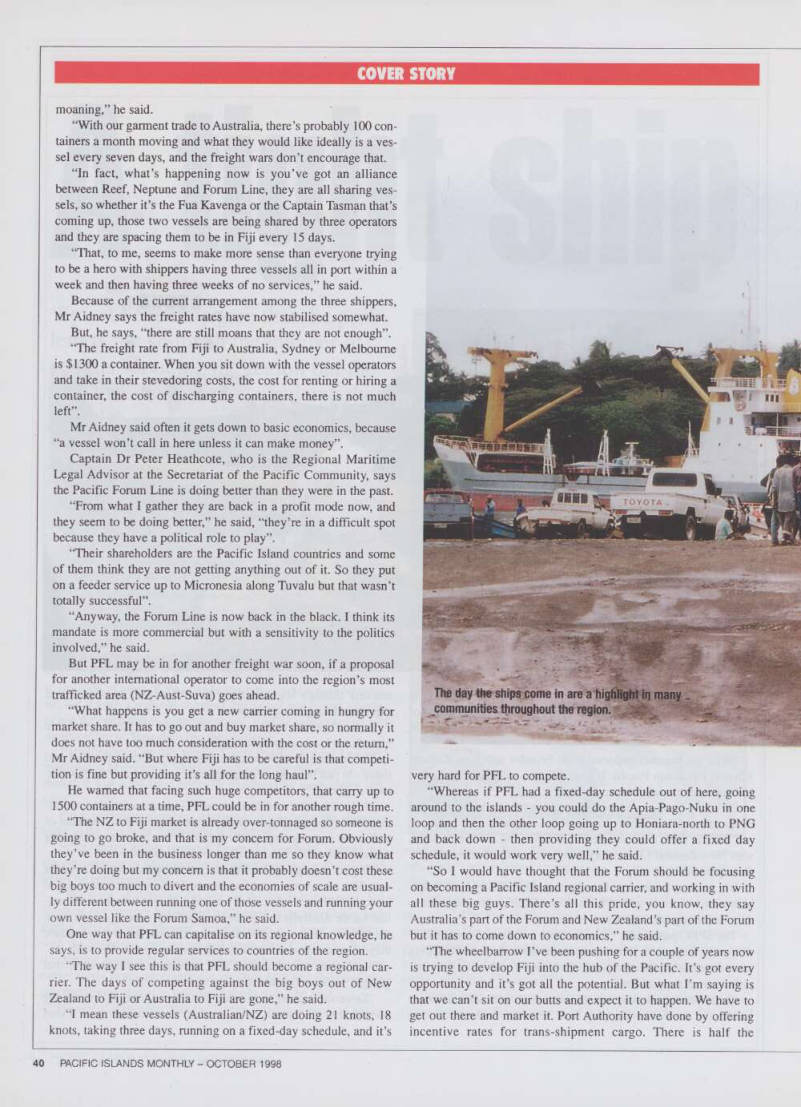
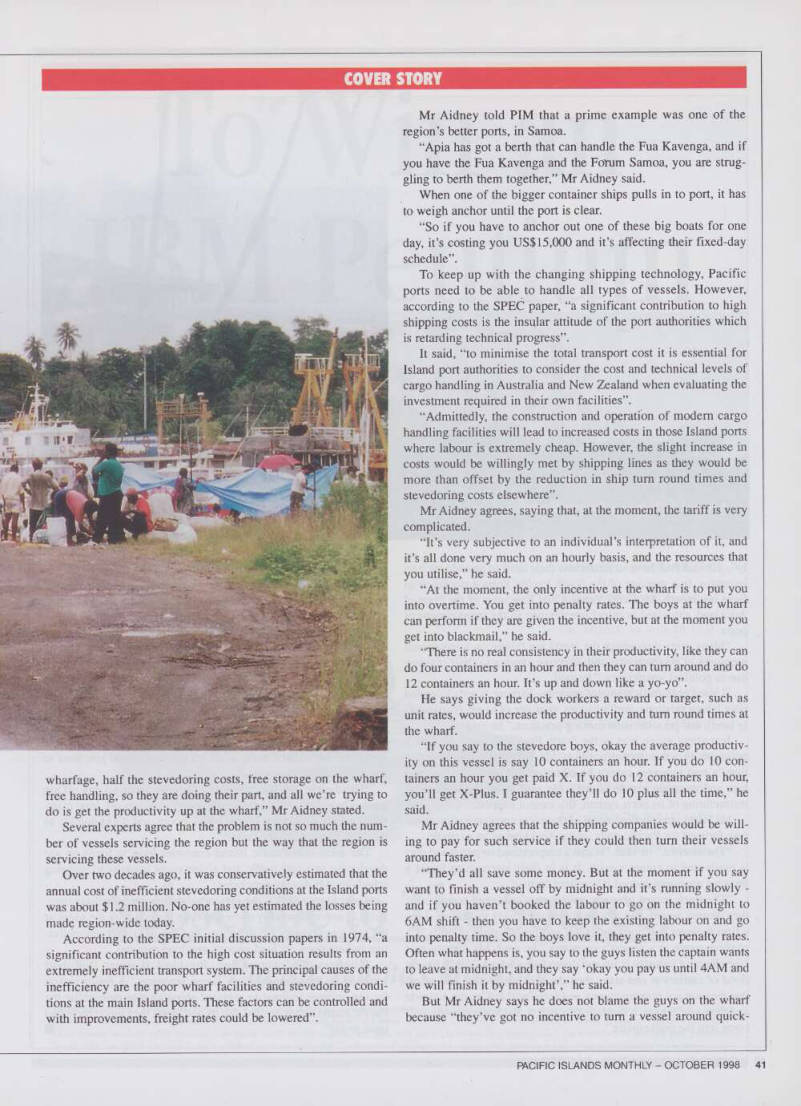
The day the ships come in are a highlight in many communities throughout the region.
wharfage, half the stevedoring costs, free storage on the wharf, free handling, so they are doing their part, and all we’re trying to do is get the productivity up at the wharf,” Mr Aidney stated.
Several experts agree that the problem is not so much the num ber of vessels servicing the region but the way that the region is servicing these vessels.
Over two decades ago, it was conservatively estimated that the annual cost of inefficient stevedoring conditions at the Island ports was about $1.2 million. No-one has yet estimated the losses being made region-wide today.
According to the SPEC initial discussion papers in 1974, “a significant contribution to the high cost situation results from an extremely inefficient transport system. The principal causes of the inefficiency are the poor wharf facilities and stevedoring condi tions at the main Island ports. These factors can be controlled and with improvements, freight rates could be lowered”.
Mr Aidney told PIM that a prime example was one of the region’s better ports, in Samoa.
“Apia has got a berth that can handle the Fua Kavenga, and if you have the Fua Kavenga and the Forum Samoa, you are strug gling to berth them together,” Mr Aidney said.
When one of the bigger container ships pulls in to port, it has to weigh anchor until the port is clear.
“So if you have to anchor out one of these big boats for one day, it’s costing you USSIS,OOO and it’s affecting their fixed-day schedule”.
To keep up with the changing shipping technology, Pacific ports need to be able to handle all types of vessels. However, according to the SPEC paper, “a significant contribution to high shipping costs is the insular attitude of the port authorities which is retarding technical progress”.
It said, “to minimise the total transport cost it is essential for Island port authorities to consider the cost and technical levels of cargo handling in Australia and New Zealand when evaluating the investment required in their own facilities”.
“Admittedly, the construction and operation of modem cargo handling facilities will lead to increased costs in those Island ports where labour is extremely cheap. However, the slight increase in costs would be willingly met by shipping lines as they would be more than offset by the reduction in ship turn round times and stevedoring costs elsewhere”.
Mr Aidney agrees, saying that, at the moment, the tariff is very
complicated.
“It’s very subjective to an individual’s interpretation of it, and it’s all done very much on an hourly basis, and the resources that you utilise,” he said.
“At the moment, the only incentive at the wharf is to put you into overtime. You get into penalty rates. The boys at the wharf can perform if they are given the incentive, but at the moment you get into blackmail,” he said.
“There is no real consistency in their productivity, like they can do four containers in an hour and then they can turn around and do 12 containers an hour. It’s up and down like a yo-yo”.
He says giving the dock workers a reward or target, such as unit rates, would increase the productivity and turn round times at the wharf.
“If you say to the stevedore boys, okay the average productiv ity on this vessel is say 10 containers an hour. If you do 10 con tainers an hour you get paid X. If you do 12 containers an hour, you’ll get X-Plus. I guarantee they’ll do 10 plus all the time,” he said.
Mr Aidney agrees that the shipping companies would be will ing to pay for such service if they could then turn their vessels around faster.
“They’d all save some money. But at the moment if you say want to finish a vessel off by midnight and it’s running slowly and if you haven’t booked the labour to go on the midnight to 6AM shift - then you have to keep the existing labour on and go into penalty time. So the boys love it, they get into penalty rates.
Often what happens is, you say to the guys listen the captain wants to leave at midnight, and they say ’okay you pay us until 4AM and we will finish it by midnight’,” he said.
But Mr Aidney says he does not blame the guys on the wharf because “they’ve got no incentive to turn a vessel around quick-
ly”. He said PAF have to restructure their tariff to provide such an incentive. In a meeting of the South Pacific Ports Association in Suva last month, Mr Geoff Vazey, Chief Executive of the Ports of Auckland, criticised political interference in the management of ports.
“Many ports throughout the world are failing on international measures of productivity, and effective service to their regions, due to political interference,” he said.
“Under politically managed regimes, harbour boards tolerated poor labour relations, inefficiencies, poor use of assets (particular ly land), and poor decision making practices,” he said.
Just about every port in the South Pacific is controlled by a politician in a ministerial position. Mr Vazey warned, however, that “a port manager cannot be effective if a politician can ring him and overrule his decisions”. He said in the New Zealand restructuring of its ports system, this cannot happen.
Mr Vazey was pushing a line of complete corporatisation as the way forward for Pacific ports, using Auckland as an example.
“The essence,” he said, “is that a corporatised or privatised port is motivated to create wealth. It is in their interests to foster a growing economy, indeed it is reliant on that”.
“The track record of many government-managed ports is that they destroy wealth and rely on forms of subsidy to survive. I am a firm believer that corporatisation and privatisation of ports is a positive move to a region’s economy,” he said. Mr Aidney said “the shipping industry is up and down like a yo-yo. You’ll have a flood of carriers at one stage then the economics of it will prove that they are not making money and some will fall by the wayside and then you’ll have a shortage of carriers and someone else will come into the marketplace”.
The one static element that Pacific ports could work on - to keep carriers running throughout the region - is to upgrade and update both people and equipment. This would increase efficien cy, reduce tariffs and decrease turn round times.
To do this, Mr Aidney says, Pacific ports have to consider a seven-day-week, a 24-hour port concept and review their tariffs.
The thinking a quarter of a century ago was that a Regional Line would “increase trade by providing a service where an inde pendent commercial operator would be unwilling to take the risk where the trade may not develop sufficiently for the service to become economic”.
Since then, though, “the whole economics of shipping has changed,” Mr Aidney says, “it’s very aggressive and you have to
run a tight ship”.
“The days of coming in port and the crew having a day off are gone. They come in and say how many containers off, how many on, when are we sailing, boom, boom, boom, and it’s as quickly as they can turn around the better”.
The areas that Pacific Island countries have to focus on are developing two-way traffic and giving some integrity to shipping schedules, Mr Aidney concludes.
According to SPEC, the region’s shipping needs include regu larity of service, stability of freight rates, liaison with the users of the services (shipper organisations and the like), and rationalisa tion (where ports off load imports and load exports).
A quarter of a century ago, President Hammer Deßoburt summed up the shipping saga in one sentence: “A major reason for the priority adopted to regional shipping was that whilst the Pacific Island States needed aid, by and large, they much preferred trade to aid” ■
A view of the harbour in Pohnpei, Micronesia.