Tasman "hijackers" capture Forum
pp. 44-45 · Read in the full issue
Forum
By Sophie Foster Hildebrand
IT was an unprecedented
move. An official from a Pacific Island country issued a warning that could be the writing on the wall for the annual South Pacific Forum meeting. It was “a warning that we want more focused attention on what is going to be discussed here. We want issues which are really going to be of relevance to the development of Pacific Island countries in immediate terms”.
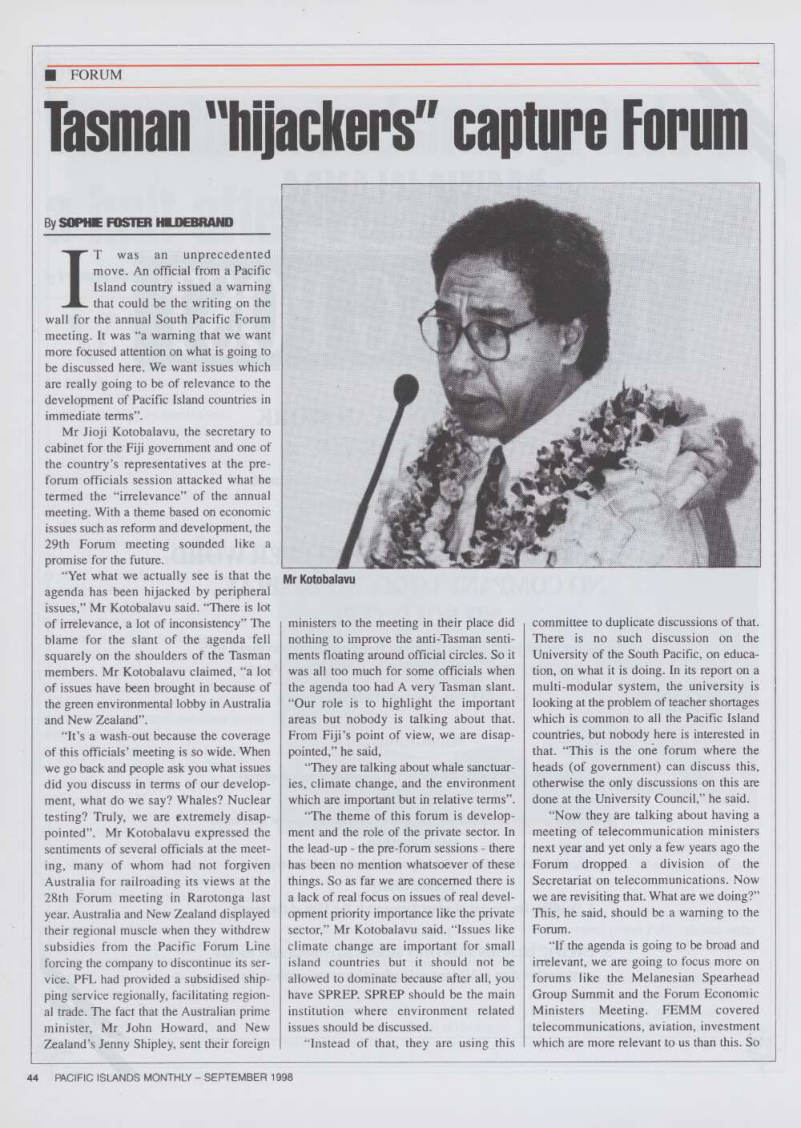
Mr Jioji Kotobalavu, the secretary to cabinet for the Fiji government and one of the country’s representatives at the pre forum officials session attacked what he termed the “irrelevance” of the annual meeting. With a theme based on economic issues such as reform and development, the 29th Forum meeting sounded like a promise for the future.
“Yet what we actually see is that the agenda has been hijacked by peripheral issues,” Mr Kotobalavu said. “There is lot of irrelevance, a lot of inconsistency” The blame for the slant of the agenda fell squarely on the shoulders of the Tasman members. Mr Kotobalavu claimed, “a lot of issues have been brought in because of the green environmental lobby in Australia and New Zealand”.
“It’s a wash-out because the coverage of this officials’ meeting is so wide. When we go back and people ask you what issues did you discuss in terms of our develop ment, what do we say? Whales? Nuclear
testing? Truly, we are extremely disap
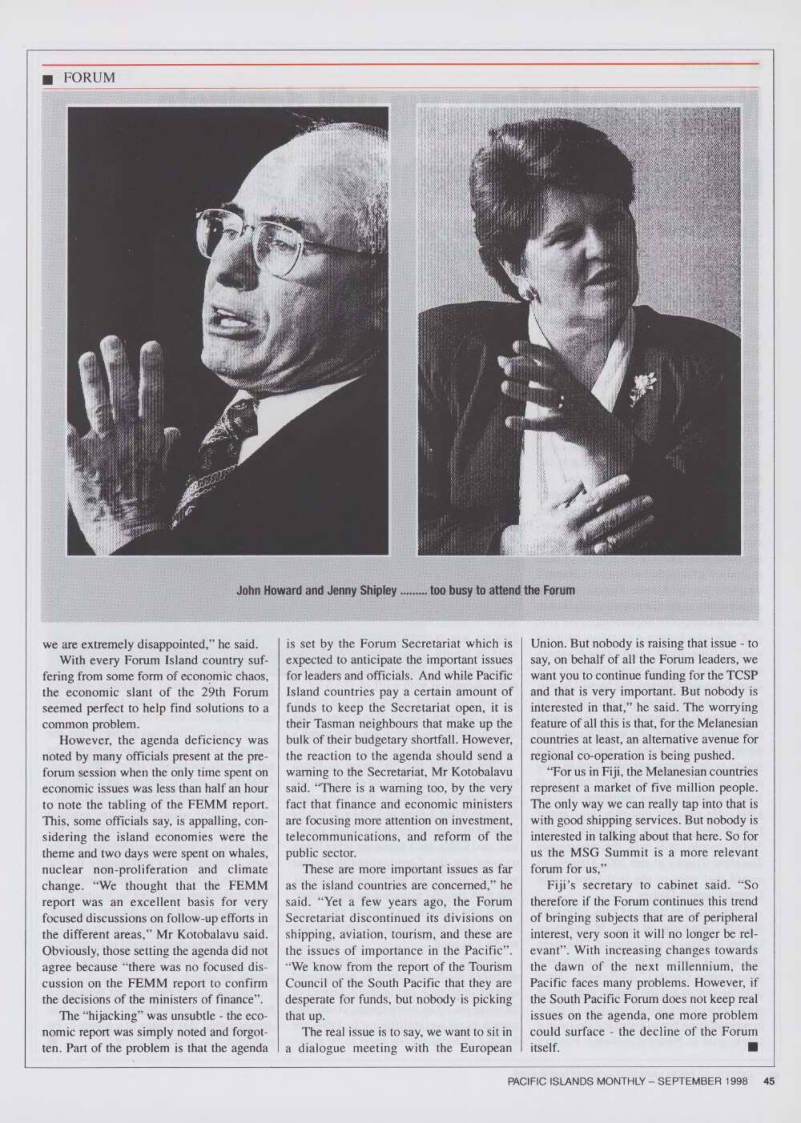
pointed”. Mr Kotobalavu expressed the sentiments of several officials at the meet ing, many of whom had not forgiven Australia for railroading its views at the 28th Forum meeting in Rarotonga last year. Australia and New Zealand displayed their regional muscle when they withdrew subsidies from the Pacific Forum Line forcing the company to discontinue its ser vice. PFL had provided a subsidised ship ping service regionally, facilitating region al trade. The fact that the Australian prime minister, Mr John Howard, and New Zealand’s Jenny Shipley, sent their foreign
ministers to the meeting in their place did nothing to improve the anti-Tasman senti ments floating around official circles. So it was all too much for some officials when the agenda too had A very Tasman slant.
“Our role is to highlight the important areas but nobody is talking about that.
From Fiji’s point of view, we are disap pointed,” he said, “They are talking about whale sanctuar ies, climate change, and the environment which are important but in relative terms”.
“The theme of this forum is develop ment and the role of the private sector. In the lead-up - the pre-forum sessions - there has been no mention whatsoever of these things. So as far we are concerned there is a lack of real focus on issues of real devel opment priority importance like the private sector,” Mr Kotobalavu said. “Issues like climate change are important for small island countries but it should not be allowed to dominate because after all, you have SPREP. SPREP should be the main institution where environment related issues should be discussed.
“Instead of that, they are using this
committee to duplicate discussions of that.
There is no such discussion on the University of the South Pacific, on educa tion, on what it is doing. In its report on a multi-modular system, the university is looking at the problem of teacher shortages which is common to all the Pacific Island countries, but nobody here is interested in that. “This is the one forum where the heads (of government) can discuss this, otherwise the only discussions on this are done at the University Council,” he said.
“Now they are talking about having a meeting of telecommunication ministers next year and yet only a few years ago the Forum dropped a division of the Secretariat on telecommunications. Now we are revisiting that. What are we doing?”
This, he said, should be a warning to the Forum.
“If the agenda is going to be broad and irrelevant, we are going to focus more on forums like the Melanesian Spearhead Group Summit and the Forum Economic Ministers Meeting. FEMM covered telecommunications, aviation, investment which are more relevant to us than this. So
Mr Kotobalavu
we are extremely disappointed,” he said.
With every Forum Island country suf fering from some form of economic chaos, the economic slant of the 29th Forum seemed perfect to help find solutions to a
common problem.
However, the agenda deficiency was noted by many officials present at the pre forum session when the only time spent on economic issues was less than half an hour to note the tabling of the FEMM report.
This, some officials say, is appalling, con sidering the island economies were the theme and two days were spent on whales, nuclear non-proliferation and climate change. “We thought that the FEMM report was an excellent basis for very focused discussions on follow-up efforts in the different areas,” Mr Kotobalavu said.
Obviously, those setting the agenda did not agree because “there was no focused dis cussion on the FEMM report to confirm the decisions of the ministers of finance”.
The “hijacking” was unsubtle - the eco nomic report was simply noted and forgot ten. Part of the problem is that the agenda
is set by the Forum Secretariat which is
expected to anticipate the important issues
for leaders and officials. And while Pacific Island countries pay a certain amount of funds to keep the Secretariat open, it is their Tasman neighbours that make up the bulk of their budgetary shortfall. However, the reaction to the agenda should send a warning to the Secretariat, Mr Kotobalavu said. “There is a warning too, by the very fact that finance and economic ministers are focusing more attention on investment, telecommunications, and reform of the public sector.
These are more important issues as far as the island countries are concerned,” he said. “Yet a few years ago, the Forum Secretariat discontinued its divisions on shipping, aviation, tourism, and these are the issues of importance in the Pacific”. ”We know from the report of the Tourism Council of the South Pacific that they are desperate for funds, but nobody is picking that up.
The real issue is to say, we want to sit in a dialogue meeting with the European
Union. But nobody is raising that issue - to say, on behalf of all the Forum leaders, we want you to continue funding for the TCSP and that is very important. But nobody is interested in that,” he said. The worrying feature of all this is that, for the Melanesian countries at least, an alternative avenue for regional co-operation is being pushed.
“For us in Fiji, the Melanesian countries represent a market of five million people.
The only way we can really tap into that is with good shipping services. But nobody is interested in talking about that here. So for us the MSG Summit is a more relevant forum for us,”
Fiji’s secretary to cabinet said. “So therefore if the Forum continues this trend of bringing subjects that are of peripheral interest, very soon it will no longer be rel evant”. With increasing changes towards the dawn of the next millennium, the Pacific faces many problems. However, if the South Pacific Forum does not keep real issues on the agenda, one more problem could surface - the decline of the Forum itself. ■
John Howard and Jenny Shipley too busy to attend the Forum