The South Pacific
pp. 34-36 · Read in the full issue
Cover Story
By Andrew Kilvert
ON July 1 this year, a wave of Melanesian independence demonstrations took place in the Indonesian controlled province of Irian Jaya. West Papua independence flags were raised in Biak, Sorong, Nabire, Wamena and in the provin cial capital Jayapura. Raising the West Papua flag is a capital offense in Irian Jaya and has resulted in both sum mary execution and life prison sentences in the past.ln 1996 Robert Wanggai died in a Jakarta prison after receiving a life sen tence for raising the West Papua flag. His wife recieved an eight year sentence for making the flag.
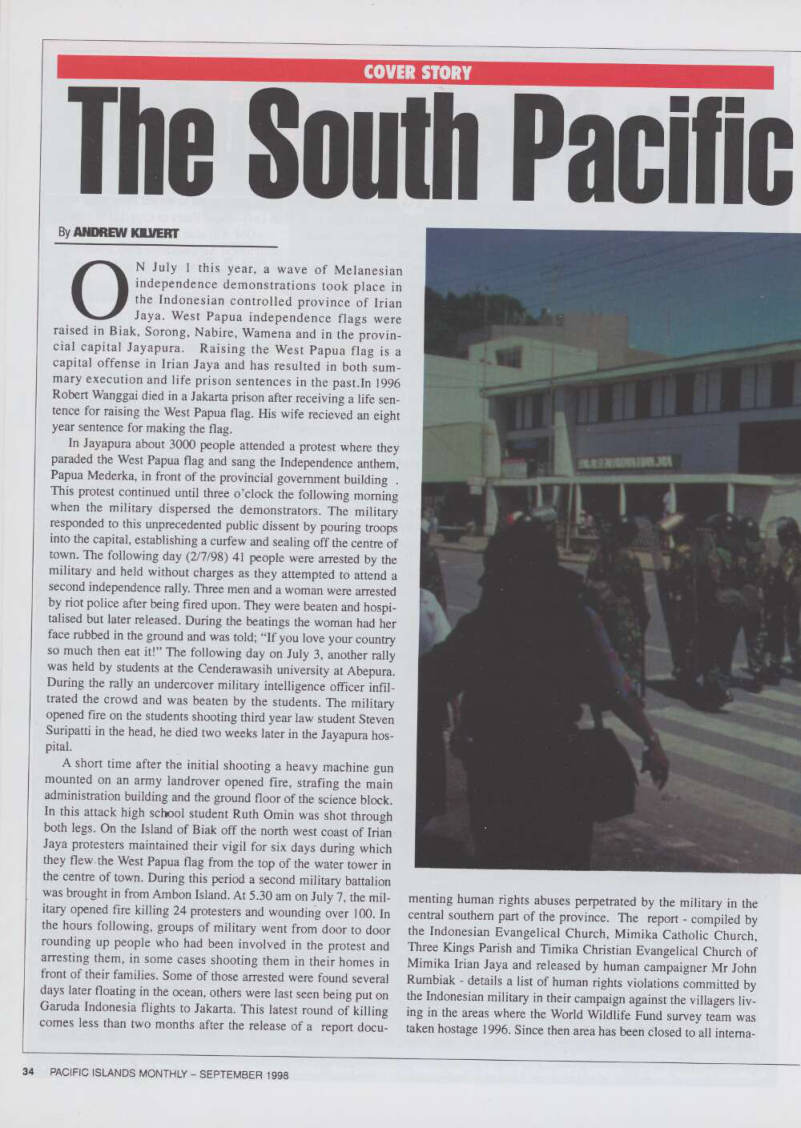
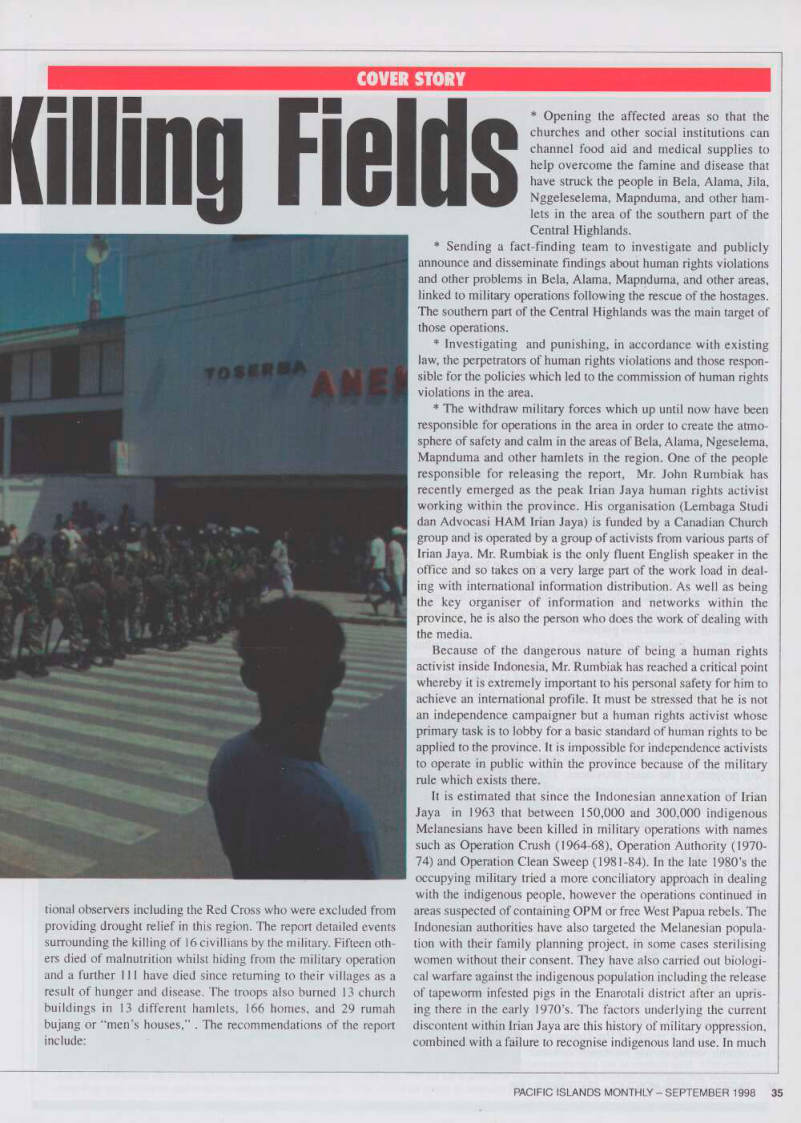
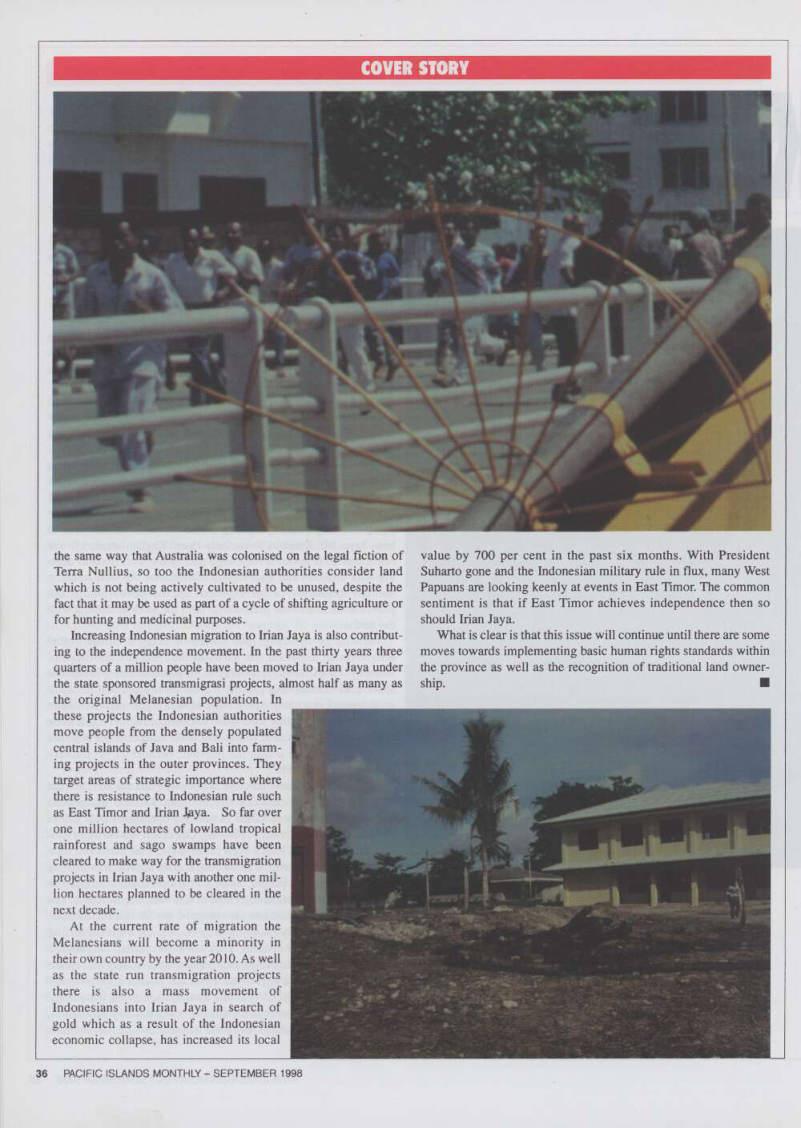
In Jayapura about 3000 people attended a protest where they paraded the West Papua flag and sang the Independence anthem, Papua Mederka, in front of the provincial government building This protest continued until three o’clock the following morning when the military dispersed the demonstrators. The military responded to this unprecedented public dissent by pouring troops into the capital, establishing a curfew and sealing off the centre of town. The following day (2/7/98) 41 people were arrested by the military and held without charges as they attempted to attend a second independence rally. Three men and a woman were arrested by riot police after being fired upon. They were beaten and hospi talised but later released. During the beatings the woman had her face rubbed in the ground and was told; “If you love your country so much then eat it!” The following day on July 3, another rally was held by students at the Cenderawasih university at Abepura.
During the rally an undercover military intelligence officer infil trated the crowd and was beaten by the students. The military opened fire on the students shooting third year law student Steven Suripatti in the head, he died two weeks later in the Jayapura hos pital.
A short time after the initial shooting a heavy machine gun mounted on an army landrover opened fire, strafing the main administration building and the ground floor of the science block.
In this attack high school student Ruth Omin was shot through both legs. On the Island of Biak off the north west coast of Irian Jaya protesters maintained their vigil for six days during which they flew the West Papua flag from the top of the water tower in the centre of town. During this period a second military battalion was brought in from Ambon Island. At 5.30 am on July 7, the mil itary opened fire killing 24 protesters and wounding over 100. In the hours following, groups of military went from door to door rounding up people who had been involved in the protest and arresting them, in some cases shooting them in their homes in front of their families. Some of those arrested were found several days later floating in the ocean, others were last seen being put on Garuda Indonesia flights to Jakarta. This latest round of killing comes less than two months after the release of a report docu-
menting human rights abuses perpetrated by the military in the central southern part of the province. The report - compiled by the Indonesian Evangelical Church, Mimika Catholic Church, Three Kings Parish and Timika Christian Evangelical Church of Mimika Irian Jaya and released by human campaigner Mr John Rumbiak - details a list of human rights violations committed by the Indonesian military in their campaign against the villagers liv ing in the areas where the World Wildlife Fund survey team was taken hostage 1996. Since then area has been closed to all intema
tional observers including the Red Cross who were excluded from providing drought relief in this region. The report detailed events surrounding the killing of 16 civillians by the military. Fifteen oth ers died of malnutrition whilst hiding from the military operation and a further 111 have died since returning to their villages as a result of hunger and disease. The troops also burned 13 church buildings in 13 different hamlets, 166 homes, and 29 rumah bujang or "men’s houses,” . The recommendations of the report include:
* Opening the affected areas so that the churches and other social institutions can channel food aid and medical supplies to help overcome the famine and disease that have struck the people in Bela, Alama, Jila, Nggeleselema, Mapnduma, and other ham lets in the area of the southern part of the
Central Highlands.
* Sending a fact-finding team to investigate and publicly announce and disseminate findings about human rights violations and other problems in Bela, Alama, Mapnduma, and other areas, linked to military operations following the rescue of the hostages.
The southern part of the Central Highlands was the main target of those operations. * Investigating and punishing, in accordance with existing law, the perpetrators of human rights violations and those respon sible for the policies which led to the commission of human rights violations in the area. * The withdraw military forces which up until now have been responsible for operations in the area in order to create the atmo sphere of safety and calm in the areas of Bela, Alama, Ngeselema, Mapnduma and other hamlets in the region. One of the people responsible for releasing the report, Mr. John Rumbiak has recently emerged as the peak Irian Jaya human rights activist working within the province. His organisation (Lembaga Studi dan Advocasi HAM Irian Jaya) is funded by a Canadian Church group and is operated by a group of activists from various parts of Irian Jaya. Mr. Rumbiak is the only fluent English speaker in the office and so takes on a very large part of the work load in deal ing with international information distribution. As well as being the key organiser of information and networks within the province, he is also the person who does the work of dealing with the media.
Because of the dangerous nature of being a human rights activist inside Indonesia, Mr. Rumbiak has reached a critical point whereby it is extremely important to his personal safety for him to achieve an international profile. It must be stressed that he is not an independence campaigner but a human rights activist whose primary task is to lobby for a basic standard of human rights to be applied to the province. It is impossible for independence activists to operate in public within the province because of the military rule which exists there.
It is estimated that since the Indonesian annexation of Irian Jaya in 1963 that between 150,000 and 300,000 indigenous Melanesians have been killed in military operations with names such as Operation Crush (1964-68), Operation Authority (1970- 74) and Operation Clean Sweep (1981-84). In the late 1980’s the occupying military tried a more conciliatory approach in dealing with the indigenous people, however the operations continued in areas suspected of containing OPM or free West Papua rebels. The Indonesian authorities have also targeted the Melanesian popula tion with their family planning project, in some cases sterilising women without their consent. They have also carried out biologi cal warfare against the indigenous population including the release of tapeworm infested pigs in the Enarotali district after an upris ing there in the early 1970’5. The factors underlying the current discontent within Irian Jaya are this history of military oppression, combined with a failure to recognise indigenous land use. In much
the same way that Australia was colonised on the legal fiction of Terra Nullius, so too the Indonesian authorities consider land which is not being actively cultivated to be unused, despite the fact that it may be used as part of a cycle of shifting agriculture or for hunting and medicinal purposes.
Increasing Indonesian migration to Irian Jaya is also contribut ing to the independence movement. In the past thirty years three quarters of a million people have been moved to Irian Jaya under the state sponsored transmigrasi projects, almost half as many as
the original Melanesian population. In these projects the Indonesian authorities
move people from the densely populated
central islands of Java and Bali into farm ing projects in the outer provinces. They target areas of strategic importance where there is resistance to Indonesian rule such as East Timor and Irian J#ya. So far over one million hectares of lowland tropical rainforest and sago swamps have been cleared to make way for the transmigration projects in Irian Jaya with another one mil lion hectares planned to be cleared in the next decade.
At the current rate of migration the Melanesians will become a minority in their own country by the year 2010. As well as the state run transmigration projects there is also a mass movement of Indonesians into Irian Jaya in search of gold which as a result of the Indonesian economic collapse, has increased its local
value by 700 per cent in the past six months. With President Suharto gone and the Indonesian military rule in flux, many West Papuans are looking keenly at events in East Timor. The common sentiment is that if East Timor achieves independence then so should Irian Jaya.
What is clear is that this issue will continue until there are some moves towards implementing basic human rights standards within the province as well as the recognition of traditional land owner
ship. ■