the Bishop
pp. 53-54 · Read in the full issue
Yachting
In the eye of the Bishop
Story and photographs by SALLY ANDREWS
AFTER dropping our sails and quietly drifting to a stop, a dugong surfaced alongside Fellowship. She paused long enough to exhale and take a quick look, then vanished. We were anchored in Patteson Bay, off the TORBA provincial town of Sola.
Our daysail up the west coast of Santa Maria in Vanuatu’s northern group of islands, past Bushman’s Bay and across the channel to the big island of Vanua Lava, had been great. We’d caught no fish, but our speed had averaged nearly seven knots the whole way.
Using a double-bladed paddle, two small boys came out in an outrigger-less canoe to tell us of a celebration scheduled for the next day - "Lafet blong St Bartholomew”.
Consequently, the following morning we wandered down a dirt road and inland towards the village of Sisial. Even though our arrival was a surprise, everybody wel comed us. the Bishop invited us to eat with him, alongside his wife Mary and the local elders, chiefs and church and government officials. We sat on mats and I tried to put myself on best behaviour, a hardship at the best of times.
All went well until I tried to open my drinking coconut. I held it discreetly to one side, took a knife and pierced the nut - the juice of which squirted straight into the eye of the Bishop. How embarrassing! I blushed
and apologised, then carried on quietly eat ing. When Foster decided to open one, he took the knife, pierced the nut, squirt... Oh no! Wota he go stret long eye blong Bishop.
Sori! (Water he go straight into the eye belong Bishop. Sorry!) This was not our lucky day. The sun was hot, and naturally the Bishop got thirsty too. He picked up a
coconut, took the knife, pierced the nut.
Oops! You guessed it. The coconut squirted straight into the Bishop's eye!
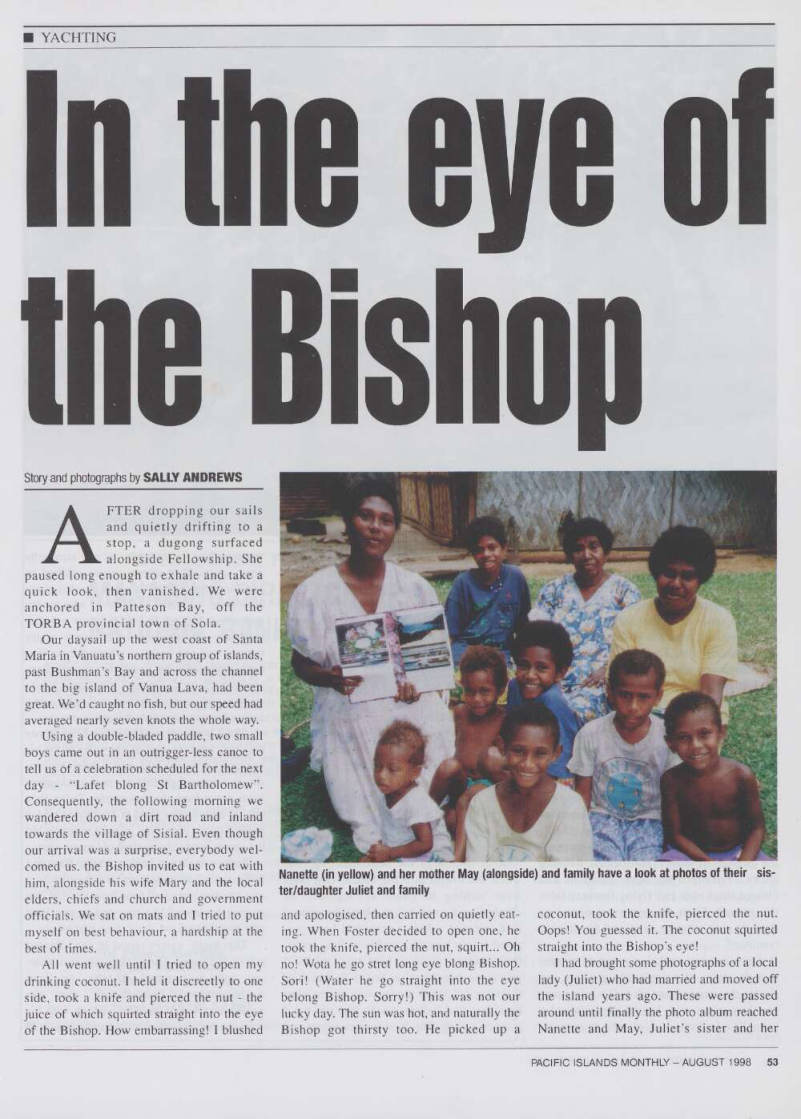
I had brought some photographs of a local lady (Juliet) who had married and moved off the island years ago. These were passed around until finally the photo album reached Nanette and May, Juliet's sister and her
Nanette (in yellow) and her mother May (alongside) and family have a look at photos of their sis ter/daughter Juliet and family
mother, who started to cry. May had not seen her daughter in nearly two decades. After lunch, a buzz of excitement hung in the air.
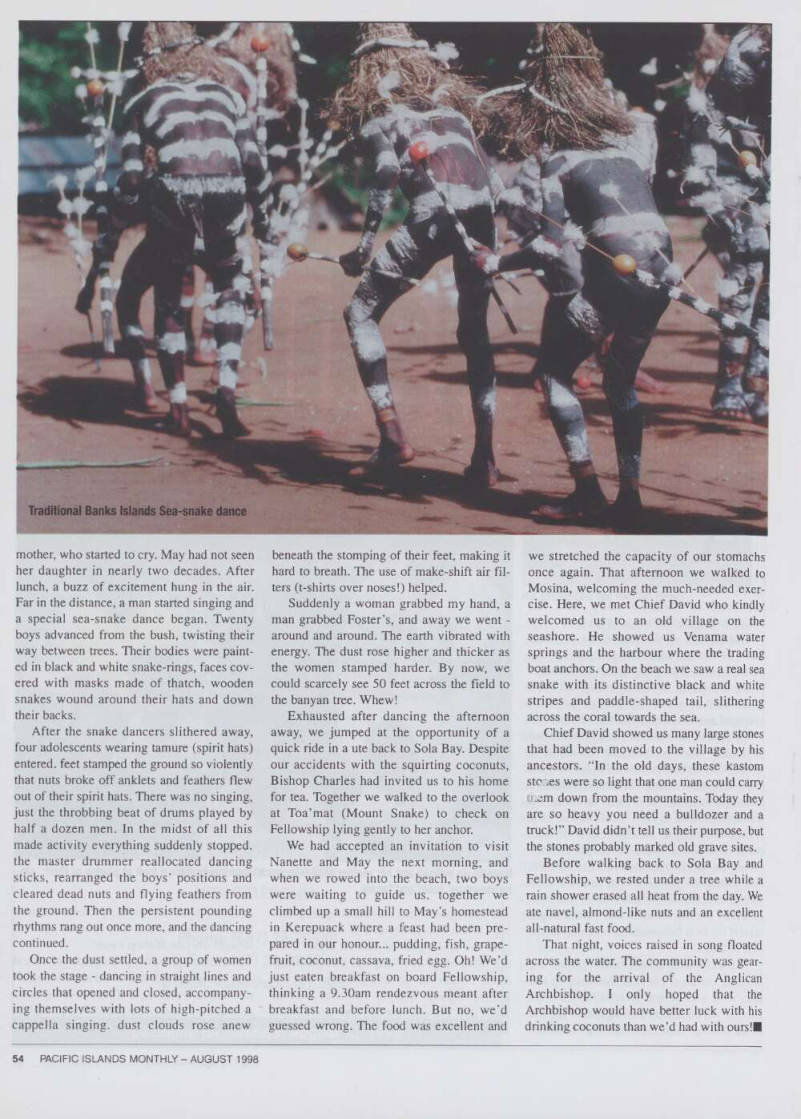
Far in the distance, a man started singing and a special sea-snake dance began. Twenty boys advanced from the bush, twisting their way between trees. Their bodies were paint ed in black and white snake-rings, faces cov ered with masks made of thatch, wooden snakes wound around their hats and down their backs.
After the snake dancers slithered away, four adolescents wearing tamure (spirit hats) entered, feet stamped the ground so violently that nuts broke off anklets and feathers flew out of their spirit hats. There was no singing, just the throbbing beat of drums played by half a dozen men. In the midst of all this made activity everything suddenly stopped, the master drummer reallocated dancing sticks, rearranged the boys’ positions and cleared dead nuts and flying feathers from the ground. Then the persistent pounding rhythms rang out once more, and the dancing continued.
Once the dust settled, a group of women took the stage - dancing in straight lines and circles that opened and closed, accompany ing themselves with lots of high-pitched a cappella singing, dust clouds rose anew
beneath the stomping of their feet, making it hard to breath. The use of make-shift air fil ters (t-shirts over noses!) helped.
Suddenly a woman grabbed my hand, a man grabbed Foster’s, and away we went around and around. The earth vibrated with energy. The dust rose higher and thicker as the women stamped harder. By now, we could scarcely see 50 feet across the field to the banyan tree. Whew!
Exhausted after dancing the afternoon away, we jumped at the opportunity of a quick ride in a ute back to Sola Bay. Despite our accidents with the squirting coconuts, Bishop Charles had invited us to his home for tea. Together we walked to the overlook at Toa’mat (Mount Snake) to check on Fellowship lying gently to her anchor.
We had accepted an invitation to visit Nanette and May the next morning, and when we rowed into the beach, two boys were waiting to guide us. together we climbed up a small hill to May’s homestead in Kerepuack where a feast had been pre pared in our honour... pudding, fish, grape fruit, coconut, cassava, fried egg. Oh! We’d just eaten breakfast on board Fellowship, thinking a 9.30 am rendezvous meant after breakfast and before lunch. But no, we’d guessed wrong. The food was excellent and
we stretched the capacity of our stomachs once again. That afternoon we walked to Mosina, welcoming the much-needed exer cise. Here, we met Chief David who kindly welcomed us to an old village on the seashore. He showed us Venama water springs and the harbour where the trading boat anchors. On the beach we saw a real sea snake with its distinctive black and white stripes and paddle-shaped tail, slithering across the coral towards the sea.
Chief David showed us many large stones that had been moved to the village by his ancestors. “In the old days, these kastom ste .es were so light that one man could carry tr.em down from the mountains. Today they are so heavy you need a bulldozer and a truck!” David didn’t tell us their purpose, but the stones probably marked old grave sites.
Before walking back to Sola Bay and Fellowship, we rested under a tree while a rain shower erased all heat from the day. We ate navel, almond-like nuts and an excellent all-natural fast food.
That night, voices raised in song floated across the water. The community was gear ing for the arrival of the Anglican Archbishop. I only hoped that the Archbishop would have better luck with his drinking coconuts than we’d had with ours!B
Traditional Banks Islands Sea-snake dance