Independence
pp. 32-33 · Read in the full issue
Feature
Kanaks will accept nothing less than Independence
By Sophie Foster Hildebrand
/ / NLY when there m ■ are n o more M m Kanaks will there be no more movement for freedom, for independence - and there are plenty of Kanaks around”.
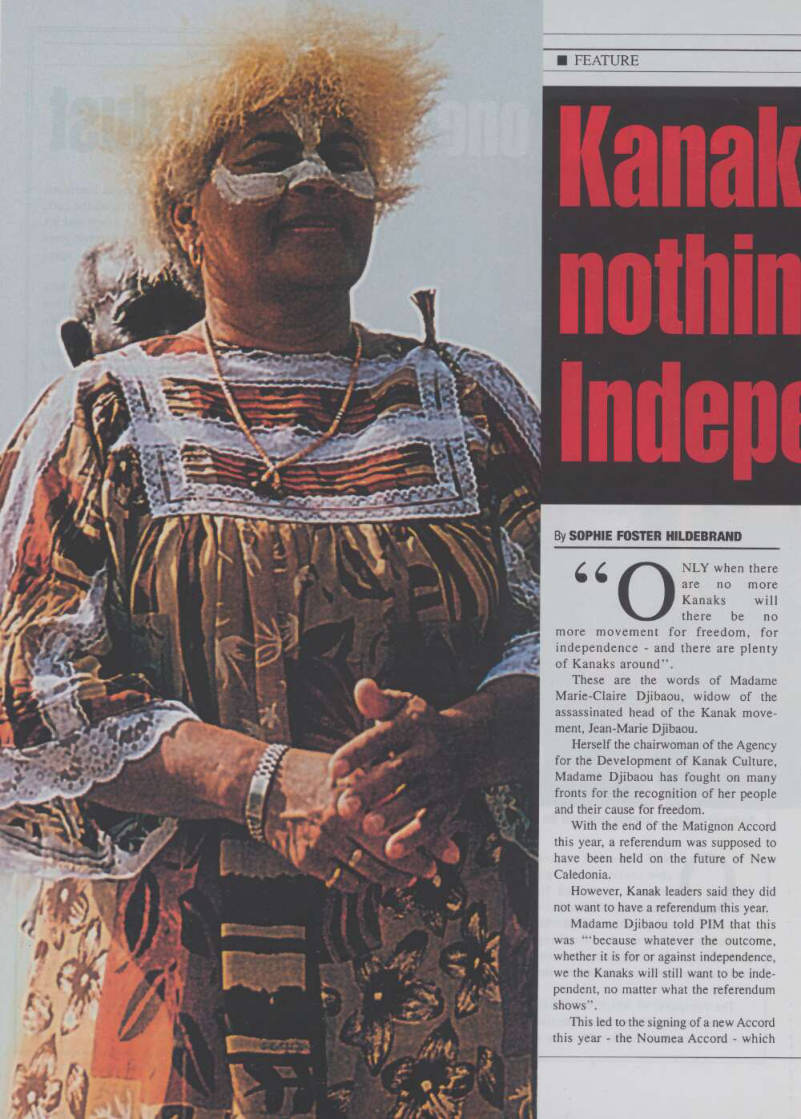
These are the words of Madame Marie-Claire Djibaou, widow of the assassinated head of the Kanak move ment, Jean-Marie Djibaou.
Herself the chairwoman of the Agency for the Development of Kanak Culture, Madame Djibaou has fought on many fronts for the recognition of her people and their cause for freedom.
With the end of the Matignon Accord this year, a referendum was supposed to have been held on the future of New Caledonia.
However, Kanak leaders said they did not want to have a referendum this year.
Madame Djibaou told PIM that this was “‘because whatever the outcome, whether it is for or against independence, we the Kanaks will still want to be inde pendent, no matter what the referendum shows”.
This led to the signing of a new Accord this year - the Noumea Accord - which
slowly takes control of the running of the country away from France.
Although the people of New Caledonia will vote on whether to accept this new accord in November this year, Madame Djibaou says the Kanaks will accept noth ing less than Independence.
If the vote is not in favour of the Noumea Accord, “’’they don’t know what’s going to happen, but things will happen”.
The Kanaks, she says, want to be inde pendent more than anything else. ‘The French say look at Vanuatu, Fiji, Solomons, they are poor after indepen dence. They do worse than they did before.
But the Kanaks say we don’t need all that the French think we need. We are happy to be poor. We have our own resources we can go back to, and even if we end up a poor country, we don’t care. We want to be independent,” she says.
The development of political awareness among Pacific island people has happened in many ways throughout the region. In New Caledonia, however, it has tied in very closely with culture.
It began in 1975 with the realisation of Jean-Marie Djibaou's vision of Melanesia 2000 - the first cultural festival that brought Kanaks from around New Caledonia together. It was the first time that all the cultures, languages and Kanak tribes
assembled in Noumea, which was then considered a white city.
“The festival, especially the Melanesia 2000, made people realise that they are not Kanaks. They have their own history, their own culture, and they are not French,” she says.
“From that day on they felt they had a rich culture and they could be proud of it.
“1975 was the starting point when they said they wanted to be recognised as a peo ple - as Kanaks and not French”.
It was for this reason that the recent Melanesian Arts and Cultural Festival was important to Kanaks, she says.
"The fact that this festival was in a Melanesian country that is independent, that it is organised by an independent coun try, and that the other participants are inde pendent Melanesian countries is very important to us,” Madame Djibaou says.
“It gives us strength and hope for our fight in New Caledonia”.
Because culture unites people, New Caledonia has managed to build its whole independence fight around it.
With the recent upsurge in interest in culture in Melanesia, it could be taken for granted that there will be an upsurge in interest in politics.
For New Caledonia, independence after 2000 may depend on it. ■