Hun[?]reds queue to be a Kiwi
pp. 28-29 · Read in the full issue
Migration
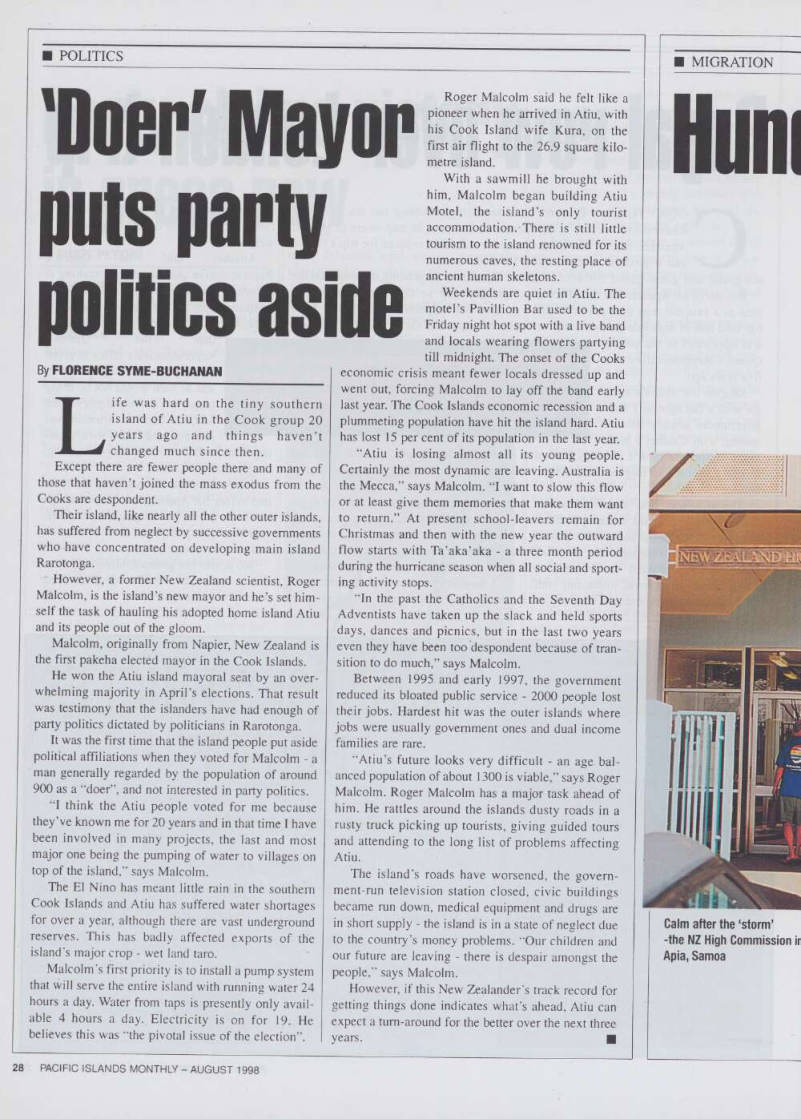
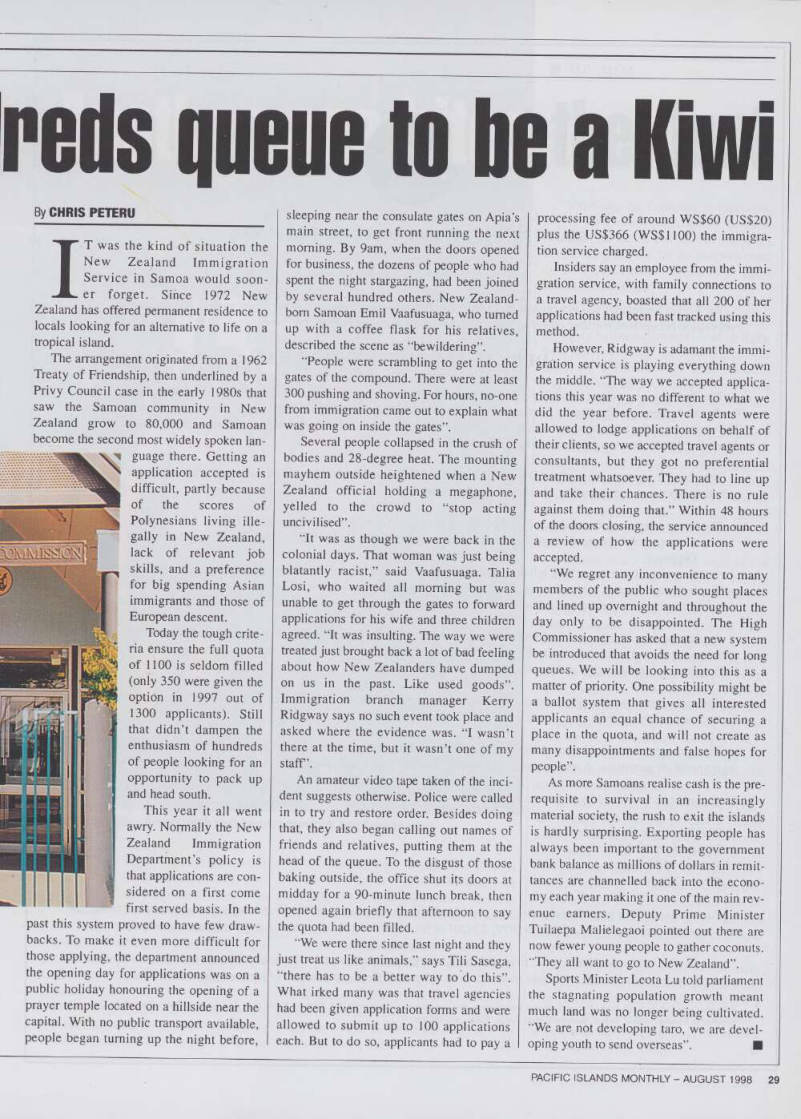
Calm after the ‘storm’ -the NZ High Commission in Apia, Samoa
By Chris Peteru
I T was the kind of situation the New Zealand Immigration Service in Samoa would soon er forget. Since 1972 New Zealand has offered permanent residence to locals looking for an alternative to life on a
tropical island.
The arrangement originated from a 1962 Treaty of Friendship, then underlined by a Privy Council case in the early 1980 s that saw the Samoan community in New Zealand grow to 80,000 and Samoan become the second most widely spoken lan
guage there. Getting an application accepted is difficult, partly because of the scores of Polynesians living ille gally in New Zealand, lack of relevant job skills, and a preference for big spending Asian immigrants and those of
European descent.
Today the tough crite ria ensure the full quota of 1100 is seldom filled (only 350 were given the option in 1997 out of 1300 applicants). Still that didn’t dampen the enthusiasm of hundreds of people looking for an opportunity to pack up and head south.
This year it all went awry. Normally the New
Zealand Immigration
Department’s policy is
that applications are con sidered on a first come first served basis. In the
past this system proved to have few draw backs. To make it even more difficult for those applying, the department announced the opening day for applications was on a public holiday honouring the opening of a prayer temple located on a hillside near the capital. With no public transport available, people began turning up the night before,
sleeping near the consulate gates on Apia’s main street, to get front running the next morning. By 9am, when the doors opened for business, the dozens of people who had spent the night stargazing, had been joined by several hundred others. New Zealand born Samoan Emil Vaafusuaga, who turned up with a coffee flask for his relatives, described the scene as “bewildering”.
“People were scrambling to get into the gates of the compound. There were at least 300 pushing and shoving. For hours, no-one from immigration came out to explain what was going on inside the gates”.
Several people collapsed in the crush of bodies and 28-degree heat. The mounting mayhem outside heightened when a New Zealand official holding a megaphone, yelled to the crowd to “stop acting uncivilised”.
“It was as though we were back in the colonial days. That woman was just being blatantly racist,” said Vaafusuaga. Talia Losi, who waited all morning but was unable to get through the gates to forward applications for his wife and three children agreed. “It was insulting. The way we were treated just brought back a lot of bad feeling about how New Zealanders have dumped on us in the past. Like used goods”.
Immigration branch manager Kerry Ridgway says no such event took place and asked where the evidence was. “I wasn’t there at the time, but it wasn’t one of my staff’.
An amateur video tape taken of the inci dent suggests otherwise. Police were called in to try and restore order. Besides doing that, they also began calling out names of friends and relatives, putting them at the head of the queue. To the disgust of those baking outside, the office shut its doors at midday for a 90-minute lunch break, then opened again briefly that afternoon to say the quota had been filled.
“We were there since last night and they just treat us like animals,” says Tili Sasega, "there has to be a better way to do this”.
What irked many was that travel agencies had been given application forms and were allowed to submit up to 100 applications each. But to do so, applicants had to pay a
processing fee of around WS$6O (US$2O) plus the US$366 (WS$1100) the immigra tion service charged.
Insiders say an employee from the immi gration service, with family connections to a travel agency, boasted that all 200 of her applications had been fast tracked using this method.
However, Ridgway is adamant the immi gration service is playing everything down the middle. “The way we accepted applica tions this year was no different to what we did the year before. Travel agents were allowed to lodge applications on behalf of their clients, so we accepted travel agents or consultants, but they got no preferential treatment whatsoever. They had to line up and take their chances. There is no rule against them doing that.” Within 48 hours of the doors closing, the service announced a review of how the applications were accepted.
“We regret any inconvenience to many members of the public who sought places and lined up overnight and throughout the day only to be disappointed. The High Commissioner has asked that a new system be introduced that avoids the need for long queues. We will be looking into this as a matter of priority. One possibility might be a ballot system that gives all interested applicants an equal chance of securing a place in the quota, and will not create as many disappointments and false hopes for people”.
As more Samoans realise cash is the pre requisite to survival in an increasingly material society, the rush to exit the islands is hardly surprising. Exporting people has always been important to the government bank balance as millions of dollars in remit tances are channelled back into the econo my each year making it one of the main rev enue earners. Deputy Prime Minister Tuilaepa Malielegaoi pointed out there are now fewer young people to gather coconuts.
“They all want to go to New Zealand”.
Sports Minister Leota Lu told parliament the stagnating population growth meant much land was no longer being cultivated.
"We are not developing taro, we are devel oping youth to send overseas”. ■