Party claims victory
p. 26 · Read in the full issue
Politics
Party claims victory in press row
By Chris Peteru
EVEN before the result of a US$l5O,OOO civil suit between Samoan prime minister Tofilau Eti Alesana and the Samoa Observer newspaper was known, the Human Rights Protection Party government was claiming victory.
During the 15-day supreme court hear ing it quickly became clear that publisher Savea Sano Malifa was finding it difficult to prove a story he wrote for the paper in December 1996. There, he said, Alesana had confessed to using over U 5593,000 (W 55250,000) of allocated funds to reno vate a family hotel in his Gagaeomauga electorate.
In his testimony, Malifa said he honest ly believed he heard the PM say as much during a parliamentary broadcast on national radio. However, any notes he kept would have been destroyed in a fire at the company premises in 1994, two years ear lier. Acting for the PM, Marcus Jacobs QC asked how Malifa could have taken notes in 1994 about an event that had yet to occur. Malifa replied that he was “con fused”.
Jacobs later said it was strange that out of the entire Samoan population only Malifa, who in the last election ran as an opposition candidate, could recall the PM’s admission. Deputy Prime Minister and government spokesman Tuilaepa Malielegaoi had no problem recalling what he wanted to say.
Within hours of judge Sir Gordon Bisson saying he would make a reserved decision, Malielegaoi, who once described the Observer as "being run by a bunch of fools”, released a four-page statement say ing that in a "dramatic turn” Malifa had apologised to the PM - something observers at the hearing say they never heard. Despite the matter being subjudice, the statement went to air frequently for the next two days on national television and
radio. Privately, legal opinions around the capital Apia say the outcome may favour Alesana (the region’s longest-serving politician) over Malifa (the most influen tial publisher on the island).
As the public is left to ponder how the doyen of journalism could have made such an elementary blunder, the hearing high lighted some embarrassing deficiencies in
the way news-makers on the island oper ate. Although journalists overseas are often tertiary graduates, in Samoa just three of the 50 reporters working for newspapers, radio stations or national television have
tertiary qualifications.
Only a handful would have completed a secondary school education. With this cal ibre of employee common, and training almost non-existent, mixed results at dead line time are assured.
"We must be the only profession in the country where people can just walk in off the street and the next day be a reporter.
This has been a long-standing problem,” says veteran journalist Alan Ah Mu of Tala Nei News Agency. "I had been hoping reporters from overseas might turn up, but Eve been waiting five years. Eve had to train myself. Since 1989, the number of reporters has actually dropped drastically.”
The result is an industry full of inexperi enced individuals who have often taken up the job by default, with little knowledge or concern about the requirements. Small wonder then, the Observer once employed an editor who did not pass school certifi cate English, and a weekly columnist who was a convicted murderer who left the paper after being charged with rape.
Nor that the government-owned Savali newspaper fritters away thousands of tax payer dollars on a directionless newspaper, with non-existent sales and poorly trained reporters.
Fuelling all this is a tendency towards pettiness, ensuring divisiveness instead of co-operation, on a professional level, pre vails. Still the demand for local news by Samoans living overseas is such that in the last ten months, several Samoan language papers and radio stations in New Zealand and Australia have set up bureaus locally.
Moreover the likelihood of these new comers being dragged into court for not doing their job efficiently has been given backing at the highest level. In a final twist to the latest stand-off, Malielegaoi told a press conference that public funds would be made available to any government MP or department official who believed they had been defamed, but did not have the money to hire legal help.
Any damages awarded would be placed into a special fund to finance other law suits by public servants. “This policy has been long thought about by the govern ment as a way to solve the ease by which reporters write what is slanderous of lead ers of the country,” said Malielegaoi.
Given the timing of the announcement, shortly after the hearing ended, it seems the PM's own hefty legal bill (conservatively estimated at US$6O,OOO) may be the first beneficiary of the taxpayer-fundee legisla tion. "Basically this places the government at a huge advantage but with so many inex perienced reporters we are leaving our selves wide open to be sued in court for inaccuracies,” says Ah Mu. Journalists’
Association president Faumuina Lance Polu believes the policy marks a backward step for investigative journalism and another attempt to stifle freedom of expres sion. In effect a warning has been sounded to Samoan reporters that their definition of good journalism is still not good enough.
Even if Malifa is not convicted, news making in Samoa will never be the same again. ■
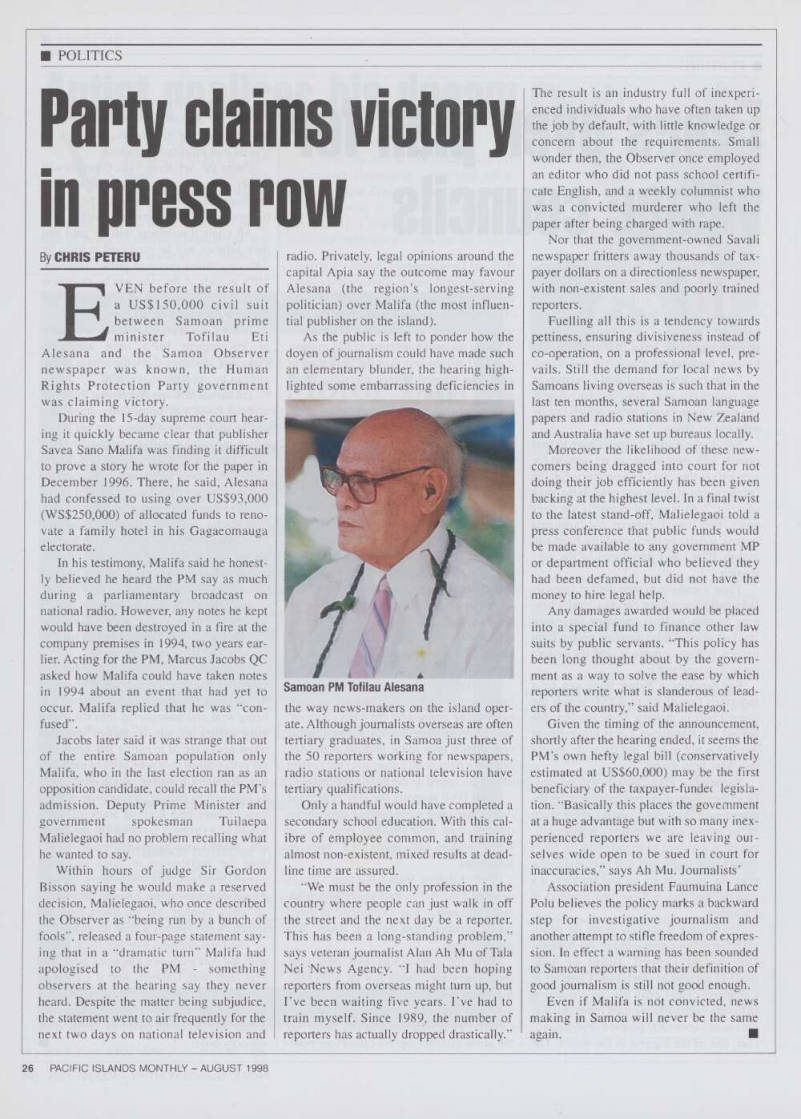
Samoan PM Tofilau Alesana