Summer Down Under - Tasmania
pp. 52-53 · Read in the full issue
Yachting
By Sally Andrew
SAILING to Australia’s island state of Tasmania is a great way to spend a summer “down under”.
Most Pacific cruisers sail out of the tropics for cyclone season, making their landfall along Australia’s east coast in the ports of Bundaberg, Brisbane or Coffs Harbour. This year we arrived further north, at Gladstone, sailing inside the Great Sandy Straits before hopping on the southbound Australian current.
With a bit of luck and a couple of days of favourable winds, crossing the rugged
stretch of water known as Bass Strait is no big deal.
In 1994, Fellowship sailed the 600 nau tical miles from Sydney to Tasmania’s loveliest anchorage, Wineglass Bay, in less than four days. A perfect run.
This year, however, El Nino conditions meant strong westerlies (often storm force), switching Northwest-Southwest on a daily basis. At the Southeast comer of the continent, we waited twenty-two frustrat ing days (yes, 22) for suitable weather to cross Bass Strait. Our patience paid off with an easy two-day passage, and we made landfall at Skeleton Bay near St.
Helens, Northeast Tasmania.
An overnight sail from there brought us
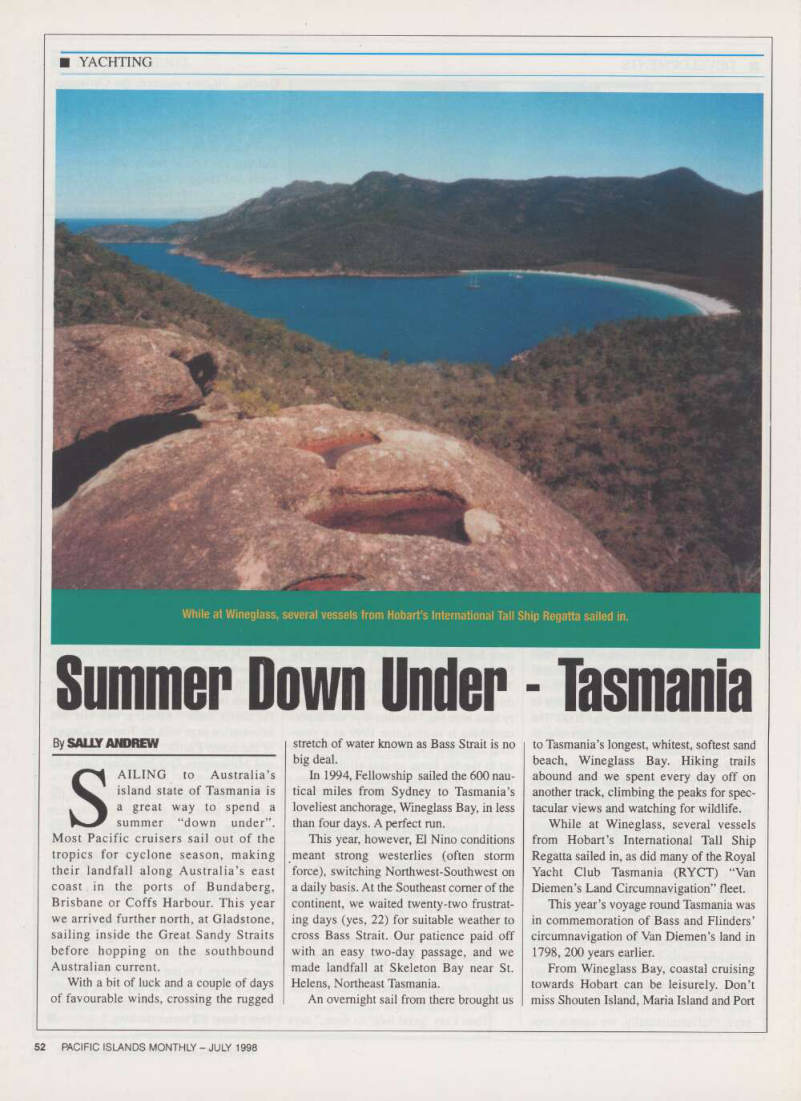
to Tasmania’s longest, whitest, softest sand beach, Wineglass Bay. Hiking trails abound and we spent every day off on another track, climbing the peaks for spec tacular views and watching for wildlife.
While at Wineglass, several vessels from Hobart’s International Tall Ship Regatta sailed in, as did many of the Royal Yacht Club Tasmania (RYCT) “Van Diemen’s Land Circumnavigation” fleet.
This year’s voyage round Tasmania was in commemoration of Bass and Flinders’ circumnavigation of Van Diemen’s land in 1798, 200 years earlier.
From Wineglass Bay, coastal cruising towards Hobart can be leisurely. Don’t miss Shouten Island, Maria Island and Port
While at Wineglass, several vessels from Hobart’s International Tall Ship Regatta sailed in.
Arthur, a historic convict set tlement.
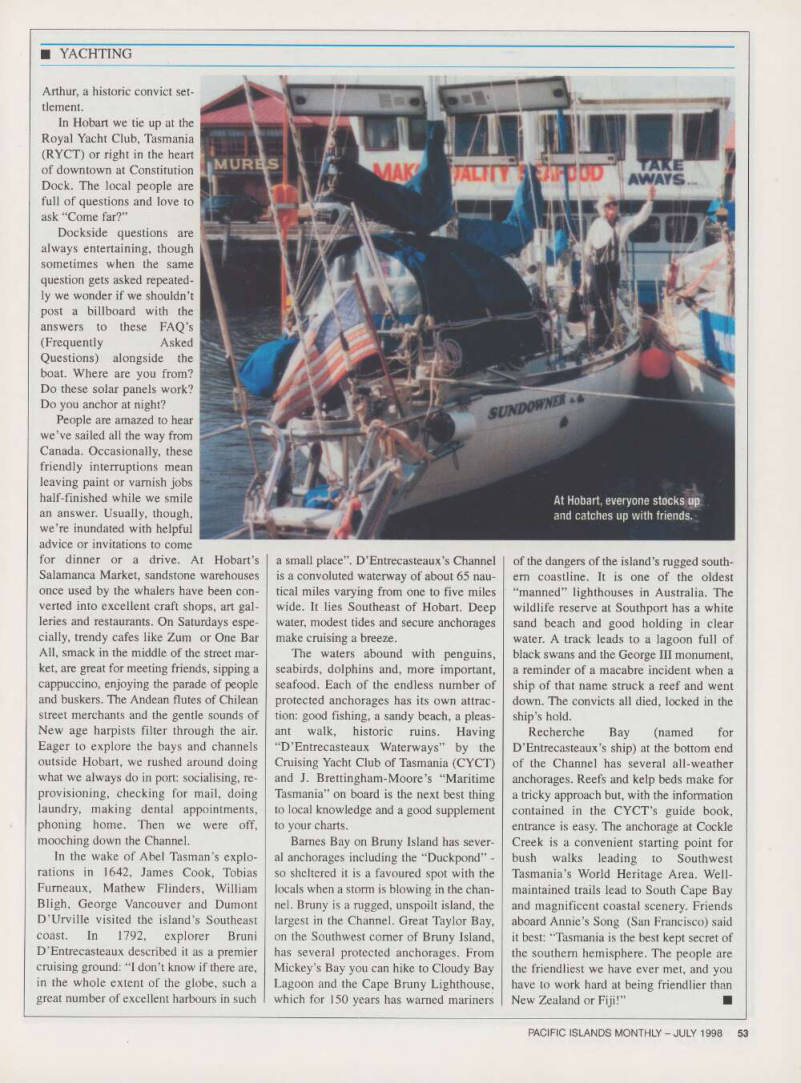
In Hobart we tie up at the Royal Yacht Club, Tasmania (RYCT) or right in the heart of downtown at Constitution Dock. The local people are full of questions and love to ask “Come far?”
Dockside questions are always entertaining, though sometimes when the same question gets asked repeated ly we wonder if we shouldn’t post a billboard with the answers to these FAQ’s
(Frequently Asked
Questions) alongside the boat. Where are you from?
Do these solar panels work?
Do you anchor at night?
People are amazed to hear we’ve sailed all the way from Canada. Occasionally, these friendly interruptions mean leaving paint or varnish jobs half-finished while we smile an answer. Usually, though, we’re inundated with helpful advice or invitations to come
for dinner or a drive. At Hobart’s Salamanca Market, sandstone warehouses once used by the whalers have been con verted into excellent craft shops, art gal leries and restaurants. On Saturdays espe cially, trendy cafes like Zum or One Bar All, smack in the middle of the street mar ket, are great for meeting friends, sipping a cappuccino, enjoying the parade of people and buskers. The Andean flutes of Chilean street merchants and the gentle sounds of New age harpists filter through the air.
Eager to explore the bays and channels outside Hobart, we rushed around doing what we always do in port: socialising, re
provisioning, checking for mail, doing
laundry, making dental appointments, phoning home. Then we were off, mooching down the Channel.
In the wake of Abel Tasman’s explo rations in 1642, James Cook, Tobias Furneaux, Mathew Flinders, William Bligh, George Vancouver and Dumont D’Urville visited the island’s Southeast coast. In 1792, explorer Bruni D’Entrecasteaux described it as a premier cruising ground: “I don’t know if there are, in the whole extent of the globe, such a great number of excellent harbours in such
a small place”. D’Entrecasteaux’s Channel is a convoluted waterway of about 65 nau tical miles varying from one to five miles wide. It lies Southeast of Hobart. Deep water, modest tides and secure anchorages make cruising a breeze.
The waters abound with penguins, seabirds, dolphins and, more important, seafood. Each of the endless number of protected anchorages has its own attrac tion; good fishing, a sandy beach, a pleas ant walk, historic ruins. Having “D’Entrecasteaux Waterways” by the Cruising Yacht Club of Tasmania (CYCT) and J. Brettingham-Moore’s “Maritime Tasmania” on board is the next best thing to local knowledge and a good supplement to your charts.
Bames Bay on Bruny Island has sever al anchorages including the “Duckpond” so sheltered it is a favoured spot with the locals when a storm is blowing in the chan nel. Bruny is a rugged, unspoilt island, the largest in the Channel. Great Taylor Bay, on the Southwest comer of Bruny Island, has several protected anchorages. From Mickey’s Bay you can hike to Cloudy Bay Lagoon and the Cape Bruny Lighthouse, which for 150 years has warned mariners
of the dangers of the island’s rugged south ern coastline. It is one of the oldest “manned” lighthouses in Australia. The wildlife reserve at Southport has a white sand beach and good holding in clear water. A track leads to a lagoon full of black swans and the George 111 monument, a reminder of a macabre incident when a ship of that name struck a reef and went down. The convicts all died, locked in the ship’s hold.
Recherche Bay (named for D’Entrecasteaux’s ship) at the bottom end of the Channel has several all-weather anchorages. Reefs and kelp beds make for a tricky approach but, with the information contained in the CYCT’s guide book, entrance is easy. The anchorage at Cockle Creek is a convenient starting point for bush walks leading to Southwest Tasmania’s World Heritage Area. Well maintained trails lead to South Cape Bay and magnificent coastal scenery. Friends aboard Annie’s Song (San Francisco) said it best: “Tasmania is the best kept secret of the southern hemisphere. The people are the friendliest we have ever met, and you have to work hard at being friendlier than New Zealand or Fiji!” ■
At Hobart, everyone stocks up and catches up with friends.