Interest rates increased to avoid devaluation
p. 25 · Read in the full issue
avoid devaluation of the vatu
By Patrick Decloitre
The Vanuatu Reserve Bank last mid-May announced a five per cent increase in the country’s interest rates to restore the country’s deplet ing foreign currency reserve, amidst fears this could strangle weakest com panies here. Reserve Bank governor Andrew Kausiama said the move aimed to restore confidence in the national curren cy, the vatu, which has been undergoing strong pressure in the past three months against foreign currencies.
A spell of political instability, followed
by loss of confidence by investors, who started to convert their savings into foreign currencies, pressured the vatu. After riots on January 12, a massive payout of contri butions to angry Vanuatu National Provident Fund (VNPF) members also caused a sudden influx of vatu in the local
economy and purchase of mainly imported
goods.
“The VNPF issue was one of the major things, the payouts contributed to increase in demand, a country like Vanuatu depends highly on imports. You look around (in Port Vila), there’s a lot of new cars, this contributes to the depletion of foreign reserves”, Kausiama said.
“The (VNPF payout) has considerably increased the consumer demand for the past three months. People bought cars, microwaves, VCRs, you name it. We’ve had the party, now we’re going to have the hangover”. Bank of Hawaii (Vanuatu) deputy general manager John McMillan said. Last March 27, former Reserve Bank governor tried to devalue the vatu by 20 per cent, saying the island state’s foreign exchange reserves had gone down from six months import cover to a mere three, about 20 million US dollars.
The reserve had now further dwindled to “2.5 to 2.7” months, Kausiama admit ted. “Although the trend is now stabilising, it’s not a very good situation”. Prime min ister Donald Kalpokas’s government reversed the devaluation as soon as it took office on March 30. Kalpokas said there was no need to devalue the vatu, citing the implication of adverse social effects.
“As for our foreign reserves, up until very recently, the trend continued to be in a downward direction. This prompted us to take this measure. Since we had ruled out the devaluation option, we didn’t have much choice”. “This is intended to increase the people’s confidence of hold ing vatu and bring them to convert their foreign currencies to vatu. However, it
might not happen as quickly as people may expect”, he added.
The decision, which brings the mini mum central bank interest rate from 5.97 to 10.97 per cent, follows recommenda tions from an International Monetary Fund (IMF) visiting team earlier this month. The IMF forecast for Vanuatu’s 1998 balance of payments was over the one billion vatu (7.9 million US dollars) mark, Kausiama said. “They concluded there was no evi dence to suggest it was necessary to deval ue the vatu, but that an interest rate increase was more appropriate. We’ve had advice from other experts who suggest the same thing”, Kausiama said.
“There’s been a loss a of confidence in the economy and the vatu, and the Reserve Bank has the duty to safeguard the value of the vatu. This is what we’re doing now.
Higher interest rates will increase the attractiveness of holding vatu”, Kausiama explained. “It will also increase the costs of overdrafts and other lines of credit, which some traders may be using as an
alternative to repatriating foreign
exchange receipts derived from exports”, he suspected. However, local commercial banks are not so sure. “In practise, Vanuatu’s going to go through a period of economic pressure”, McMillan said. “Our commercial clients and nearly everyone will certainly be affected. Many compa nies have not profited in the past three months and most of our loan contracts are on a floating rates basis. A five per cent increase means our lending rate will go up to 17 per cent. Some companies might simply go bankrupt or decide to leave”.
“Investors might be jumping on their foot saying it’s expensive to borrow, but we can always go back as soon as situation gets back to normal”, Kausiama said. “But if this increase proves insufficient to reduce speculative pressures on foreign exchange market, further increases in interest rates are not ruled out”.
“We’re a bit sceptical, but we want to give the Reserve Bank the benefit of the doubt”, McMillan said. ■
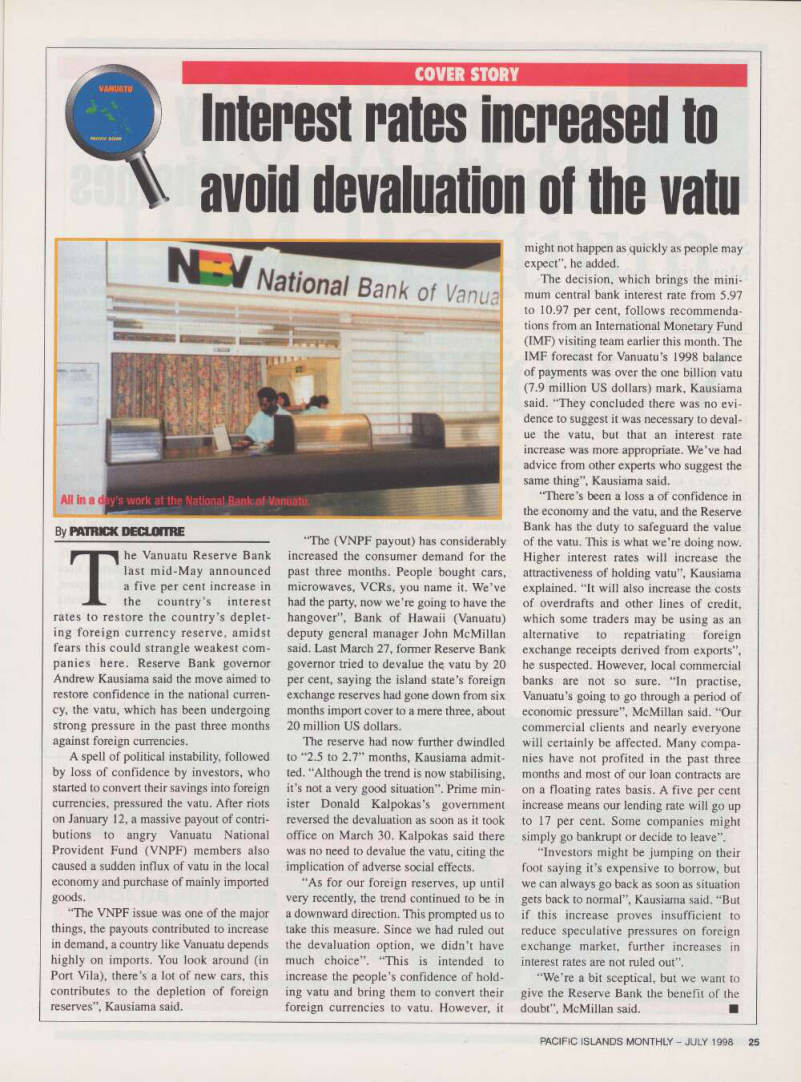
All in a day's work at the National Bank of Vanuatu.